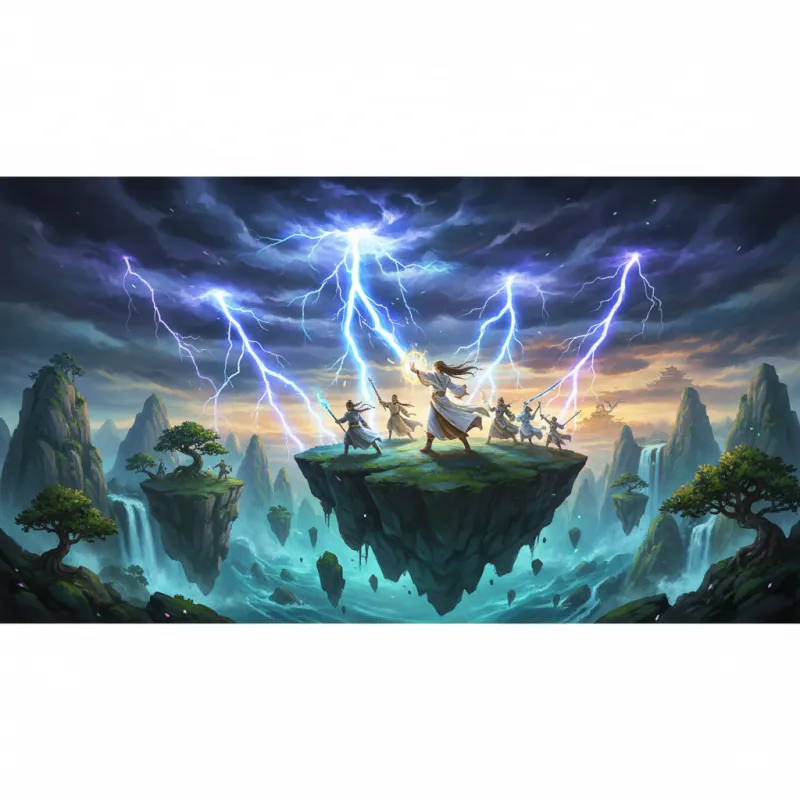
Lightning doesn't discriminate—it seeks the tallest tree, the highest peak, and in the world of cultivation, the most powerful soul. When a cultivator breaks through to a new realm, the heavens themselves take notice, and what follows is not celebration but judgment. This is Heavenly Tribulation (天劫, tiān jié), the universe's way of saying: "You want to defy mortality? Prove you deserve it."
The Philosophy Behind Divine Punishment
Heavenly Tribulation isn't arbitrary cosmic cruelty—it's rooted in the Daoist concept of balance. The Dao (道, dào) maintains equilibrium in all things, and when a cultivator accumulates enough spiritual energy to transcend their mortal limitations, they're essentially stealing from the natural order. Think of it like this: every human is allocated a certain lifespan, a fixed amount of qi (气, qì). When you cultivate, you're hoarding energy, extending your life beyond what Heaven decreed. The tribulation is the bill coming due.
This philosophy appears consistently across xianxia literature, but it's particularly well-articulated in I Shall Seal the Heavens by Er Gen. The protagonist Meng Hao faces tribulations that aren't just obstacles—they're moral reckonings. Each lightning bolt carries the weight of his choices, his karma, and his defiance of natural law. The stronger you become, the more you've disrupted the balance, and the more severe your tribulation.
The Nine-Nine Heavenly Tribulation
The most feared tribulation is the Nine-Nine Heavenly Tribulation (九九天劫, jiǔ jiǔ tiān jié)—eighty-one bolts of divine lightning that strike when a cultivator attempts to ascend from mortality to true immortality. Why eighty-one? In Chinese numerology, nine represents the ultimate yang number, the peak of heavenly power. Nine times nine creates a complete cycle, a perfect test that examines every aspect of a cultivator's foundation.
Each set of nine bolts increases in power exponentially. The first nine might merely test your physical body, burning away impurities. The second nine assault your spiritual sea, attempting to shatter your cultivation base. By the seventh or eighth wave, the lightning carries the weight of karmic retribution—every person you've wronged, every life you've taken, manifests as additional tribulation clouds. The final nine bolts? Those are pure annihilation, the heavens' last attempt to erase you from existence.
In Coiling Dragon, the protagonist Linley Baruch faces a variation of this when breaking through to the Highgod realm. The tribulation doesn't just test his power—it forces him to confront the fundamental laws he's comprehended. This is crucial: tribulation isn't just about surviving lightning. It's about proving your understanding of the Dao is genuine, not stolen or superficial.
Why Lightning Specifically?
Lightning represents the purest form of yang energy, the masculine, active, destructive force of Heaven. It's the opposite of the yin energy cultivators accumulate through meditation and absorption of worldly qi. When these forces collide—the cultivator's accumulated yin meeting Heaven's yang—the result is explosive. This isn't just poetic imagery; it's based on actual Daoist cosmology where balance between yin and yang governs all existence.
But there's another layer. Lightning is instantaneous, impartial, and absolute. It doesn't negotiate. It doesn't show mercy based on your background or intentions. A tribulation bolt will strike the emperor and the beggar with equal force if they've reached the same cultivation level. This reflects the Confucian ideal that Heaven (天, tiān) is the ultimate meritocracy—your birth, wealth, and connections mean nothing when facing divine judgment.
Tribulation Clouds and Karmic Debt
Before the lightning strikes, tribulation clouds (劫云, jié yún) gather. These aren't ordinary storm clouds—they're manifestations of karmic debt, visible proof of how much you've disrupted the natural order. The darker and more extensive the clouds, the more severe your tribulation. Experienced cultivators can read these clouds like a book, identifying specific colors and patterns that indicate what type of tribulation approaches.
Purple-gold clouds suggest a tribulation enhanced by karmic merit—you've done good deeds that Heaven acknowledges, but you still must be tested. Blood-red clouds indicate you've killed extensively, and the tribulation will be proportionally vicious. In Renegade Immortal by Er Gen, the protagonist Wang Lin faces tribulations so severe that his clouds turn black with hints of gold, representing both his monstrous kill count and his unwavering determination to protect those he loves.
The concept of karmic debt (业力, yè lì) is central here. Every action creates ripples in the fabric of reality. Save a village? Those ripples might slightly weaken your tribulation. Massacre a sect? Expect additional lightning bolts carrying the resentment of the dead. This is why some cultivators specifically perform good deeds before major breakthroughs—not from altruism, but as tribulation insurance.
Surviving and Transcending
Most cultivators don't survive their tribulations. The mortality rate for major tribulations exceeds ninety percent in most xianxia novels, and that's probably generous. Those who do survive often emerge crippled, their cultivation base damaged, forced to spend decades recovering. The rare few who not only survive but transcend—using the tribulation to temper their body and soul—become legends.
The key is understanding that tribulation isn't meant to be blocked or avoided. It's meant to be absorbed and transformed. The lightning wants to destroy you, yes, but it's also pure heavenly energy. If you can withstand the destructive force and capture even a fraction of that power, you'll emerge stronger than before. This is why protagonists in novels like Martial World actively seek out tribulations, treating them as opportunities rather than disasters.
Some cultivators use tribulation treasures specifically designed to redirect or absorb lightning. Others rely on formation arrays that disperse the energy across multiple points. The truly bold face tribulation with nothing but their physical body and willpower, believing that any external aid weakens the tempering effect. This debate—whether to use tribulation aids or face it raw—mirrors real philosophical discussions about whether hardship builds character or simply destroys potential.
The Tribulation Paradox
Here's the cruel irony: the more talented you are, the harder your tribulation. A genius who reaches Core Formation at age thirty will face a tribulation three times more severe than someone who reaches it at age three hundred. Why? Because rapid advancement suggests you've taken shortcuts, absorbed resources meant for others, or disrupted the natural order more dramatically. Heaven doesn't reward efficiency—it punishes disruption.
This creates a fascinating strategic dilemma. Do you advance quickly, accepting harsher tribulations but gaining power while young? Or do you advance slowly, facing easier tribulations but risking death from enemies before you reach your peak? Different novels explore different answers. In A Record of a Mortal's Journey to Immortality, the protagonist Han Li deliberately slows his advancement, carefully managing his tribulation difficulty. In Desolate Era, Ji Ning charges forward recklessly, trusting his foundation to carry him through.
Modern Interpretations and Evolution
Contemporary xianxia authors have evolved the tribulation concept beyond simple lightning strikes. Some novels introduce "inner demons" (心魔, xīn mó) as psychological tribulations that attack during breakthrough moments. Others feature tribulations that manifest as illusions, forcing cultivators to relive their worst memories or face their deepest fears. The most creative interpretations combine physical and mental challenges, recognizing that true cultivation encompasses both body and mind.
The tribulation concept has also become a narrative tool for character development. A protagonist's approach to tribulation reveals their philosophy: Do they face it alone, proving individual strength? Do they accept help from allies, showing wisdom and humility? Do they manipulate others into weakening the tribulation first, demonstrating cunning but questionable morality? These choices define characters more effectively than pages of internal monologue.
Ultimately, Heavenly Tribulation represents the central tension in all cultivation fiction: the struggle between individual ambition and cosmic order. You want to become immortal? The universe will test whether you deserve it. You want to defy fate? Fate will strike back with lightning. And if you survive, if you emerge from those flames stronger and wiser, then perhaps—just perhaps—you've earned the right to stand among the immortals.
Related Reading
- Bottlenecks and Breakthroughs: The Emotional Core of Cultivation Fiction
- Exploring Immortal Cultivation and Spiritual Realms in Chinese Xianxia Fiction
- Nascent Soul Formation: The Critical Breakthrough
- The Ultimate Guide to Cultivation Fiction (Xiuxian): From Mortal to Immortal
- Spiritual Roots: The Innate Talent System of Cultivation
- Cultivation Worlds: How Web Novels Build Entire Universes
- The Allure of Chinese Cultivation Fiction: A Journey Through Immortal Realms
- Spirit Stones: The Currency and Fuel of the Cultivation World