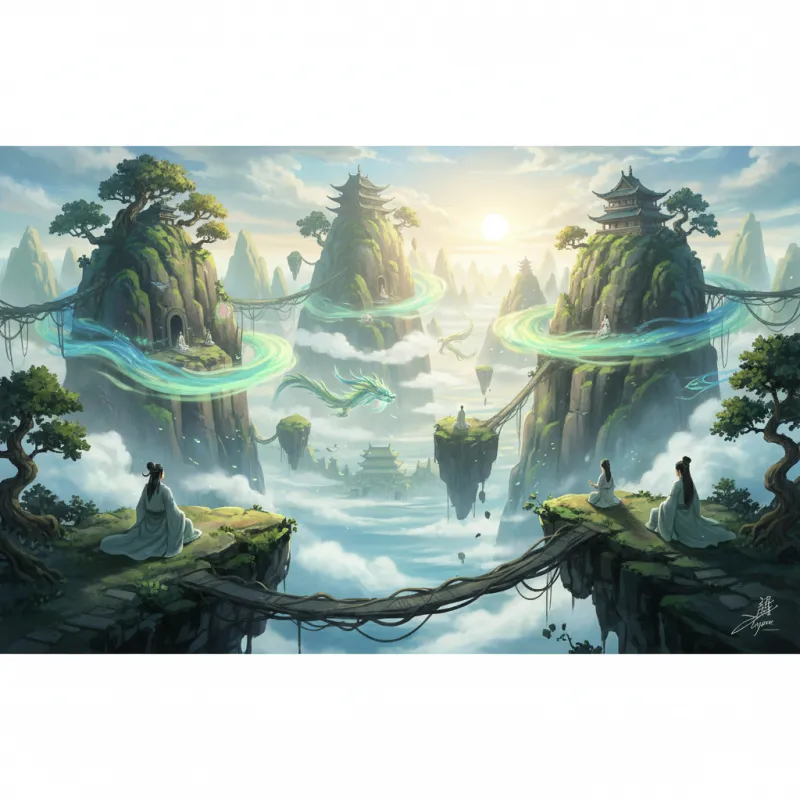
A young cultivator stands at the edge of a cliff, staring into swirling clouds that hide entire worlds. One step forward means abandoning mortality forever. One step back means accepting that some truths remain forever out of reach. This moment—this threshold between the mundane and the transcendent—captures the essence of xianxia fiction, where spiritual realms aren't just settings but philosophical statements about human potential.
The Architecture of Heaven: Understanding Spiritual Realms
Chinese xianxia fiction constructs reality as a vertical hierarchy of spiritual realms, each separated by barriers that only cultivation can breach. The mortal realm (凡界, fán jiè) sits at the bottom, followed by the spirit realm (灵界, líng jiè), the immortal realm (仙界, xiān jiè), and sometimes even higher dimensions like the divine realm (神界, shén jiè). This isn't arbitrary worldbuilding—it's a narrative expression of Daoist cosmology dating back to the Warring States period (475-221 BCE), when philosophers like Zhuangzi wrote about transcending the physical world.
What makes these realms compelling isn't just their power scaling. Each realm operates under different natural laws. In Er Gen's "I Shall Seal the Heavens," the immortal realm has fundamentally different time flow and spatial properties. Gravity works differently. Even causality bends. This creates genuine stakes: a cultivator ascending to a higher realm isn't just getting stronger—they're becoming a different kind of being, adapted to a reality that would crush their former self.
The barrier between realms, often called the heavenly tribulation (天劫, tiān jié), serves as both plot device and philosophical examination. When a cultivator faces lightning tribulation to ascend, they're not just proving their strength. They're demonstrating that their understanding of the Dao has evolved enough to survive in a reality with different fundamental rules. It's the universe's quality control system.
Cultivation Systems: The Ladder to Transcendence
Every xianxia novel presents its own cultivation system, but most follow a recognizable pattern rooted in Daoist internal alchemy (内丹, nèi dān). The typical progression starts with Qi Condensation (凝气, níng qì), where practitioners first sense and gather spiritual energy. Then comes Foundation Establishment (筑基, zhù jī), Core Formation (结丹, jié dān), Nascent Soul (元婴, yuán yīng), and so on through increasingly esoteric stages.
These aren't just power levels—they represent genuine philosophical transformations. The Nascent Soul stage, for instance, draws directly from Daoist meditation practices where practitioners visualize an immortal embryo forming within their dantian (丹田, dān tián). When a xianxia protagonist forms their Nascent Soul, they're literalizing a metaphor that Daoist monks have used for over a thousand years to describe spiritual awakening.
The genius of modern xianxia lies in how it gamifies these ancient practices while maintaining their philosophical core. In "Coiling Dragon" by I Eat Tomatoes, the cultivation stages directly correlate with understanding fundamental laws of reality—fire, water, earth, wind. A cultivator doesn't just get fire powers; they comprehend the essential nature of combustion and transformation. This mirrors the Daoist concept of 格物致知 (gé wù zhì zhī)—investigating things to extend knowledge—from the Great Learning.
Different novels innovate within this framework. "Reverend Insanity" presents cultivation as raising and refining Gu worms that embody different aspects of reality. "Lord of the Mysteries" blends Western occultism with cultivation mechanics, creating potion sequences that feel both familiar and alien. Yet all maintain that core principle: advancement requires understanding, not just accumulation of power.
The Immortal Realm: Paradise or Prison?
Here's where xianxia gets philosophically interesting: the immortal realm isn't always portrayed as paradise. In many novels, it's a cutthroat society where the strong devour the weak with even less restraint than in the mortal world. The immortals in "A Will Eternal" are petty, vindictive, and obsessed with face—they've transcended mortality but not human nature.
This reflects a sophisticated understanding of Daoist philosophy that casual readers might miss. The Daodejing warns repeatedly about the dangers of seeking immortality for its own sake. Chapter 50 states that "those who seek to preserve life end up dying." The immortal realm in xianxia fiction often serves as a cautionary tale: these characters achieved eternal life but lost something essential in the process.
The best xianxia novels use the immortal realm to explore what it means to be human. In "Desolate Era," the protagonist Ji Ning discovers that immortals can live for millions of years but still experience profound loneliness and existential dread. Time loses meaning. Relationships become impossible when you might outlive entire civilizations. The immortal realm becomes a meditation on whether eternal life is actually desirable—a question Daoist philosophers have debated for millennia.
Some novels subvert this entirely. "Forty Millenniums of Cultivation" presents cultivation as a tool for societal advancement rather than individual transcendence. The spiritual realms aren't separate dimensions but stages of technological and spiritual development that entire civilizations can achieve together. It's xianxia filtered through science fiction, asking whether the pursuit of immortality might be a collective rather than individual journey.
Heavenly Tribulations: The Universe Fights Back
The concept of heavenly tribulation (天劫, tiān jié) deserves special attention because it reveals xianxia's core tension: the universe doesn't want you to transcend. When cultivators attempt to break through to higher realms, heaven itself sends lightning, fire, or even karmic retribution to stop them. This isn't random—it's based on the Daoist concept of 天人感应 (tiān rén gǎn yìng), the resonance between heaven and humanity.
In "Against the Gods," tribulations scale with the cultivator's potential. Someone destined for greatness faces proportionally more terrifying obstacles. This creates a beautiful narrative paradox: the more talented you are, the harder the universe tries to kill you. It's a cosmic balancing mechanism, ensuring that only those who truly understand the Dao can advance.
The tribulation system also allows authors to explore themes of karma and fate. In many novels, cultivators face inner demons (心魔, xīn mó) during tribulation—manifestations of their regrets, fears, and moral failings. You can't cheat your way to enlightenment. The universe knows what you've done, and it will make you confront it. This draws from Buddhist concepts of karma that have deeply influenced Chinese spiritual thought since the Han Dynasty.
Modern xianxia has gotten creative with tribulations. Some novels feature tribulations that attack your loved ones instead of you, forcing impossible choices. Others present tribulations as riddles or philosophical tests rather than combat challenges. "Renegade Immortal" features a protagonist who learns to manipulate tribulation lightning, turning the universe's weapon against itself—a very Daoist solution to an existential problem.
Spiritual Roots and Destiny: The Genetics of Transcendence
Most xianxia novels include the concept of spiritual roots (灵根, líng gēn)—innate talent for cultivation that determines how far you can advance. This might seem like a simple plot device to explain why some characters progress faster, but it's actually engaging with deep questions about determinism and free will that have occupied Chinese philosophers since Mencius and Xunzi debated human nature in the 4th century BCE.
The spiritual root system creates immediate dramatic tension. A protagonist with trash-tier spiritual roots must work exponentially harder than a jade-beauty genius with heaven-grade talent. But here's what makes it philosophically rich: most xianxia novels ultimately argue that spiritual roots aren't destiny. "A Record of a Mortal's Journey to Immortality" features a protagonist with mediocre talent who reaches heights that geniuses never achieve through careful planning, persistence, and a bit of luck.
This reflects the Confucian emphasis on self-cultivation (修身, xiū shēn) over innate ability. Yes, some people start with advantages, but the Analects repeatedly emphasize that virtue and achievement come from effort, not birth. Xianxia novels literalize this philosophical debate: can hard work overcome natural talent? The answer is usually "yes, but it's going to hurt."
Some novels flip the script entirely. In "Reverend Insanity," the protagonist's mediocre spiritual roots become an advantage because they make him underestimated. In "The Grandmaster Strategist," cultivation talent matters less than strategic thinking and understanding human nature. These novels argue that the obsession with spiritual roots is itself a limitation—a failure to understand that the Dao has many paths.
The Dao: What Are We Actually Cultivating?
Strip away the flying swords and alchemy pills, and xianxia fiction is asking a fundamental question: what does it mean to cultivate yourself? The Dao (道, dào)—often translated as "the Way"—sits at the center of every cultivation novel, but it's deliberately undefined. The opening line of the Daodejing states: "The Dao that can be spoken is not the eternal Dao."
Different xianxia novels interpret the Dao differently, and that's the point. In "Stellar Transformations," the Dao is about transcending the limitations of your birth and creating your own path. In "Desolate Era," it's about understanding the fundamental nature of reality. In "Renegade Insanity," it's about accepting that the universe is fundamentally indifferent and finding meaning anyway. Each interpretation reflects different schools of Daoist and Buddhist thought.
The best xianxia novels use cultivation as a metaphor for any kind of self-improvement. When a character spends decades in closed-door cultivation, they're not just gathering energy—they're confronting themselves, their limitations, their fears. The spiritual realms become psychological states as much as physical locations. The immortal realm isn't just a place you go; it's a state of being you achieve.
This is why xianxia resonates beyond Chinese audiences. The specifics are culturally Chinese—the terminology, the philosophical framework, the aesthetic—but the core question is universal: how do we become better than we are? How do we transcend our limitations? The cultivation journey, with its clearly defined stages and measurable progress, provides a satisfying narrative structure for exploring these eternal questions.
Beyond the Immortal Realm: Where Does Cultivation End?
The most ambitious xianxia novels don't stop at the immortal realm. They keep going: the divine realm, the primordial realm, the chaos realm, each one representing a higher level of existence and understanding. At some point, this stops being about power and becomes purely philosophical. What exists beyond existence? What comes after immortality?
"Desolate Era" takes this to its logical extreme, with realms so high that cultivators become capable of creating and destroying entire universes. At that level, cultivation becomes indistinguishable from enlightenment in the Buddhist sense—a complete transcendence of the self and merger with the fundamental nature of reality. The protagonist's final breakthrough isn't gaining more power; it's understanding that power was never the point.
This is where xianxia circles back to its Daoist roots. The Zhuangzi tells a story about a frog in a well who thinks the well is the entire universe. When someone tells the frog about the ocean, the frog can't comprehend it. Each spiritual realm in xianxia is like that well—a complete reality unto itself, until you break through and realize how limited your previous understanding was. The journey never truly ends because there's always a higher level of understanding, always another well to escape.
The question xianxia ultimately poses isn't "can you become immortal?" but "what will you do with immortality once you achieve it?" The spiritual realms aren't the destination—they're the journey. And like all good journeys, the point isn't where you end up but who you become along the way. That's a very Daoist conclusion for a genre that started with people just wanting to throw fireballs and fly on swords.
Related Reading
- From Mortal to Immortal: Every Stage Explained
- Nascent Soul Formation: The Critical Breakthrough
- Cultivation Realms Explained: The Ladder to Immortality
- The Complete Guide to Cultivation Realms in Xianxia Fiction
- Bottlenecks and Breakthroughs: The Emotional Core of Cultivation Fiction
- Flying Swords: The Cultivator's Signature Weapon
- Xianxia vs. Wuxia vs. Xuanhuan: What's the Difference?
- The Art of Immortal Cultivation: A Dive into Chinese Xianxia Fiction