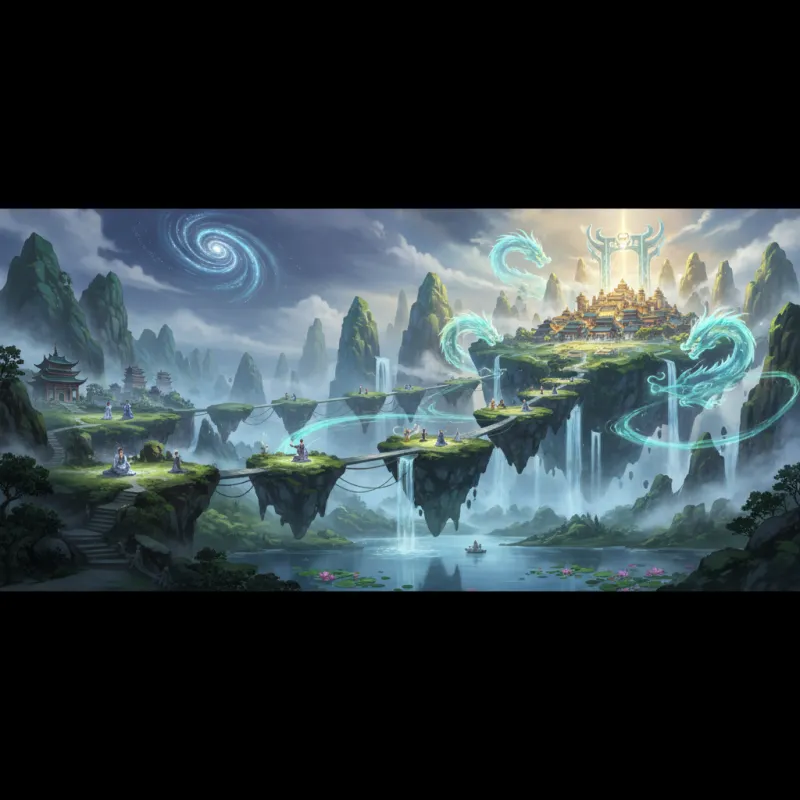
A single misstep on the path to immortality doesn't just mean failure — it means your foundation crumbles, your meridians shatter, and you spend the rest of your drastically shortened life as a crippled mortal, watching your former peers ascend to the heavens. This is why cultivation realms aren't just power levels in a video game. They're existential thresholds, each one a life-or-death gamble where success means transcending your previous limits and failure means losing everything you've built.
Why Realms Matter More Than You Think
Western fantasy often treats power progression as a smooth curve — you get stronger, learn new spells, level up. Cultivation fiction rejects this entirely. The realm system (境界, jìngjiè) creates a world of hard barriers and revolutionary transformations. A peak Foundation Establishment cultivator isn't just slightly weaker than an early Core Formation cultivator — they're in a completely different category of existence. Their qi operates on different principles. Their lifespan jumps from two hundred years to five hundred. Their spiritual sense expands from a few hundred meters to several kilometers.
This creates the genre's signature dramatic tension. In I Shall Seal the Heavens, Meng Hao spends entire arcs preparing for a single breakthrough, gathering resources, comprehending dao insights, and building the perfect foundation. When he finally advances, it's not a quiet level-up notification — mountains shake, heavenly tribulation descends, and his enemies panic because they know he's just entered a realm where he can actually threaten them.
The Foundation: Qi Condensation to Core Formation
Qi Condensation (炼气, liànqì) is where everyone starts, and most people end. You're learning to sense spiritual energy, draw it into your body, and circulate it through your meridians. The twelve sub-stages of Qi Condensation represent the gradual filling of your meridians with qi. You're stronger than mortals, sure — you can punch through wooden doors and run for hours without tiring. But a well-placed arrow can still kill you. In Forty Millenniums of Cultivation, the protagonist spends his Qi Condensation stage getting beaten up by basically everyone, which is refreshingly honest about how weak this realm actually is.
Foundation Establishment (筑基, zhùjī) is the first real threshold. You're not just storing qi anymore — you're building a permanent spiritual structure in your dantian that will support every future advancement. This is why novels obsess over "perfect foundations" and "flawed foundations." Build a mediocre foundation and you might reach Golden Core, but you'll never see Nascent Soul. The foundation determines your ceiling. In Renegade Immortal, Wang Lin's ruthless pursuit of a perfect foundation through morally questionable means sets up his entire character arc. He understands what many protagonists don't: compromise here and you compromise your entire future.
Core Formation (金丹, jīndān) — also called Golden Core — is where you compress all your qi into a single golden sphere in your dantian. This isn't metaphorical. Novels describe cultivators literally forming a physical core that contains their entire cultivation base. Break someone's core and you cripple them permanently. The quality of your core matters enormously: a nine-revolution golden core (the theoretical maximum) versus a basic three-revolution core means the difference between being a genius and being mediocre. This realm typically grants a five-hundred-year lifespan, which is when cultivators start thinking in terms of decades instead of years.
The Transformation: Nascent Soul and Beyond
Nascent Soul (元婴, yuányīng) is where things get weird. You're not just cultivating qi anymore — you're cultivating a spiritual infant inside your golden core, a miniature version of yourself made of pure spiritual energy. If your physical body dies, your Nascent Soul can escape and possess a new body or survive as a pure spirit. This is the realm where cultivators become genuinely hard to kill. In A Record of a Mortal's Journey to Immortality, Han Li's paranoid personality makes perfect sense once he reaches Nascent Soul — everyone at this level has multiple backup plans because the stakes are too high for anything less.
The Nascent Soul grows through stages (early, middle, late, peak), and each stage represents the infant maturing. By peak Nascent Soul, your spiritual infant is nearly ready to transform into something greater. Lifespan jumps to around two thousand years. You can fly without treasures. Your spiritual sense can cover an entire city. You're essentially a walking strategic weapon.
Soul Formation (化神, huàshén) — sometimes called Spirit Severing or Deity Transformation depending on the translation — is where your Nascent Soul transforms into a true spiritual deity. The specifics vary wildly between novels, but the common thread is that you're no longer entirely bound by physical laws. You can split your consciousness, exist in multiple places simultaneously, and manipulate space itself. In Desolate Era, this is roughly equivalent to the Zifu Disciple realm, where cultivators start building internal worlds.
The Transcendent Realms
Void Refinement (炼虚, liànxū) and Body Integration (合体, hétǐ) represent the late-stage realms where cultivators begin merging with the dao itself. You're refining the void, comprehending the fundamental laws of reality, and integrating your physical body with your spiritual cultivation. These realms are where the power scaling gets absurd — casual gestures that reshape landscapes, battles that destroy mountain ranges, lifespans measured in tens of thousands of years.
Mahayana (大乘, dàchéng) is typically the final mortal realm, the peak of what's possible before attempting true immortality. The name comes from Buddhism, meaning "great vehicle," and represents the cultivator's readiness to transcend the mortal world entirely. Mahayana cultivators are essentially demigods, and there are usually only a handful in any given world.
Tribulation Transcendence (渡劫, dùjié) isn't always listed as a separate realm, but it's the process of surviving heavenly tribulation to ascend to the immortal world. The heavens themselves test you with lightning tribulation, and failure means death — or worse, being crippled and losing all your cultivation. This is the ultimate filter, ensuring only the worthy achieve immortality.
Why Different Novels Use Different Systems
Here's what most articles won't tell you: there's no canonical cultivation system. Coiling Dragon uses a completely different progression (Warrior, Master, Grandmaster, Saint, Deity). Martial World has its own variant. Lord of the Mysteries barely uses traditional realms at all. The system I've described above is roughly the "standard" version popularized by novels like I Shall Seal the Heavens and A Record of a Mortal's Journey to Immortality, but authors modify it constantly.
Why? Because the realm system is a storytelling tool, not a rigid rule. Authors adjust it to create the dramatic beats they want. Some add realms to extend the story. Some compress them to move faster. Some create entirely new systems to differentiate their work. The key isn't memorizing every variation — it's understanding the underlying principle: cultivation realms create hard barriers that force characters to struggle, plan, and risk everything for advancement.
The Real Purpose of Realms
The genius of the realm system isn't the power scaling — it's the structure it provides for character development. Each realm breakthrough is a narrative climax, a moment where the protagonist must demonstrate growth not just in power but in understanding. The best cultivation novels use realm breakthroughs to mark character evolution. When Wang Lin breaks through to Nascent Soul in Renegade Immortal, it's not just about getting stronger — it's about him finally accepting his path and committing to his choices.
This is why cultivation techniques and spiritual roots matter so much in these stories. They're not just mechanical systems — they're expressions of character. Your realm shows where you are on the path. Your technique shows how you got there. Your spiritual roots show your potential ceiling. Together, they create a framework where power has meaning beyond simple numbers.
The ladder to immortality isn't just about climbing higher. It's about transforming yourself at each step, shedding your mortal limitations piece by piece until you become something entirely new. That's why cultivators call it the "path" (道, dào) — it's not a destination, it's a journey of continuous transformation. And every realm is another death and rebirth, another chance to prove you deserve to keep climbing.
Related Reading
- The Complete Guide to Cultivation Realms in Xianxia Fiction
- Nascent Soul Formation: The Critical Breakthrough
- From Mortal to Immortal: Every Stage Explained
- Exploring the Enigmatic Realms of Chinese Cultivation and Xianxia Fiction
- Spiritual Roots: The Innate Talent System of Cultivation
- Unveiling the Essence of Chinese Cultivation: A Journey Through Xianxia and Immortal Realms
- Unraveling the Mysteries of Formations in Chinese Cultivation and Xianxia Fiction
- Sword Intent: Understanding the Dao of the Blade