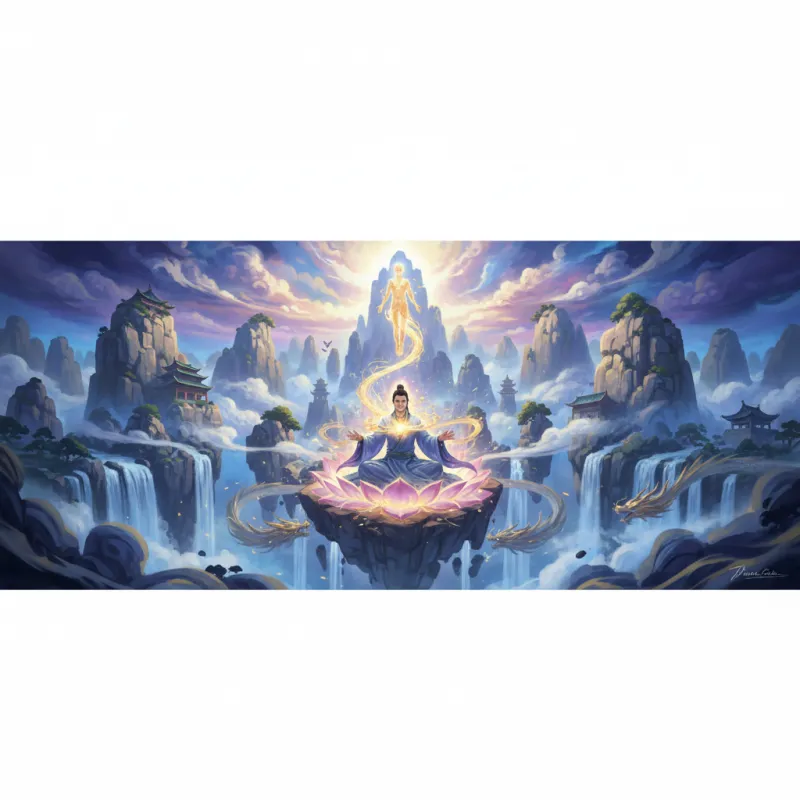
The moment a cultivator's spiritual sea trembles and a miniature version of themselves opens its eyes for the first time, everything changes. This isn't just another breakthrough—it's the moment when a mortal truly begins to shed their limitations and step onto the path of immortality. Nascent Soul Formation (元婴, yuán yīng) represents the single most dangerous and transformative leap in the cultivation journey, where failure doesn't mean stagnation—it means death, or worse, a shattered foundation that can never be repaired.
Why Nascent Soul Marks the True Beginning
Most cultivation novels treat the early realms—Qi Condensation, Foundation Establishment, even Golden Core Formation—as preparatory stages. And they're right to do so. A Golden Core cultivator might live for five hundred years and command respect in mortal kingdoms, but they're still fundamentally bound by physical laws. The Nascent Soul changes this equation entirely.
When Er Gen wrote I Shall Seal the Heavens, he made this distinction brutally clear. Meng Hao's breakthrough to Nascent Soul wasn't just about gaining power—it was about achieving a form of spiritual immortality. Even if his physical body were destroyed, his Nascent Soul could escape and eventually reconstruct itself. This is the critical difference: Golden Core cultivators can die. Nascent Soul cultivators have to be truly killed, and that's exponentially harder.
The Nascent Soul itself is a spiritual construct formed within the dantian (丹田, dān tián), typically visualized as a miniature infant sitting in lotus position. But calling it an "infant" undersells what it actually represents—it's a complete spiritual body containing the cultivator's consciousness, memories, and cultivation base. In Daoist internal alchemy texts from the Tang Dynasty, this concept appears as the "spiritual embryo" (圣胎, shèng tāi), suggesting that cultivators are literally giving birth to their immortal selves.
The Formation Process: Three Tribulations
The actual breakthrough process varies wildly between novels, but most draw from a common framework of three critical challenges. Renegade Immortal by Er Gen presents perhaps the most visceral depiction of this process through Wang Lin's experience.
First comes the Spiritual Tribulation (心魔劫, xīn mó jié)—the confrontation with one's inner demons. This isn't metaphorical. The cultivator's consciousness is pulled into an illusory realm where every regret, fear, and suppressed emotion manifests as a tangible threat. Wang Lin faced visions of everyone he'd failed to save, every compromise he'd made, every moment of weakness. Many cultivators never emerge from this stage, their minds shattered by truths they can't accept about themselves.
The second challenge is the Physical Tribulation (肉身劫, ròu shēn jié). The Golden Core must be shattered—deliberately destroyed—to release the energy needed to form the Nascent Soul. Imagine crushing a diamond with your bare hands while that diamond is inside your chest. The pain is described as beyond mortal comprehension, and the risk is absolute. If the cultivator hesitates or lacks sufficient spiritual energy, the shattered core simply dissipates, and they die. No second chances.
Finally, the Heavenly Tribulation (天劫, tiān jié) descends. The heavens themselves reject this transformation, sending down lightning tribulation to destroy the newly forming Nascent Soul. This is where Tribulation Lightning becomes a genuine threat rather than a distant concern. The cultivator must endure anywhere from three to nine bolts of heavenly lightning, each one capable of annihilating a Golden Core cultivator instantly. The number of bolts often correlates with the quality of the Nascent Soul being formed—nine bolts indicate a heaven-defying talent, but also a near-certain death sentence without proper preparation.
Nascent Soul Quality and Potential
Not all Nascent Souls are created equal, and this is where xianxia fiction gets genuinely interesting from a world-building perspective. The quality of one's Nascent Soul determines their future potential, and it's influenced by everything that came before: the purity of their spiritual roots, the quality of their Foundation Establishment, the perfection of their Golden Core, and the resources consumed during breakthrough.
In A Record of a Mortal's Journey to Immortality, Han Li's meticulous preparation—spending decades gathering spirit medicines, studying ancient jade slips, and perfecting his cultivation technique—results in a high-grade Nascent Soul with exceptional spiritual sense range. Meanwhile, cultivators who rush the breakthrough or lack resources end up with low-grade Nascent Souls that limit their future achievements.
The traditional classification system recognizes five grades: low, middle, high, supreme, and heaven-defying. A low-grade Nascent Soul might grant a lifespan of one thousand years and spiritual sense extending a few miles. A heaven-defying Nascent Soul could offer three thousand years of life and spiritual sense covering an entire region. More importantly, the grade affects comprehension speed, energy recovery, and the ability to withstand future tribulations.
Some novels introduce colored Nascent Souls—gold, purple, or even multicolored—each indicating different attributes or affinities. Martial World by Cocooning Butterfly takes this further, suggesting that Nascent Soul color reflects one's dao comprehension and elemental affinity. A cultivator who comprehends the Dao of Fire might form a crimson Nascent Soul wreathed in flames, while someone following the Dao of Sword might manifest a silver Nascent Soul holding a miniature sword.
The Power Gap: Before and After
The difference between peak Golden Core and early Nascent Soul is often compared to the difference between a human and an ant—and that's not hyperbole in xianxia terms. A Nascent Soul cultivator can fly without treasures, their spiritual sense can blanket entire cities, and their casual attacks carry enough force to level mountains.
But the real advantage is versatility. Nascent Soul cultivators can split their consciousness, allowing them to control multiple treasures simultaneously or maintain several techniques at once. They can perform Nascent Soul Separation (元婴出窍, yuán yīng chū qiào), sending their Nascent Soul out to scout, possess weaker beings, or escape danger. Their recovery speed increases exponentially—injuries that would cripple a Golden Core cultivator for months heal in days.
In Desolate Era, IET illustrates this power gap through Ji Ning's breakthrough. Before Nascent Soul, he struggled against peak Golden Core opponents. After breakthrough, he casually defeated multiple Golden Core cultivators simultaneously while barely paying attention. This isn't just about raw power—it's about operating on a fundamentally different level of existence.
Preparation: The Difference Between Life and Death
Smart protagonists spend entire arcs preparing for Nascent Soul breakthrough, and with good reason. The mortality rate for unprepared cultivators attempting this breakthrough hovers around seventy percent in most novels. With proper preparation, it drops to maybe thirty percent. Those are still terrible odds, but in a world where stagnation means eventual death anyway, cultivators take the risk.
Essential preparations typically include: a secluded location with dense spiritual energy, protective formations to prevent interference, healing pills for the physical tribulation, soul-stabilizing treasures for the spiritual tribulation, and lightning-resistant artifacts for the heavenly tribulation. The truly cautious also arrange for a trusted protector to guard them during the vulnerable breakthrough period.
In Forty Millenniums of Cultivation, the protagonist spends years accumulating resources specifically for this breakthrough, including a legendary pill that costs more than most sects' annual budgets. This might seem excessive, but the novel makes clear that skimping on preparation is the fastest way to become a cautionary tale.
The Nascent Soul Realm: Subdivisions and Progression
Most xianxia novels divide the Nascent Soul realm into early, middle, late, and peak stages, with some adding a half-step or perfection stage before the next major realm. Each subdivision represents significant power growth, but the gaps between them are smaller than the chasm between Golden Core and Nascent Soul.
Progression through these stages involves refining and strengthening the Nascent Soul, expanding its size, and deepening one's dao comprehension. Some novels introduce the concept of Nascent Soul transformation—the infant gradually matures into a child, then an adolescent, and finally an adult form. This physical maturation reflects spiritual growth and increasing mastery.
The peak of Nascent Soul realm serves as preparation for the next breakthrough: Soul Formation, where the Nascent Soul transforms yet again into something even more profound. But that's a tribulation for another day—surviving Nascent Soul Formation is challenge enough for most cultivators.
Why This Realm Matters Narratively
From a storytelling perspective, Nascent Soul Formation serves as a major milestone that fundamentally changes the protagonist's role in the world. Before this breakthrough, they're talented but ultimately still playing in the minor leagues. After, they become genuine players on the continental or even world stage.
This is why so many xianxia novels structure their narratives around this breakthrough occurring roughly one-third to halfway through the story. It's a natural escalation point that allows the author to introduce higher-level conflicts, more powerful enemies, and deeper mysteries about the cultivation world. The protagonist has proven they're not just lucky—they have the talent and determination to reach the upper realms.
The best xianxia authors use Nascent Soul Formation as a character development moment too. The spiritual tribulation forces protagonists to confront their inner demons, leading to genuine growth beyond just power levels. Wang Lin's breakthrough in Renegade Immortal fundamentally changed his personality and approach to cultivation, making him more ruthless but also more focused on his ultimate goals.
Nascent Soul Formation isn't just a power-up—it's a transformation that separates those who merely cultivate from those who truly walk the path toward immortality. The infant soul that opens its eyes in that moment of breakthrough carries within it the potential for godhood, but also the weight of every choice and sacrifice that made its formation possible.
Related Reading
- The Ultimate Guide to Cultivation Fiction (Xiuxian): From Mortal to Immortal
- Cultivation Realms Explained: The Ladder to Immortality
- Heavenly Tribulation: Why Lightning Strikes the Powerful
- Bottlenecks and Breakthroughs: The Emotional Core of Cultivation Fiction
- The Complete Guide to Cultivation Realms in Xianxia Fiction
- Exploring the Intricate World of Chinese Cultivation and Xianxia Fiction
- Unraveling the Mysteries of Chinese Cultivation and Xianxia Fiction
- Top 10 Cultivation Web Novels That Changed the Genre