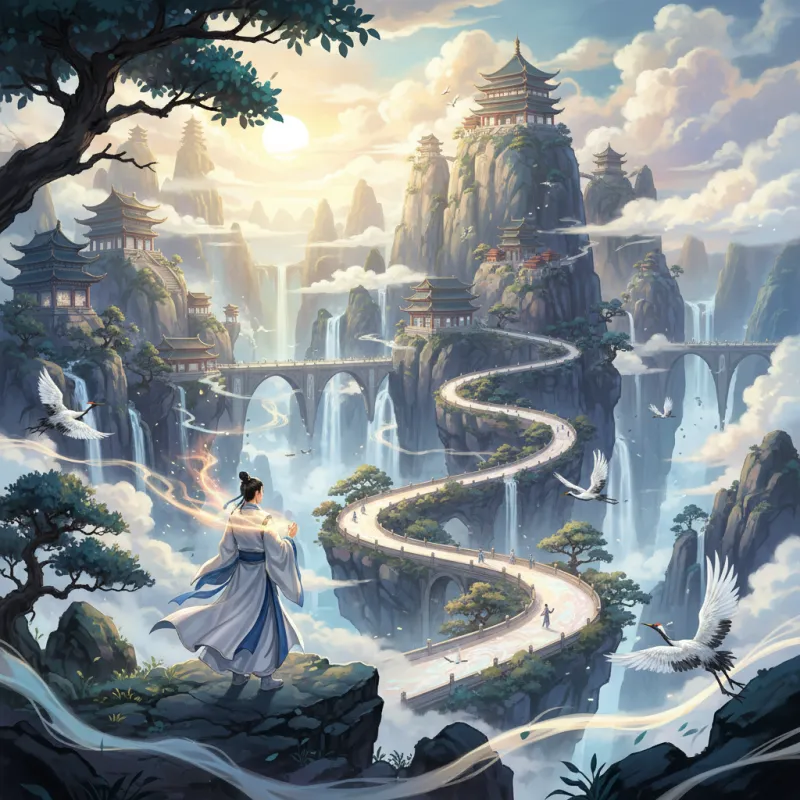
You're about to die. Again.
Your meridians are shattered, your dantian is cracked, and that arrogant young master whose engagement you accidentally ruined is about to finish you off with his family's signature palm technique. But wait — as your blood drips onto that mysterious jade pendant your deceased grandfather left you, a blinding light erupts, an ancient voice echoes in your mind, and suddenly you're learning the long-lost cultivation method of an immortal emperor who died ten thousand years ago.
Welcome to xiuxian (修仙, xiūxiān) fiction, where death is just the setup for your next power-up.
What Actually Is Cultivation Fiction?
Xiuxian translates literally as "cultivating immortality," but that barely scratches the surface. This is a genre where protagonists systematically transform themselves from ordinary mortals into beings who can split mountains, cross continents in a single step, and live for millions of years. The "cultivation" part refers to the rigorous, often brutal process of absorbing spiritual energy (灵气, língqì), refining it through meditation and combat, and advancing through increasingly powerful realms.
Think of it as a progression fantasy on steroids, mixed with Daoist philosophy, traditional Chinese medicine theory, and the kind of power scaling that makes Dragon Ball Z look restrained. The genre exploded in the early 2000s with novels like I Shall Seal the Heavens and Coiling Dragon, and today dominates Chinese web fiction platforms with millions of readers following hundreds of ongoing series.
Unlike wuxia, where martial artists remain fundamentally human (just really, really good at punching), xiuxian protagonists transcend mortality itself. They're not learning kung fu — they're rewriting the laws of physics, one breakthrough at a time.
The Cultivation Realm System: Your Roadmap to Godhood
Every xiuxian novel has a cultivation realm system, and while the names vary wildly between authors, the structure is remarkably consistent. You start weak, you break through to the next realm, you become exponentially stronger, and you discover there are always higher realms above you. It's turtles all the way up.
The most common progression looks something like this:
Qi Condensation (练气, liànqì) — You're learning to sense and absorb spiritual energy. Most people never make it past this stage. You might live to 150 if you're lucky.
Foundation Establishment (筑基, zhùjī) — You've built a stable foundation in your dantian (丹田, dāntián), the energy center below your navel. Now you can actually fight other cultivators without embarrassing yourself. Lifespan: 300-500 years.
Core Formation (金丹, jīndān) — You've condensed your spiritual energy into a golden core. This is where you stop being cannon fodder and start being a real player. You can fly now. Lifespan: 1,000 years.
Nascent Soul (元婴, yuányīng) — Your golden core hatches into a miniature spiritual infant version of yourself. If your body dies, your Nascent Soul can escape and possess someone else. Lifespan: 3,000-5,000 years.
Soul Formation and Beyond — The names get increasingly grandiose (Spirit Severing, Dao Seeking, Immortal Ascension), and the power levels become absurd. Late-stage cultivators can destroy planets, create pocket dimensions, and rewind time.
The genius of this system is that it creates natural story arcs. Each realm is a mini-goal, each breakthrough is a climactic moment, and there's always a bigger fish. The protagonist who just became the strongest Foundation Establishment cultivator in his sect? He's an ant to the Core Formation elders. And those elders? They're terrified of the Nascent Soul ancestors in seclusion.
For a deeper dive into how these realms actually work, check out our guide to cultivation realms and breakthroughs.
The Protagonist Formula: Trash to Treasure
Xiuxian protagonists follow a template so reliable you could set your watch by it. They start as the most pathetic, talentless loser in their sect or clan. Maybe they have blocked meridians. Maybe their cultivation was crippled by a rival. Maybe they're just naturally terrible at absorbing spiritual energy.
Then comes the cheat.
It might be a mysterious ring containing the soul of an ancient expert (see: Tales of Demons and Gods). It might be a heaven-defying cultivation technique found in a cave (see: Martial God Asura). It might be the ability to absorb other people's cultivation, or a system that gives them quests, or memories from a past life where they were already an immortal.
The point is: they get something that lets them break the normal rules. While other cultivators need decades to advance one realm, the protagonist does it in months. While others need rare pills and treasures, the protagonist has a cheat that manufactures them. The entire genre is built on the power fantasy of the underdog who has a secret advantage.
But here's what makes it work: the protagonist still has to struggle. The cheat doesn't make them invincible — it just gives them a chance to compete with the geniuses who have better resources, better backgrounds, and better starting talent. They still get beaten up, still face impossible odds, still have to outsmart enemies who are stronger than them.
Until they're not. And then they find even stronger enemies.
Alchemy, Artifacts, and the Economy of Power
Cultivation isn't just about sitting in a cave and meditating (though there's plenty of that). It's about resources. Spiritual stones for currency. Pills for breakthroughs. Artifacts for combat. Rare herbs that only grow in death zones. Ancient techniques hidden in forgotten ruins.
The alchemy system deserves special mention because it's central to almost every xiuxian novel. Alchemists refine pills from spiritual herbs using specialized furnaces, and these pills can do everything from healing injuries to forcing breakthroughs to extending lifespan. A single high-grade pill might be worth more than a small kingdom.
This creates a fascinating economy where cultivators are constantly hunting for resources, trading treasures, and fighting over inheritance sites. The protagonist who can refine pills, forge artifacts, or create formations has a massive advantage — they can generate their own resources instead of relying on their sect or clan.
It also creates natural conflict. That rare herb the protagonist needs for his breakthrough? Someone else needs it too, and they're willing to kill for it. That ancient cave with the immortal's inheritance? Hundreds of cultivators are competing to enter it, and most of them won't come out alive.
Sects, Clans, and the Politics of Immortality
Xiuxian fiction is surprisingly political. Cultivation sects function like corporations, clans like mafia families, and the relationships between them drive much of the plot. You have righteous sects that claim to uphold justice (but are often hypocritical), demonic sects that practice forbidden techniques (but sometimes have more honest codes), and neutral sects that just want to be left alone (but always get dragged into conflicts anyway).
The protagonist usually starts in a low-tier sect or clan, gets underestimated and bullied, then gradually rises through the ranks while making enemies of increasingly powerful factions. By the mid-point of most novels, they've offended so many people that half the cultivation world wants them dead.
This is where face (面子, miànzi) becomes crucial. In xiuxian fiction, reputation and honor matter almost as much as actual power. If someone insults you and you don't respond, you lose face. If you lose face, you're seen as weak. If you're seen as weak, people will walk all over you. So conflicts escalate rapidly — a minor insult becomes a duel, a duel becomes a sect war, a sect war becomes a continental crisis.
The protagonist, of course, has no face to lose because they started at the bottom. This gives them freedom to act in ways that established powers can't. They can offend young masters, steal treasures, and break rules because they have nothing to protect except their own life.
Why Xiuxian Fiction Hits Different
Here's what makes cultivation fiction addictive: it's a genre built on progression, and progression triggers something primal in our brains. Every breakthrough is a dopamine hit. Every new technique is a power-up. Every realm is a level-up in the world's most elaborate RPG.
But it's more than just power fantasy. The best xiuxian novels explore what it means to pursue immortality at any cost. What do you sacrifice for power? How do you maintain your humanity when you're living for thousands of years? What happens when you've climbed so high that there's no one left who remembers your original name?
I Shall Seal the Heavens by Er Gen (耳根) asks these questions while delivering some of the most creative cultivation concepts in the genre. A Record of a Mortal's Journey to Immortality by Wang Yu (忘语) strips away the power fantasy to show cultivation as a brutal, lonely grind where most people fail. Reverend Insanity (before it was banned) pushed the genre into genuinely dark territory, with a protagonist who treats morality as an obstacle to overcome.
The genre has its flaws — repetitive plot beats, paper-thin side characters, nationalism that can get uncomfortable, and a tendency to treat women as prizes or obstacles. But when it works, when you find that novel that clicks, you'll understand why millions of readers stay up until 3 AM waiting for the next chapter.
Because once you start cultivating, it's hard to stop. There's always one more realm to reach, one more breakthrough to achieve, one more enemy to face. The path to immortality is long, but the journey is what makes it worth reading.
Related Reading
- Heavenly Tribulation and Ascension: The Final Test of Cultivation
- Spiritual Roots: The Innate Talent System of Cultivation
- Exploring Immortal Cultivation and Spiritual Realms in Chinese Xianxia Fiction
- Cultivation Realms Explained: The Ladder to Immortality
- Nascent Soul Formation: The Critical Breakthrough
- The Philosophical Underpinnings of Chinese Cultivation Fiction and Immortal Realms
- Righteous vs. Demonic Sects: The Great Divide in Cultivation Fiction
- The Essence of Immortality: Understanding Chinese Cultivation and Xianxia Fiction