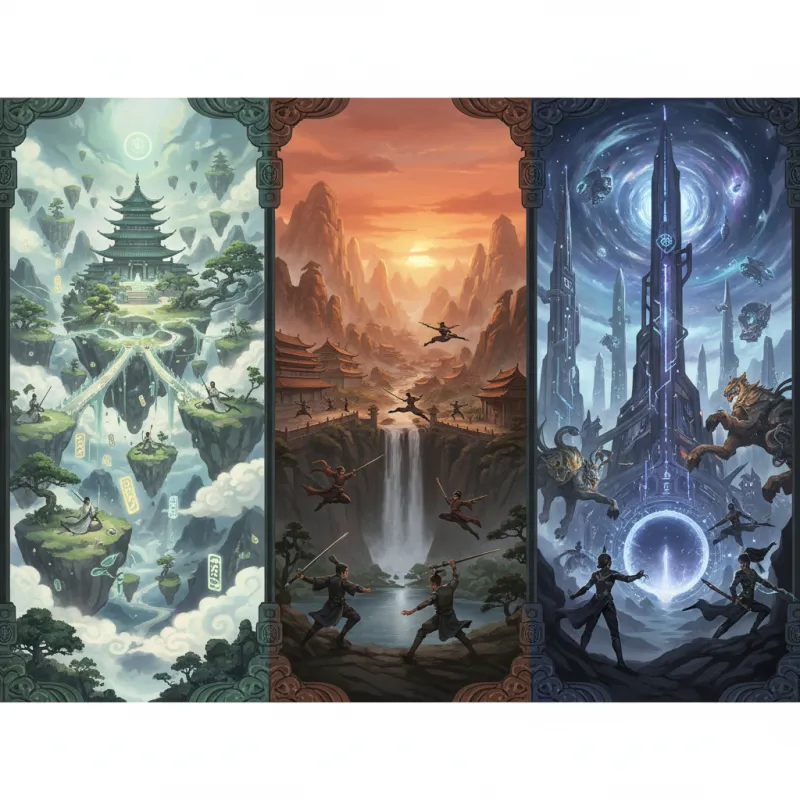
You've just finished binge-reading a cultivation novel where the protagonist punches through mountains and ascends to godhood. Your friend recommends another "Chinese fantasy," but this one features sword-fighting heroes who can't even fly. What happened? You've stumbled into the often-confusing world of Chinese fantasy genre distinctions—and trust me, mixing up xianxia with wuxia is like confusing Superman with Batman. They're both heroes, but the power scales aren't even in the same universe.
The Foundation: Wuxia (武侠) — Where It All Began
Wuxia, literally "martial heroes," is the grandfather of Chinese fantasy fiction. Born in early 20th century serialized novels and perfected by masters like Jin Yong (Louis Cha) and Gu Long in the 1950s-70s, wuxia stays firmly grounded in historical China—usually during the Song, Ming, or Qing dynasties. Think Crouching Tiger, Hidden Dragon or Hero: warriors with superhuman martial arts skills, but still fundamentally human.
The power ceiling in wuxia is deliberately constrained. A master might leap across rooftops, deflect arrows with their sword, or fight off dozens of opponents, but they're not splitting mountains or living for millennia. The martial arts system revolves around internal energy called qi (气), cultivated through decades of training. Characters might master the "Eighteen Dragon-Subduing Palms" or achieve "unity of heaven and man," but these are peak human achievements, not supernatural transformations.
What makes wuxia compelling isn't raw power—it's the code. The jianghu (江湖), the "rivers and lakes" world of martial artists, operates on principles of honor, loyalty, and righteousness. Heroes fight corrupt officials, protect the weak, and uphold justice. The conflicts are deeply human: revenge, forbidden love, political intrigue, and the eternal question of whether the ends justify the means. Jin Yong's The Legend of the Condor Heroes exemplifies this perfectly—Guo Jing isn't the most talented fighter, but his unwavering moral compass makes him the ultimate wuxia protagonist.
The Ascension: Xianxia (仙侠) — Breaking Human Limits
Xianxia, meaning "immortal heroes," exploded in popularity with online web novels in the early 2000s. If wuxia asks "How skilled can a human become?", xianxia asks "What lies beyond humanity?" The answer: immortality, godhood, and power that makes wuxia masters look like children playing with wooden swords.
The defining feature of xianxia is the cultivation system—a structured progression from mortal to immortal through absorbing spiritual energy, forming a golden core, surviving tribulations, and eventually transcending the mortal plane entirely. I Shall Seal the Heavens by Er Gen and Coiling Dragon by I Eat Tomatoes showcase this progression beautifully, with protagonists starting as weak mortals and ending as beings who create universes.
The setting shifts from historical China to cultivation worlds—fantasy realms where spiritual energy permeates everything, sects control territories like nations, and ancient ruins hide heaven-defying treasures. Geography matters: lower realms, middle realms, upper realms, each with increasingly powerful cultivators. A Nascent Soul cultivator who dominates the lower realm becomes an ant in the upper realm—this vertical progression is xianxia's signature move.
But here's what separates xianxia from mere power fantasy: it inherits wuxia's moral framework while adding Daoist philosophy. The pursuit of immortality isn't just about power—it's about transcending mortal limitations, understanding the Dao (道), and achieving spiritual enlightenment. Sure, protagonists engage in plenty of face-slapping and treasure hunting, but the best xianxia novels explore what it means to remain human while becoming divine. A Record of a Mortal's Journey to Immortality nails this balance—Han Li's methodical, cautious approach to cultivation feels more real than the typical overpowered protagonist.
The Wild Card: Xuanhuan (玄幻) — Anything Goes
Xuanhuan, roughly "mysterious fantasy," is the rebellious younger sibling that refuses to follow anyone's rules. Emerging alongside xianxia in the web novel boom, xuanhuan throws out the historical setting requirement and the strict cultivation framework. Want Western-style magic systems? Go ahead. Prefer a game-like leveling system? Sure. How about mixing cultivation with mecha? Why not?
The term xuanhuan literally means "mysterious/profound fantasy," and that vagueness is intentional. It's a catch-all category for Chinese fantasy that doesn't fit neatly into wuxia or xianxia boxes. Battle Through the Heavens (Douqi Continent) features a cultivation-like system called "Dou Qi" but in a completely original fantasy world with its own geography, races, and rules. Tales of Demons and Gods mixes cultivation with time travel and game mechanics.
What xuanhuan shares with its siblings is the Chinese narrative sensibility—the focus on personal power progression, the importance of face and reputation, the sect/clan structures, and the "young master" antagonists who exist solely to be humiliated. But it's freed from the constraints of Daoist philosophy or historical accuracy. A xuanhuan novel might feature a protagonist who cultivates magic, tames dragons, builds a business empire, and romances multiple heroines—all while the power system borrows from video game RPGs.
The flexibility makes xuanhuan both exciting and inconsistent. Without the established frameworks of wuxia's jianghu or xianxia's cultivation realms, each xuanhuan novel essentially creates its own rules. Some are brilliant innovations; others feel like the author is making things up as they go (because they often are—web novel serialization is unforgiving).
Power Scales: From Rooftops to Universes
Let's talk numbers, because power scaling is where these genres truly diverge. In wuxia, a top-tier master might have 100 years of internal energy cultivation and can fight off 100 ordinary soldiers. Impressive, but still countable.
In xianxia, a Foundation Establishment cultivator (low-tier) lives 200-300 years and can level a small town. A Nascent Soul cultivator (mid-tier) lives thousands of years and can destroy cities. A Mahayana cultivator (high-tier) can shatter continents. And that's before they ascend to the Immortal Realm, where the power scaling starts over with even more ridiculous multipliers. By the end of Desolate Era, the protagonist Ji Ning is fighting across multiple universes and creating/destroying entire realities.
Xuanhuan's power scaling varies wildly by novel, but it typically falls somewhere between wuxia and xianxia, or occasionally exceeds both. The lack of standardization means authors can adjust the ceiling as needed—convenient for serialized stories that need to keep escalating stakes.
Themes and Philosophy: What Are We Really Reading About?
Strip away the power systems and fight scenes, and you'll find each genre explores different questions. Wuxia asks: What does it mean to be a hero in a corrupt world? How do we balance personal desires with moral duty? The best wuxia novels are character studies wrapped in sword fights—Jin Yong's The Smiling, Proud Wanderer uses martial arts to explore freedom versus conformity.
Xianxia asks: What would you sacrifice for immortality? Is power worth losing your humanity? How do you maintain relationships when you'll outlive everyone you love? Renegade Immortal by Er Gen is brutally honest about cultivation's dark side—Wang Lin's journey to immortality costs him nearly everything he cares about.
Xuanhuan, freed from philosophical constraints, often focuses on simpler pleasures: adventure, romance, revenge, and the satisfaction of watching an underdog rise to the top. It's not shallow—novels like Lord of the Mysteries weave complex mysteries and world-building—but xuanhuan prioritizes entertainment over enlightenment.
Modern Blending: Why Categories Get Messy
Here's where it gets complicated: modern web novels increasingly blur these boundaries. Martial World starts as xianxia but incorporates xuanhuan elements with its multiple realms and diverse power systems. Reverend Insanity features xianxia cultivation but in a xuanhuan-style original world with unique magic (Gu insects). Some novels even cycle through genres—starting wuxia-lite before revealing a hidden cultivation world.
The English translation community hasn't helped clarity. Translators often tag everything as "xianxia" because it's the most recognizable term to Western readers, even when the novel is clearly xuanhuan or wuxia. Cultivation novels get lumped together regardless of their actual genre distinctions.
Which Should You Read?
If you want grounded martial arts with complex characters and moral dilemmas, start with wuxia—Jin Yong's Legends of the Condor Heroes trilogy is the gold standard. If you're here for the power fantasy and want to watch someone ascend from mortal to god, xianxia delivers—A Will Eternal by Er Gen balances humor with genuine cultivation progression. If you want creative world-building without genre restrictions, xuanhuan offers the most variety—Warlock of the Magus World features a protagonist with an AI chip in a cultivation world, which is exactly the kind of wild premise xuanhuan enables.
The truth is, the best novels transcend their genre labels. Lord of the Mysteries is technically xuanhuan but has better world-building than most xianxia. Grandmaster Strategist is wuxia but focuses more on political intrigue than martial arts. The categories help you find what you're looking for, but great storytelling is great storytelling, regardless of whether the protagonist is leaping across rooftops or shattering dimensions.
Just remember: if they're flying on swords and forming golden cores, it's probably xianxia. If they're avenging their master in historical China, it's wuxia. And if you can't figure out what's happening because the author just introduced a seventh magic system, welcome to xuanhuan.
Related Reading
- Essential Cultivation Terms: The Complete Xianxia Glossary
- Cultivation Sects Explained: Schools, Clans, and Holy Lands
- The Glossary Problem: Why Cultivation Fiction Is Hard to Translate
- Cultivation Glossary: 50 Terms Every Reader Needs to Know
- The Enchantment of Chinese Cultivation Fiction: Immortal Aspirations and Alchemical Journeys
- The Art of Immortal Cultivation: A Dive into Chinese Xianxia Fiction
- Unraveling the Mysteries of Formations in Chinese Cultivation and Xianxia Fiction