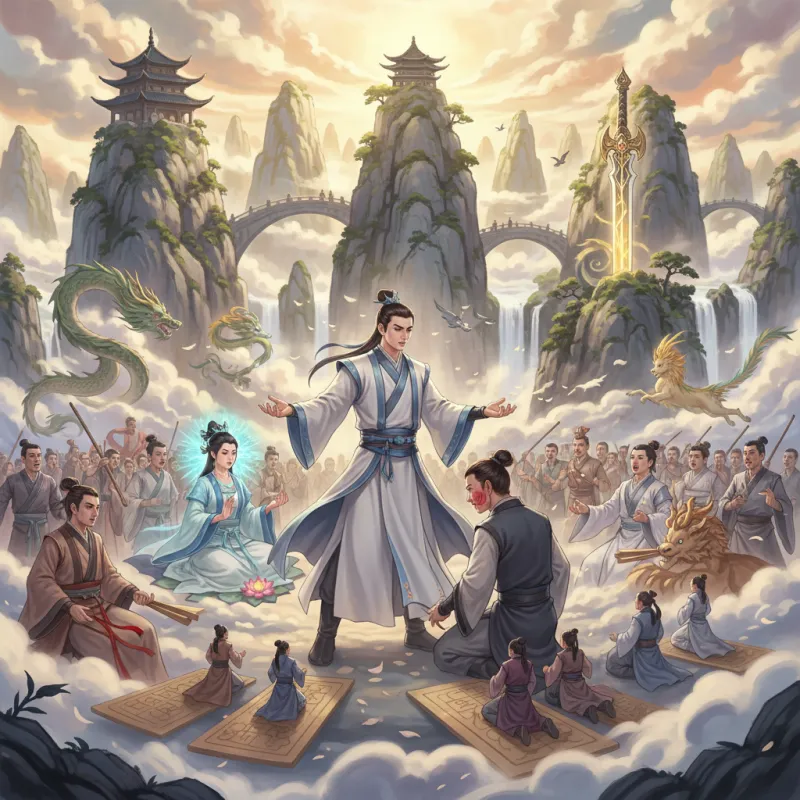
A young master in silk robes sneers at the "trash" before him, loudly proclaiming that this nobody couldn't possibly defeat him even if given three moves. Two chapters later, that same young master is coughing blood, his cultivation crippled, his jade pendant shattered, and his fiancée has just announced she's breaking their engagement. The crowd that gathered to watch his easy victory stands in stunned silence. This is the face-slap (打脸 dǎliǎn), and if you've read more than three xianxia novels, you've seen this scene play out at least fifty times. You probably loved it every single time.
The Anatomy of a Perfect Face-Slap
The face-slap isn't just about someone being wrong—it's a carefully orchestrated humiliation with specific beats that readers have come to expect. First comes the setup: the antagonist must be loud, public, and absolutely certain of their superiority. They can't just think the protagonist is weak; they need to announce it to everyone within earshot, preferably while surrounded by their lackeys and admirers. The more witnesses, the better.
Then comes the reversal. The protagonist reveals hidden strength—a concealed cultivation level, a trump card technique, or simply raw talent that nobody expected. What makes this satisfying isn't just that the protagonist wins, but that the antagonist's own arrogance becomes the weapon used against them. They set the stage for their own humiliation by making such bold claims in the first place.
The aftermath is crucial. The antagonist doesn't just lose; they lose face (丢脸 diūliǎn), which in the context of Chinese cultivation society is often worse than losing the actual fight. Their reputation crumbles. Their allies distance themselves. Sometimes their cultivation gets crippled, their treasures seized, or their engagement broken. The punishment must fit the crime of arrogance, and in xianxia, arrogance is the cardinal sin.
The Arrogant Young Master (嚣张的少爷 xiāozhāng de shàoye)
If face-slapping is the verb, the arrogant young master is the direct object. This character appears so frequently in cultivation fiction that he's practically a force of nature. He's always from a powerful family or sect, always dressed in expensive robes, always surrounded by followers who laugh at his jokes and echo his insults. He's never met a situation he couldn't make worse by opening his mouth.
The arrogant young master serves a specific narrative function: he's a walking conflict generator. Protagonists in xianxia novels need constant challenges to drive their cultivation forward, and the young master provides low-stakes conflicts that can be resolved satisfyingly within a few chapters. He's strong enough to be a credible threat initially, but not so strong that defeating him requires a training arc. He's the perfect speed bump on the path of cultivation.
What's interesting is how self-aware modern xianxia has become about this trope. Novels like "Reverend Insanity" (2011) and "Lord of the Mysteries" (2018) deliberately subvert it, while others like "I Shall Seal the Heavens" lean into it with such enthusiasm that it becomes almost satirical. Er Gen's protagonist Meng Hao encounters so many arrogant young masters that readers started keeping count.
Jade Beauties and Broken Engagements
The jade beauty (玉女 yùnǚ) trope walks hand-in-hand with face-slapping, usually in the form of the broken engagement scenario. The setup is formulaic: the protagonist was once engaged to a beautiful, talented woman from a powerful family. But after his cultivation was crippled or his family fell from grace, she (or her family) broke the engagement, often publicly and humiliatingly. This becomes the protagonist's motivation for revenge and self-improvement.
Years later, after the protagonist has risen to prominence, they meet again. She realizes her mistake—he's now powerful, influential, and usually has several other beautiful women interested in him. Sometimes she tries to rekindle the relationship. Sometimes she just regrets. Either way, the protagonist's indifference to her is presented as the ultimate face-slap. He's moved beyond her, and she has to live with the knowledge that she gave up someone extraordinary.
The broken engagement trope appears so frequently that it's become a joke in the community. "Against the Gods" (2014) uses it as the inciting incident. "Battle Through the Heavens" (2009) built its entire first arc around it. The trope is so prevalent that when a novel doesn't include it, readers sometimes comment on its absence.
Courting Death (找死 zhǎosǐ)
"You're courting death!" (你找死 nǐ zhǎosǐ) might be the most frequently spoken phrase in all of xianxia fiction. It's what antagonists say right before they get face-slapped, what guards say before the protagonist reveals their true identity, what elders say before discovering the protagonist is backed by someone even more powerful. It's the verbal equivalent of a death flag, and everyone knows it.
The phrase represents a fundamental principle of xianxia: actions have consequences, and disrespecting someone more powerful than you is essentially suicide. In a world where cultivation realms create vast power gaps, where a single realm difference can mean the difference between a god and an ant, knowing your place isn't just social etiquette—it's survival.
What makes "courting death" work as a trope is the dramatic irony. Readers know the antagonist is about to be destroyed, but the antagonist doesn't. The phrase becomes a signal that justice (or at least karmic retribution) is about to be served. It's the xianxia equivalent of "I have a bad feeling about this" in Star Wars—a genre-specific phrase that carries weight beyond its literal meaning.
The Heavenly Tribulation of Tropes
Critics of xianxia often point to these tropes as evidence of lazy writing, arguing that the genre is repetitive and predictable. They're not wrong about the repetition, but they're missing the point. These tropes are features, not bugs. They're the genre's vocabulary, the shared language between author and reader that allows for efficient storytelling and satisfying payoffs.
Consider how Western fantasy uses the "power of friendship" or the "dark lord's return." These tropes are just as predictable, just as frequently mocked, and just as beloved by their audiences. The difference is familiarity. Western readers have been trained to recognize and appreciate their genre conventions; xianxia tropes feel foreign until you've read enough to understand their cultural context and narrative function.
The best xianxia authors don't avoid these tropes—they play with them. They set up the expected pattern and then twist it, or they lean into it so hard that it becomes entertaining through sheer audacity. "Forty Millenniums of Cultivation" (2014) features a protagonist who actively tries to avoid face-slapping scenarios because he finds them tedious, which itself becomes a source of humor. "The Grandmaster Strategist" (2012) uses the arrogant young master trope but gives these characters actual depth and motivation beyond being punching bags.
Why We Keep Coming Back
The real question isn't why these tropes exist, but why they work so well. Face-slapping provides catharsis—the satisfaction of seeing arrogance punished and merit rewarded. The arrogant young master gives readers someone to root against without moral complexity. The jade beauty scenario offers validation and vindication. These tropes tap into fundamental human desires for justice, recognition, and the triumph of the underdog.
In Chinese cultivation fiction, where the protagonist's journey often spans thousands of chapters and multiple realms of power, these tropes provide structure and rhythm. They're the beats that keep the story moving, the familiar patterns that make a 2000-chapter novel feel navigable rather than overwhelming. They're checkpoints on the path to immortality, markers that show how far the protagonist has come.
So yes, we've all read the face-slapping scene a hundred times. We'll read it a hundred more. Because when it's done well—when the setup is properly established, when the antagonist is sufficiently arrogant, when the reversal hits just right—it never gets old. That's not a weakness of the genre. That's its strength.
Related Reading
- Cultivation Sects Explained: Schools, Clans, and Holy Lands
- Cultivation Glossary: 50 Terms Every Reader Needs to Know
- The Glossary Problem: Why Cultivation Fiction Is Hard to Translate
- Xianxia vs. Wuxia vs. Xuanhuan: What's the Difference?
- Essential Cultivation Terms: The Complete Xianxia Glossary
- Body Cultivation: The Path of Physical Transcendence
- The Black Market: Forbidden Goods in the Cultivation World
- The Philosophical Underpinnings of Chinese Cultivation Fiction and Immortal Realms