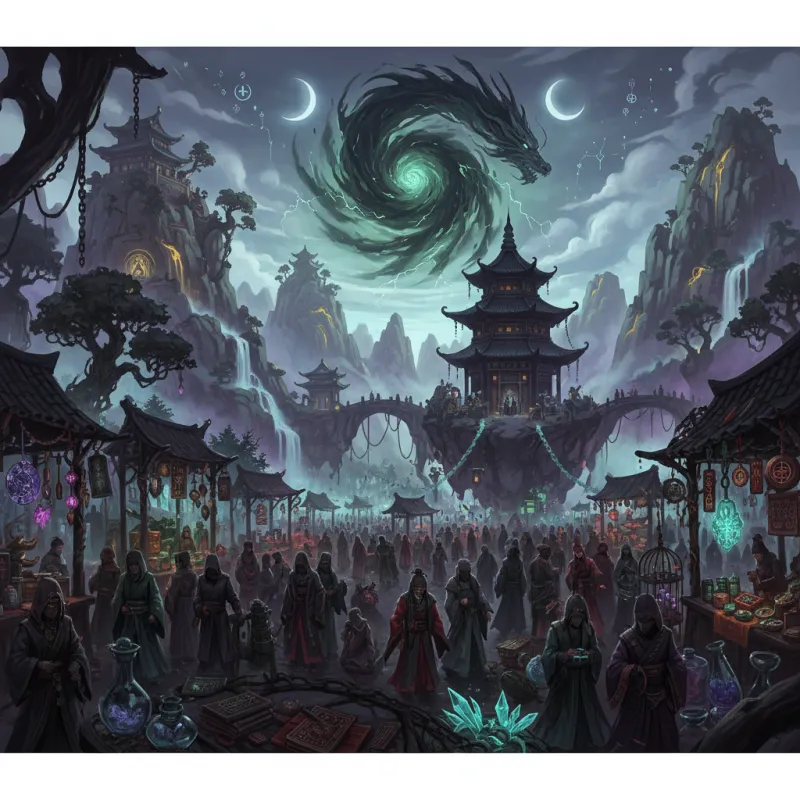
The old cultivator's stall smells like dried blood and regret. No sign advertises his wares—just a tattered cloth spread across cracked stone, displaying items that would get you executed in any righteous sect. A jade slip containing the Soul Devouring Scripture. Bone fragments from an ancient demon lord. Pills that glow with an unsettling purple light. Welcome to the black market (黑市 hēishì), where the cultivation world's dirty secrets are bought and sold like spiritual rice.
The Economics of Forbidden Power
The black market exists because cultivation society is fundamentally hypocritical. Righteous sects preach about proper dao and moral cultivation, but their disciples still need that edge in combat. That rare ingredient for a breakthrough pill. That technique their sect master refuses to teach them. The underground economy fills the gap between what cultivators are supposed to want and what they actually need to survive.
Unlike legitimate auction houses, black markets operate on different principles entirely. There's no spirit stone guarantee, no sect backing, no recourse if that "ancient immortal's legacy" turns out to be a clever forgery. Transactions happen fast, often in code, with both parties wearing concealment talismans or disguise artifacts. The currency isn't always spirit stones either—sometimes it's information, favors, or other forbidden goods in trade.
What makes this fascinating is how authors use black markets to show the real power structures in their worlds. In Renegade Immortal (仙逆 Xiān Nì), Wang Lin's early interactions with black market dealers reveal more about cultivation society's true nature than any sect elder's lecture. The underground economy doesn't care about your righteous credentials—only whether you can pay and whether you'll survive using what you bought.
What Actually Gets Sold in the Shadows
Demonic cultivation techniques (魔功 mógōng) top every black market's inventory. These are methods that righteous sects have banned, usually because they involve killing, soul manipulation, or drawing power from sources that corrupt the cultivator. The irony? Many of these techniques are simply more efficient than their "proper" counterparts. A demonic body refining method might require bathing in blood essence, but it can advance someone two minor realms in the time a righteous technique takes for one.
Then there are the pills and elixirs that no legitimate alchemist would touch. Human essence pills (人元丹 rényuán dān), refined from cultivators' life force. Soul condensing pills made from ghost cultivators. Berserker pills that boost your power temporarily but damage your foundation permanently. These aren't just shock value—they represent desperate choices. A rogue cultivator with no sect backing might need that forbidden pill to survive the next tribulation, consequences be damned.
Forbidden zone maps and ancient ruins information form another major category. Righteous sects hoard this knowledge, but black market information brokers trade in it constantly. That secret realm that opens once every century? Someone's selling the entry method. That demonic sect's hidden treasury? There's a map, though the last five buyers died trying to use it. The black market democratizes access to power, even if that access is usually fatal.
Stolen sect treasures, of course, make regular appearances. When a disciple goes rogue or a sect gets destroyed, their artifacts end up in underground markets. A Heaven-rank sword from the Azure Cloud Sect. Formation flags from the extinct Thousand Poison Valley. These items carry history and danger in equal measure—using them marks you as either very brave or very stupid.
The Geography of Underground Commerce
Black markets aren't random. They cluster in specific locations that authors use to build atmosphere and tension. Border cities between righteous and demonic territories are classic spots—places where neither side has complete control and both sides' cultivators mingle uneasily. I Shall Seal the Heavens (我欲封天 Wǒ Yù Fēng Tiān) does this brilliantly with its various border markets, where Meng Hao learns that survival matters more than sect politics.
Ruins of destroyed sects become natural black market locations. The old formations still provide some protection, the lingering spiritual energy attracts cultivators, and the tragic history keeps righteous sects from claiming the territory. There's poetic justice in forbidden goods being traded where a once-mighty sect fell—usually because they were too rigid in their righteousness.
Some black markets exist in pocket dimensions or hidden spaces, accessible only through specific methods or tokens. These are the high-end markets where truly dangerous items change hands. We're talking immortal-grade artifacts, complete inheritance caves, or techniques that could restart ancient wars. The entry requirements alone—usually a recommendation from an existing member plus proof you can actually afford to shop there—keep out casual browsers.
Mobile markets appear in some novels, moving between locations on a schedule known only to regular customers. This adds an element of urgency and scarcity. Miss the market's three-day window in your city, and you'll wait months for another chance. Martial World (武极天下 Wǔjí Tiānxià) uses this concept effectively, with underground auctions that appear and vanish like ghosts.
The Players: Who Runs the Underground
Black market merchants are their own breed of cultivator. They're usually mid-level in power—strong enough to defend their goods but not so powerful they attract unwanted attention from major sects. Many are former sect disciples who left (or were expelled) and found that their knowledge of rare items and cultivation resources translated well to underground commerce.
Information brokers occupy a special niche. They don't sell physical goods but knowledge: which sect is planning a raid, which forbidden zone's restrictions are weakening, which young master just broke through and will be hunting for resources. In Reverend Insanity (蛊真人 Gǔ Zhēnrén), information trading is elevated to an art form, with entire networks dedicated to gathering and selling secrets.
Rogue cultivators form the bulk of black market customers. Without sect backing, they need every advantage they can get, and they're less concerned about the moral implications of their purchases. They're also more willing to take risks—that suspicious pill might kill them, but staying weak definitely will.
Surprisingly, sect disciples are regular customers too, though they're careful to hide their identities. A core disciple might need a specific ingredient for a personal project their sect won't support. An elder might be researching forbidden techniques "to better defend against them." The hypocrisy is thick enough to cut with a spiritual sword.
Risk, Reputation, and the Rules That Aren't Rules
Black markets operate on unwritten codes that are somehow more binding than sect laws. Break your word in an underground deal, and you'll find yourself blacklisted from every shadow market in the region. Betray a seller's identity, and you might wake up with a curse mark slowly draining your cultivation. The lack of official structure doesn't mean there's no order—it just means the enforcement is more creative and permanent.
Reputation matters intensely in these spaces. A merchant known for quality goods can charge premium prices. A buyer who pays fairly and doesn't cause trouble gets access to better items and advance notice of rare opportunities. This creates a strange honor among thieves dynamic that many novels explore. The black market might deal in forbidden goods, but it has standards.
The risk of raids adds constant tension. Righteous sects periodically crack down on black markets, usually when they need to look virtuous or when something particularly dangerous gets sold. These raids are spectacular set pieces in novels—formations activating, cultivators scattering, desperate fights as merchants try to protect their inventory. Smart operators have escape routes planned, but there's always someone too slow or too greedy.
Curses and tracking methods are real concerns. That ancient artifact might have a sect's tracking formation embedded in it. That technique manual could contain a soul mark that alerts its original owner when someone reads it. Savvy black market shoppers bring appraisal experts or use detection talismans, but there's always risk. The best novels use this to create paranoia and difficult choices—do you risk the potentially cursed item because you desperately need its power?
Why Black Markets Make Stories Better
From a narrative perspective, black markets are gold. They're morally gray spaces where protagonists can make questionable choices without becoming outright villains. Your hero needs power to save someone? The black market offers it, but at a cost that might compromise their principles. This creates internal conflict and character development that pure righteous or demonic paths can't match.
Black markets also serve as great equalizers in stories. A low-level protagonist can potentially access high-level resources if they're clever, lucky, or desperate enough. This breaks the rigid hierarchy of sect-based cultivation societies and creates underdog opportunities. Wang Lin's rise in Renegade Immortal is partly enabled by his willingness to use black market resources that righteous cultivators wouldn't touch.
The underground economy reveals world-building depth. A well-developed black market shows that the author has thought about how their cultivation society actually functions, not just the idealized version sects present. It demonstrates that power structures have cracks, that rules create their own violations, and that human (or cultivator) nature finds ways around restrictions.
The Moral Complexity Nobody Talks About
Here's what makes black markets genuinely interesting: they force readers to question the righteousness of righteous cultivation. If a technique is banned because it's "evil," but it's just more efficient than approved methods, who's really in the wrong? If a sect hoards life-saving resources while rogue cultivators die, is the black market that redistributes those resources actually immoral?
The best xianxia novels use black markets to explore these questions without preaching. They show cultivators making hard choices in gray situations. That soul-refined pill might be made through terrible means, but if it's the only thing that can cure your master's poison, what do you do? The black market doesn't judge—it just offers options and lets cultivators live with their choices.
This moral ambiguity extends to the merchants themselves. Many aren't evil—they're pragmatists operating in a world where the powerful make rules that benefit themselves. A black market dealer selling forbidden techniques might see themselves as democratizing access to power, breaking the sects' monopoly on advancement. Are they wrong?
The underground economy in cultivation fiction ultimately reflects a truth about power: those who have it will always try to control who else can get it, and those without it will always find ways around those controls. The black market is where that eternal struggle plays out, one forbidden transaction at a time. It's messy, dangerous, and morally complicated—which is exactly why it makes for compelling storytelling.
Related Reading
- Auction House Economics: How Cultivation Markets Shape Power Dynamics
- Auction Houses in Cultivation Fiction: Where Power Is Bought and Sold
- Merchant Guilds and Trade Routes in Cultivation Worlds
- Unraveling the Mysteries of Chinese Cultivation and Xianxia Fiction
- Cultivation Techniques: The Methods of Becoming Immortal
- Weapon Spirits: When Your Sword Has Opinions