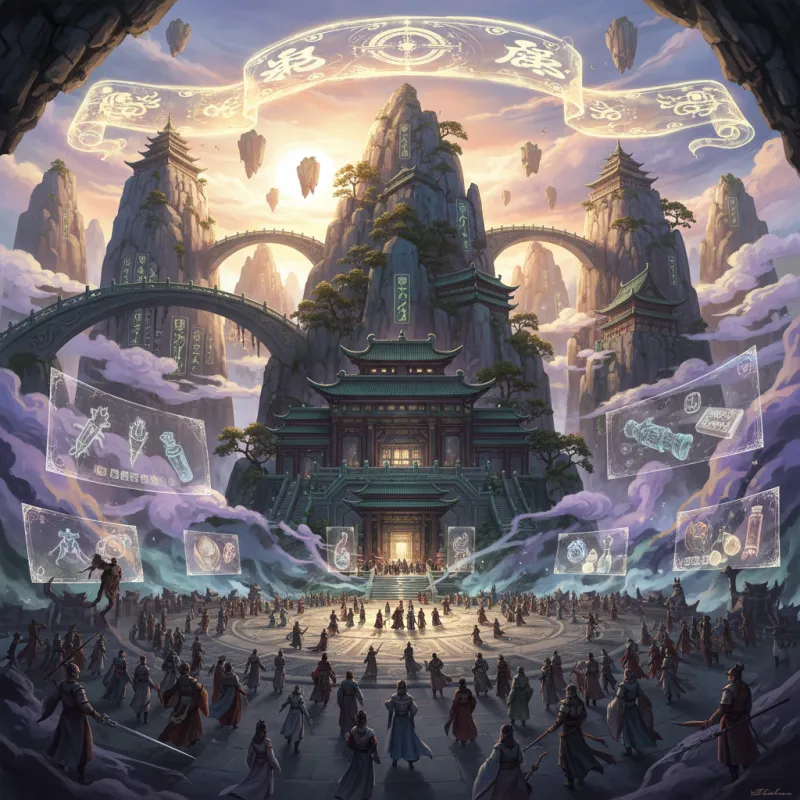
The auctioneer's gavel strikes three times, and the entire hall falls silent. A jade box floats onto the stage, sealed with formation arrays that shimmer like trapped starlight. "Foundation Establishment cultivators, please control your spiritual sense," the auctioneer warns with a knowing smile. "This item has caused three sect wars in the past millennium." Every reader knows what comes next—the protagonist is about to bankrupt themselves for something they absolutely need, and it's going to be glorious.
Why Auction Arcs Hit Different
Cultivation novels (修仙小说 xiūxiān xiǎoshuō) love their auction scenes, and for good reason. These chapters deliver concentrated drama: you've got wealth displays, face-slapping, mysterious identities, and the delicious tension of watching someone bet everything on a single item. The auction house is where the protagonist's plot armor becomes most visible—they always have just enough spirit stones (灵石 língshí), or they know someone who does, or the item they casually brought to sell turns out to be worth a fortune.
But here's what makes these scenes actually work: they're economic warfare dressed up as polite bidding. When a young master from the Heavenly Sword Sect raises the bid by ten thousand spirit stones, he's not just buying a treasure—he's making a statement about his sect's wealth and his willingness to crush anyone who challenges him. The protagonist's counter-bid isn't about money; it's about refusing to back down. Every price increase is a declaration of intent.
The best auction scenes understand this. In I Shall Seal the Heavens, Meng Hao doesn't just outbid people—he psychologically destroys them by revealing he has more resources than their entire sect. The money is secondary to the humiliation.
The Architecture of Face and Fortune
Walk into any cultivation auction house and you'll see the same social hierarchy made physical. The main hall floor seats the common cultivators—Core Formation (金丹 jīndān) and below, mostly there to gawk and maybe bid on a few low-tier items. They're the audience, the chorus that gasps at every dramatic bid increase.
Then you've got the private rooms on the second and third floors. These jade-and-spirit-wood boxes are where the real players sit: Nascent Soul (元婴 yuányīng) elders, sect masters, hidden experts who haven't shown their faces in centuries. The rooms are ranked by position and prestige. Ground floor? You're nobody. Second floor? You're somebody. Third floor? You're somebody people write legends about.
The room assignments alone can trigger conflicts. Imagine being a sect elder who's been given a second-floor room, only to see some unknown junior occupying a third-floor box. That's a face-slapping waiting to happen—either the junior is hiding their true cultivation, or they've got backing so powerful that the auction house itself is showing deference. Either way, drama is guaranteed.
Some novels add a fourth floor or even a fifth for transcendent powers, but that's usually overkill. Three floors is the sweet spot: commoners, nobles, and gods. Clean hierarchy, maximum tension.
The Items That Break Banks and Sects
Auction houses in cultivation fiction operate on a predictable rhythm. The first items are warm-ups: decent pills, acceptable weapons, useful but not essential treasures. These establish the baseline—this is what normal cultivators can afford, this is what the economy looks like for regular people.
Then the mid-tier items arrive, and this is where the protagonist usually starts paying attention. A cultivation technique (功法 gōngfǎ) that complements their path. A rare medicinal ingredient they need for breakthrough alchemy. A defensive talisman that could save their life in the upcoming tournament arc. The bids get serious here, and you start seeing the second-floor rooms light up with spiritual sense as the real cultivators assess the goods.
But everyone's waiting for the finale items—the legendary treasures that appear once every hundred auctions. Ancient weapons with weapon spirits. Pills that can extend lifespan by centuries. Fragments of immortal techniques. Spatial rings that contain entire pocket dimensions. These are the items that make sects go to war, that cause "accidents" in dark alleys after the auction ends, that justify the protagonist revealing they've been hiding their true wealth all along.
The smart novels don't just list items—they make each treasure tell a story. That sword? It belonged to a Sword Immortal who fell during the ancient demon war. That pill? The last one ever refined by the Pill Saint before his ascension. The history makes the bidding war personal. You're not just buying power; you're buying legacy.
The Economics of Spirit Stones and Desperation
Here's where cultivation novels get surprisingly sophisticated: the currency systems. Low-grade spirit stones (下品灵石 xiàpǐn língshí) for common items, mid-grade for serious purchases, high-grade for legendary treasures. Some auctions accept contribution points, rare materials, or even barter deals for the truly exceptional items. The exchange rates vary by novel, but the principle stays consistent—there's always a currency tier the protagonist barely has access to, and they're always bidding at the absolute limit of their resources.
The tension comes from watching someone gamble everything. The protagonist has fifty thousand spirit stones saved up from months of dangerous missions. The item they need starts at forty thousand. They're confident—until a second-floor room casually bids sixty thousand like it's pocket change. Now what? Do they reveal they have more resources? Do they try to negotiate a payment plan? Do they cause a scene and hope their mysterious backing scares people off?
The best auction arcs make the protagonist earn their victory. In Renegade Immortal, Wang Lin doesn't just outbid people with money—he offers items so rare that the auction house itself gets involved in the negotiation. He turns the auction into a trade deal, using his knowledge and resources creatively instead of just having infinite wealth. That's the difference between a satisfying auction scene and a boring one.
Face-Slapping: The True Currency
Let's be honest about what auction scenes really deliver: concentrated, premium-grade face-slapping (打脸 dǎliǎn). The young master who mocked the protagonist earlier? He's about to discover that the "poor junior" he insulted has more spirit stones than his entire clan. The arrogant elder who tried to steal the protagonist's seat? Watch him realize he's bidding against someone with backing from a transcendent sect.
The formula is simple but effective: establish the antagonist's arrogance, let them bid confidently, then have the protagonist casually double their offer. The antagonist's face turns red. They bid higher, voice shaking with rage. The protagonist counters without even looking up, maybe while eating spirit fruits. The antagonist finally realizes they're outmatched and sits down in humiliation while everyone in the hall whispers about their loss of face.
Some novels elevate this into an art form. The protagonist doesn't just outbid—they do it in ways that maximize humiliation. They reveal the antagonist's sect is actually poor. They point out the antagonist is bidding with borrowed money. They casually mention they're only bidding this high because they're bored and the item isn't even that useful to them. It's psychological warfare with spirit stones as ammunition.
The key is making the face-slapping feel earned. If the antagonist was genuinely cruel or dangerous, their humiliation is satisfying. If they were just mildly annoying, it feels like overkill. The best novels calibrate the punishment to match the crime.
When Auctions Go Wrong (And They Always Do)
No cultivation auction ends peacefully. The protagonist wins their item, and then one of three things happens:
Ambush in the alley — The losing bidders decide to just kill the protagonist and take the item. This usually backfires spectacularly when they discover the protagonist is either stronger than expected or has terrifying backup. The auction house may or may not intervene, depending on whether the attackers are important customers.
The item is fake or cursed — Plot twist: that legendary treasure has a weapon spirit that tries to possess the protagonist, or it's a elaborate trap set by an enemy, or it's actually a sealed demon that's been waiting centuries for someone stupid enough to buy it. This is rarer but makes for interesting complications.
Political fallout — The protagonist just outbid a major sect's young master, and now that sect wants revenge. Or the item they bought was actually bait to identify someone with specific knowledge or resources. Or they've attracted the attention of hidden powers who now want to "recruit" them (which is cultivation-speak for "control or eliminate").
The smart protagonists plan for this. They arrange escape routes, hide their true identity, or have powerful allies waiting outside. The reckless ones just fight their way out and hope their plot armor holds. Either way, the auction's aftermath often generates more chapters than the auction itself.
Some novels subvert this by having the auction house itself be the real power player. In A Record of a Mortal's Journey to Immortality, the auction houses are backed by forces so powerful that causing trouble on their premises is suicide. The drama shifts from physical conflict to political maneuvering and careful negotiation. It's a more mature take on the trope, though admittedly less immediately satisfying than watching the protagonist punch their way through an ambush.
The Meta-Game: Why We Keep Reading These Scenes
Here's the thing about cultivation auction arcs—we've all read dozens of them, we know exactly how they'll play out, and we still get excited every time. Why? Because they're pure wish fulfillment distilled into narrative form.
The auction house is where the protagonist's growth becomes undeniable. They're not just stronger than before; they're wealthy enough to compete with sects and clans. They're not just surviving; they're thriving. Every bid they make is proof they've moved up in the world. When they casually spend a hundred thousand spirit stones on a single pill, it's a flex that says "remember when I was a poor outer sect disciple? Look at me now."
It's also one of the few places where the protagonist can show off without seeming arrogant. They're not bragging—they're just bidding on items they need. If other people feel humiliated by their wealth, well, that's not the protagonist's fault. The auction house provides plausible deniability for what is essentially a wealth-measuring contest.
And let's not forget the treasure itself. Auction items are always perfectly suited to the protagonist's needs. They need a fire-attribute technique? The auction has a legendary flame manual. They need to break through to Nascent Soul? Here's a pill that does exactly that. The convenience is absurd, but that's part of the appeal. The auction house is where the universe conspires to give the protagonist exactly what they need, as long as they're willing to pay for it.
The best novels acknowledge this meta-awareness. They'll have characters comment on the absurd coincidence, or the protagonist will note how suspiciously convenient the timing is. That self-awareness doesn't break the immersion—it enhances it, because it shows the author knows what they're doing. They're not accidentally writing a wish-fulfillment scene; they're deliberately crafting one, and they're inviting you to enjoy it with full awareness of what it is.
The Auction House as Social Mirror
Beyond the entertainment value, auction houses serve a crucial worldbuilding function: they show how cultivation society actually works. The sect hierarchies and realm systems tell you the theory, but the auction house shows you the practice.
Watch who bids on what, and you learn about sect priorities. The Sword Sect bids aggressively on weapon refinement materials but ignores alchemy ingredients. The Pill Pavilion does the opposite. The demonic cultivators bid on blood-attribute treasures and life-extension pills, revealing their path's costs. The righteous sects bid on purification treasures and merit law manuals, showing their values.
The auction house also reveals the hidden economy. Where do all these treasures come from? Who's selling them? The answers often point to secret realms, ancient ruins, and the dangerous work of treasure hunters who risk their lives for items they can't even use. The auction house is where that shadow economy surfaces into legitimacy.
And then there's the social dynamics. Who sits where, who bids against whom, who backs down and who fights—these interactions map the real power structure of the cultivation world. Official sect rankings might say one thing, but auction house behavior reveals the truth. If the "weaker" sect consistently outbids the "stronger" one, maybe those rankings are outdated.
The protagonist's journey through auction houses often mirrors their rise in status. First auction: they're in the main hall, watching others bid. Second auction: they've got a second-floor room and can participate. Third auction: they're in a third-floor room, and people are wondering who they are. Final auction: they're the mysterious bidder everyone fears, the one who can casually outbid sect masters. It's a progression that makes their growth tangible in a way that cultivation realm increases sometimes don't.
Related Reading
- The Black Market: Forbidden Goods in the Cultivation World
- Auction House Economics: How Cultivation Markets Shape Power Dynamics
- Merchant Guilds and Trade Routes in Cultivation Worlds
- Auction Houses in Cultivation Fiction: Where Power Is Bought and Sold
- The Enigmatic Beasts of Chinese Cultivation Fiction: A Journey Through the Spiritual Realms
- Flying Swords: The Cultivator's Signature Weapon
- The Essence of Immortality: Understanding Chinese Cultivation and Xianxia Fiction