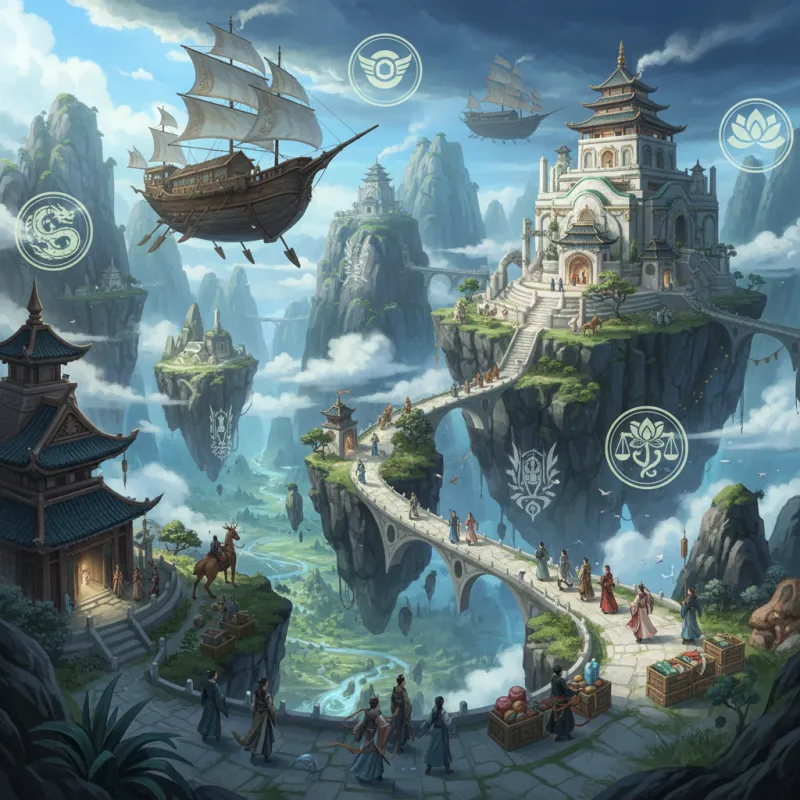
A single caravan of the Treasure Pavilion (宝阁 Bǎo Gé) carries more power than most Golden Core cultivators will ever wield. Not the flashy, mountain-splitting kind of power — the quiet, world-shaping kind. When that caravan doesn't arrive, sects run out of spirit stones. Alchemists can't refine pills. Weapon forges go cold. The entire cultivation ecosystem grinds to a halt, and suddenly everyone remembers that the merchants they've been looking down on for centuries are the ones who actually run the world.
The Economics of Immortality
Merchant guilds in cultivation worlds operate on a principle that would make any MBA student weep with joy: they've created artificial scarcity in a market where the customers literally cannot afford to shop elsewhere. The Myriad Treasure Pavilion (万宝阁 Wànbǎo Gé) in I Shall Seal the Heavens perfected this model — they don't just sell cultivation resources, they control the entire distribution network across multiple continents. When Meng Hao eventually tangles with them, he discovers they've been manipulating spirit stone prices for millennia, creating boom-and-bust cycles that keep sects perpetually dependent.
The genius of these organizations lies in their understanding of cultivator psychology. A Foundation Establishment cultivator who needs a breakthrough pill doesn't haggle. They pay whatever price is asked, because the alternative is watching their juniors surpass them or dying when their lifespan runs out. The merchant guilds know this desperation intimately, and they've built entire economic empires on it. They're not just middlemen — they're the invisible hand that shapes cultivation society, deciding which sects rise and which fall based purely on resource allocation.
What makes this even more fascinating is how merchant guilds maintain neutrality while wielding such influence. The Treasure Pavilion doesn't care if you're a righteous sect or a demonic cult. Your spirit stones spend the same either way. This calculated indifference drives righteous cultivators absolutely insane, but it's also what keeps the guilds alive. When you sell to everyone, no one can afford to destroy you without crippling themselves in the process.
Trade Routes as Lifelines
The great trade routes in cultivation worlds aren't just roads — they're arteries pumping lifeblood through the body of civilization. The Heavenly Star Trade Route (天星商路 Tiānxīng Shānglù) that appears in multiple Er Gen novels spans tens of thousands of miles, connecting dozens of cultivation regions. Control a segment of this route, and you control the flow of wealth itself. Lose access to it, and your sect might as well start planning its funeral.
These routes follow patterns that make perfect sense once you understand cultivation geography. They connect spirit stone mines to refinement centers, link alchemy ingredient sources to major markets, and create networks that allow rare treasures to flow from remote danger zones to the auction houses where they'll fetch astronomical prices. The routes themselves become valuable real estate — sects pay protection fees to merchant guilds just to ensure caravans keep flowing through their territory.
But here's where it gets interesting: the routes aren't static. When a new secret realm opens or an ancient ruin is discovered, trade routes shift almost overnight. Merchant guilds employ specialized scouts — often failed cultivators who couldn't break through to higher realms — to map these changes. These scouts risk their lives exploring unstable spatial rifts and monster-infested territories, all so the guilds can be first to establish new routes and monopolize emerging markets. In A Record of a Mortal's Journey to Immortality, Han Li encounters several such scouts, and their knowledge of hidden paths proves more valuable than most cultivation techniques.
The protection of these routes requires its own ecosystem. Merchant guilds maintain private armies of cultivators, usually those who've hit bottlenecks and need steady income. These guards aren't as powerful as sect elites, but they're professional, disciplined, and most importantly, loyal to whoever pays them. A caravan guard captain at the Foundation Establishment stage might earn more in a decade than a sect elder at the same realm, simply because the guilds can afford to pay for reliability.
The Guild Hierarchy Nobody Talks About
Every merchant guild presents itself as a meritocracy where anyone can rise through hard work and shrewd dealing. This is, to put it mildly, complete nonsense. The real power structure of organizations like the Myriad Treasure Pavilion resembles a cultivation sect more than a business — ancient ancestors in seclusion, hereditary positions, and secret techniques passed down through bloodlines.
The difference is that merchant guilds hide their hierarchy behind a facade of commercial openness. The "guild master" you meet at a branch location is usually a mid-level manager with limited authority. Real decisions get made by the Council of Elders (长老会 Zhǎnglǎo Huì), typically Nascent Soul or higher cultivators who've spent centuries building commercial empires. These elders rarely show themselves, operating through proxies and intermediaries, because the moment people realize how powerful they are, the guilds lose their carefully cultivated image of neutral service providers.
In Renegade Immortal, Wang Lin discovers that the Heavenly Treasure Trading Company (天宝商行 Tiānbǎo Shāngháng) is actually controlled by a single Spirit Severing cultivator who's been alive for over ten thousand years. This ancestor doesn't cultivate through meditation or pill consumption — he advances by absorbing the karmic merit generated by facilitating millions of transactions. It's a cultivation path that most sects don't even acknowledge exists, but it's devastatingly effective. Every trade, every deal, every exchange of goods generates tiny threads of karmic energy that flow back to him.
The guild hierarchy also includes specialists that most cultivators never encounter. Formation masters who design spatial storage arrays. Appraisers who can identify a treasure's origin and value with a single glance. Negotiators trained in reading micro-expressions and detecting lies. These aren't combat cultivators — they're support specialists who've honed their skills to supernatural levels. An appraiser at the Core Formation stage might seem weak compared to a sword cultivator at the same realm, but put them in front of a pile of mysterious artifacts, and they're worth their weight in spirit stones.
Information as Currency
Here's something most cultivation novels gloss over: merchant guilds don't just trade goods, they trade information. And in a world where knowing about a secret realm opening three months early can mean the difference between a sect's rise and fall, information might be the most valuable commodity of all.
The intelligence networks maintained by major guilds make most sect spy operations look like amateur hour. They have informants in every major city, scouts in every danger zone, and contacts in every significant organization. When a new heaven-defying treasure appears, the guilds usually know about it before the person who found it has finished celebrating. This information gets packaged, priced, and sold to the highest bidder — or sometimes withheld entirely if selling it would destabilize markets the guild profits from.
In Forty Millenniums of Cultivation, the Crystal Processors Guild (晶脑公会 Jīngnǎo Gōnghuì) maintains a database of cultivation resources, treasure locations, and market prices that's updated in real-time across an entire star sector. This isn't just record-keeping — it's a strategic asset that allows them to predict market movements, manipulate prices, and ensure they're always positioned to profit from any major event. The guild's information brokers are cultivators who've specialized in memory techniques and data analysis, turning raw intelligence into actionable insights.
The really sophisticated guilds go further: they don't just collect information, they shape it. Rumors about a spirit stone mine running dry can crash prices, allowing the guild to buy up cheap inventory before revealing the mine is actually fine. Whispers about a new alchemy technique can create artificial demand for specific ingredients the guild happens to have stockpiled. This kind of market manipulation would be illegal in any modern economy, but in cultivation worlds where might makes right, it's just considered good business.
When Merchants Go to War
The popular image of merchant guilds as peaceful, neutral organizations falls apart the moment their interests are seriously threatened. These organizations didn't survive for millennia by being pushovers — they survived by being absolutely ruthless when necessary, just in ways that don't look like traditional warfare.
Economic warfare is the guild's preferred weapon. When the Profound Sky Sect in Against the Gods tried to establish their own trading network to bypass guild fees, the Blackwood Trading Company (黑木商会 Hēimù Shānghuì) didn't send assassins or declare open conflict. They simply stopped selling to anyone who did business with the sect. Within six months, the Profound Sky Sect's allies were abandoning them, their disciples couldn't buy basic cultivation resources, and their grand plan collapsed without a single sword being drawn.
But when economic pressure isn't enough, guilds have other options. Most maintain relationships with mercenary cultivator groups — not officially, of course, but through layers of intermediaries that provide plausible deniability. These mercenaries handle the dirty work: eliminating competitors, recovering stolen goods, and sending messages to those who think merchant guilds are soft targets. The key difference between guild violence and sect violence is that guild violence looks like accidents, robberies gone wrong, or unfortunate encounters with spirit beasts.
The most terrifying aspect of merchant guild warfare is their patience. Sects think in terms of generations. Guilds think in terms of centuries. They'll take a loss for decades if it means positioning themselves for a bigger win down the line. They'll support a weak sect against a strong one, not out of righteousness, but because they've calculated that a balanced power structure is better for business than a single dominant force. This long-term strategic thinking makes them far more dangerous than most cultivators realize.
The Cultivation Path Nobody Chooses
Here's an uncomfortable truth that most xianxia novels avoid: the merchant path might actually be more reliable than traditional cultivation. A talented sword cultivator has maybe a one-in-ten-thousand chance of reaching Nascent Soul. A shrewd merchant with decent cultivation talent and good business sense? Their odds are significantly better, because they're not relying purely on personal power — they're building systems that generate resources and opportunities.
The Wealth Accumulation Scripture (聚财经 Jùcái Jīng) mentioned in several novels isn't just a cultivation technique — it's a complete philosophy that treats commerce as cultivation. Practitioners advance by building successful businesses, creating value, and facilitating exchanges. Each successful transaction generates a tiny amount of merit energy that feeds their cultivation. It's slow compared to swallowing pills or absorbing spirit stones, but it's steady, reliable, and doesn't require risking your life in ancient ruins or secret realms.
Yet almost no protagonist ever chooses this path. Why? Because it's boring. It doesn't involve face-slapping young masters or collecting jade beauties. It requires patience, planning, and the ability to smile at people you'd rather punch. The merchant path is cultivation for adults who've realized that sustainable growth beats explosive advancement followed by explosive death.
The few protagonists who do engage seriously with commerce — like Meng Hao in I Shall Seal the Heavens during his time with the Fang Clan — discover that business acumen is its own form of power. When Meng Hao manipulates the entire cultivation world's economy to fund his breakthrough to Immortal Realm, he's not using sword techniques or divine abilities. He's using supply and demand, market psychology, and strategic resource allocation. It's arguably more impressive than any of his combat achievements, but it gets a fraction of the attention because readers want to see explosions, not spreadsheets.
The Future of Cultivation Commerce
As cultivation worlds advance and connect with each other — through spatial rifts, teleportation formations, or in some novels, literal space travel — merchant guilds are evolving faster than sects. They're the first to establish cross-realm trade, the first to figure out currency exchange between different cultivation systems, and the first to realize that a multiverse of cultivation worlds means infinite market expansion.
The treasure pavilions that once served single continents now operate across multiple realms. The trade routes that connected cities now connect planets. And the merchant guilds that adapted to this new reality are becoming powers that rival ancient sects in influence, if not in raw combat strength. They're proving what they've always known: in the long run, controlling the economy is more powerful than controlling the sword.
The smart cultivators are paying attention. The ones who realize that the future belongs not to the strongest fighter, but to whoever controls the flow of resources that makes fighting possible. The merchant guilds have been playing a different game all along, and they're winning.
Related Reading
- Auction House Economics: How Cultivation Markets Shape Power Dynamics
- Auction Houses in Cultivation Fiction: Where Fortunes Change Hands
- Auction Houses in Cultivation Fiction: Where Power Is Bought and Sold
- The Black Market: Forbidden Goods in the Cultivation World
- Beast Taming in Cultivation Fiction: Your Pet Dragon and You
- Spiritual Roots: The Innate Talent System of Cultivation
- Exploring the Intricate World of Chinese Cultivation and Xianxia Fiction