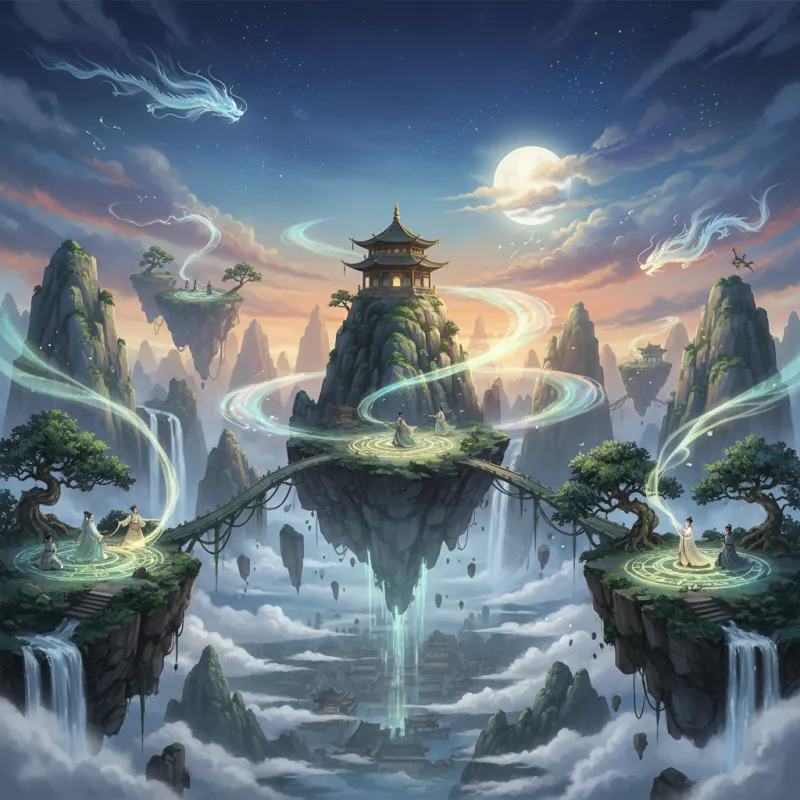
You're reading a cultivation novel. The protagonist just broke through to "Golden Core." You nod along, picturing... what, exactly? A shiny sphere? A literal core made of gold? Meanwhile, the Chinese reader sees "金丹" (jīndān) and instantly connects it to Daoist internal alchemy, the legendary elixir of immortality, and centuries of cultivation literature. You're reading the same story, but experiencing completely different narratives.
This is the glossary problem, and it's killing half the meaning in every cultivation novel that crosses the Pacific.
Why Direct Translation Fails
The term "筑基" (zhùjī) literally means "building foundation." Simple enough, right? Translators render it as "Foundation Establishment" and move on. But they've just stripped away everything that makes the term meaningful.
In Daoist cultivation theory, zhùjī refers to the process of constructing a stable base for your spiritual practice — not just getting stronger, but fundamentally restructuring your body's energy channels. It's the difference between lifting weights and rebuilding your skeleton. The Chinese reader knows this. The English reader thinks the protagonist just leveled up.
Or consider "渡劫" (dùjié) — commonly translated as "tribulation" or "heavenly tribulation." The English suggests a test or trial. The Chinese term literally means "crossing the tribulation," implying passage through something, survival of a cosmic judgment. When a cultivator faces their dùjié, they're not just being tested — they're defying the natural order, and heaven itself is trying to kill them for their presumption. That's a radically different narrative beat.
The problem compounds with every term. Cultivation realms aren't just power levels — they're philosophical stages. Spiritual roots aren't just talent meters — they're your fundamental compatibility with the Dao itself.
The Localization Trap
Some translators try to solve this by going full localization. They replace "金丹" with "Golden Core" and add a footnote explaining Daoist alchemy. They turn "元婴" into "Nascent Soul" and hope context does the rest.
This approach has produced some readable translations. It's also produced some spectacular failures.
Take "炼气" (liànqì) — literally "refining qi." Most translations render this as "Qi Condensation" or "Qi Refining." Both miss the point. The term comes from Daoist internal alchemy (内丹术, nèidān shù), where liàn means the same kind of refining you'd do to metal or medicine — heating, purifying, transforming. A cultivator at the Qi Refining stage isn't just gathering energy. They're literally cooking their qi like an alchemist refines cinnabar, burning away impurities to create something purer.
The English reader sees "Qi Condensation" and thinks: "Oh, they're compressing energy." Close, but fundamentally wrong.
The Untranslatable Core
Some terms simply cannot be translated without losing essential meaning. "道" (dào) is the classic example — usually left as "Dao" because "the Way" sounds like a street name and "the Path" sounds like a self-help book.
But the real untranslatables are the mid-tier terms that translators think they can handle.
"神识" (shénshí) gets translated as "divine sense" or "spiritual sense." Both are technically correct. Both are completely inadequate. Shénshí isn't just supernatural perception — it's the consciousness of your spirit (神, shén) manifested as a sensory organ. It's what remains when your body dies. It's how you'll perceive reality after you transcend mortality. Calling it "divine sense" is like calling your brain "the thinking meat."
"法宝" (fǎbǎo) becomes "magic treasure" or "dharma treasure." The English reader pictures a glowing sword. The Chinese reader understands: this is a treasure refined according to the laws (法, fǎ) of heaven and earth, imbued with the cultivator's understanding of the Dao, capable of growth and transformation. It's not a magic item. It's a crystallized philosophy given form.
The Genre Knowledge Gap
Here's where it gets worse: cultivation fiction assumes genre literacy. Chinese readers have absorbed these concepts through decades of wuxia and xianxia novels, TV shows, and games. They know the tropes. They understand the implications.
When a Chinese novel mentions that someone has "五灵根" (wǔ língēn) — five spiritual roots — the Chinese reader immediately knows: this person is trash. Having all five elemental roots means your talent is spread too thin. You'll never achieve greatness. It's a one-sentence character assassination.
The English translation says "five spiritual roots" and the Western reader thinks: "Wow, five! That sounds impressive!" They're reading the opposite of what was written.
Or consider "散修" (sǎnxiū) — usually translated as "rogue cultivator" or "independent cultivator." Technically accurate. Completely missing the connotation. In Chinese cultivation fiction, sǎnxiū are the desperate poor, cultivators without sect backing, scraping by on the margins, likely to die young and unmourned. They're not cool lone wolves. They're the cultivation world's homeless population.
Translation Strategies That Actually Work
Some translators have found clever solutions. Deathblade, who translated "I Shall Seal the Heavens," leaves many terms in pinyin and provides a glossary. Readers learn "dantian" and "nascent soul" as vocabulary, the same way they'd learn terms in any specialized fiction.
This works because cultivation fiction is already a genre that requires learning new concepts. Science fiction readers learn "ansible" and "FTL drive." Fantasy readers learn "mithril" and "lich." Cultivation fiction readers can learn "金丹" and "元婴."
The key is consistency and context. When "Coiling Dragon" introduces "圣域" (shèngyù) as "Saint-level," it sticks with that translation throughout. Readers build associations. By book three, "Saint-level" carries weight and meaning, even if it's not a perfect translation of the original.
Some translators create hybrid terms. "Dao heart" for "道心" (dàoxīn) works better than "heart of the Way." "Soul formation" for "化神" (huàshén) captures more meaning than a literal "transforming spirit." These compromises sacrifice precision for comprehensibility — but they preserve more meaning than pure localization.
The Untranslated Future
The best solution might be no translation at all — at least for core terminology. Leave "金丹" as "jindan." Keep "元婴" as "yuanying." Let readers learn the vocabulary.
This is already happening in fan translation communities. Readers on forums casually discuss "nascent soul tribulations" and "jindan formation techniques," mixing English and pinyin naturally. They've created a hybrid language that preserves Chinese concepts while remaining accessible to English speakers.
Professional translations are slowly following suit. More novels are keeping terms like "dantian" and "qi" untranslated. Glossaries are becoming standard. Readers are adapting.
The glossary problem won't disappear — too much cultural context is embedded in these terms. But as cultivation fiction builds an English-speaking audience, that audience is learning to read between languages, picking up enough Chinese concepts to understand what "筑基" really means, even when it's translated as "Foundation Establishment."
We're not reading Chinese novels in English anymore. We're reading cultivation fiction in a new hybrid language, one that borrows from both traditions to create something that works for neither culture perfectly — but works for the genre itself.
And maybe that's the real solution: not translation, but evolution. Let the genre create its own vocabulary, its own conventions, its own way of bridging the gap between "元婴" and whatever English word we settle on this week. The glossary problem isn't a bug. It's the growing pains of a genre learning to speak two languages at once.
Related Reading
- Essential Cultivation Terms: The Complete Xianxia Glossary
- Xianxia vs. Wuxia vs. Xuanhuan: What's the Difference?
- Cultivation Glossary: 50 Terms Every Reader Needs to Know
- Cultivation Sects Explained: Schools, Clans, and Holy Lands
- Face-Slapping and Other Essential Xianxia Tropes
- The Essence of Immortality: Understanding Chinese Cultivation and Xianxia Fiction
- The Art of Pill Refinement: Alchemy in Cultivation Fiction
- Unraveling the Mysteries of Chinese Cultivation and Xianxia Fiction