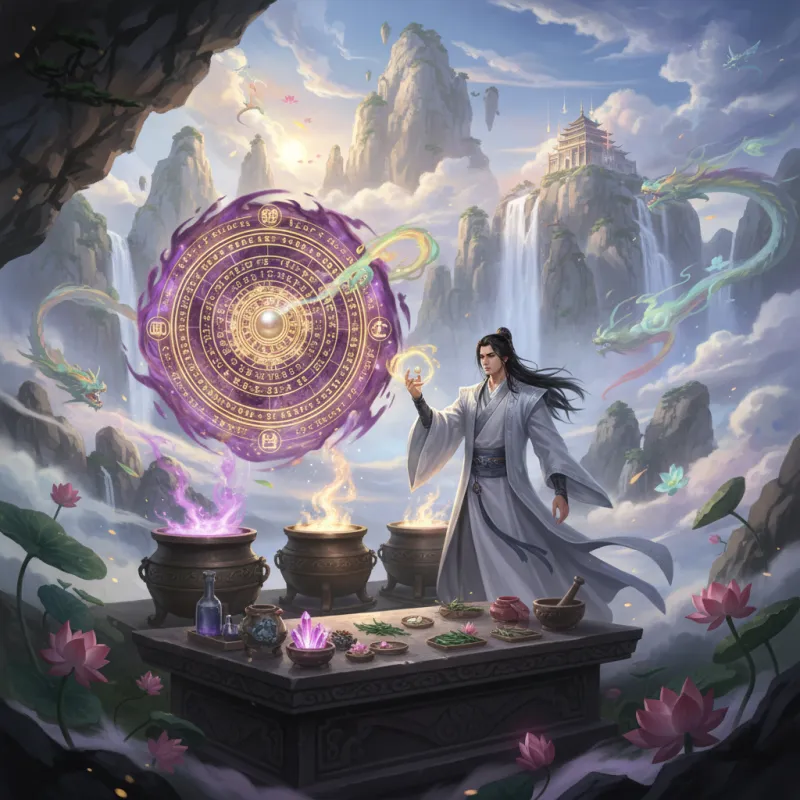
The cauldron explodes. Again. Purple smoke billows through the alchemy pavilion as another Foundation Establishment disciple watches three months of gathered spiritual herbs turn to ash. This scene plays out in nearly every cultivation novel, yet pill refinement (炼丹, liàn dān) remains one of the most coveted skills in the xianxia universe—because when it works, it literally rewrites the laws of heaven and earth.
Why Alchemists Rule the Cultivation World
Let's be blunt: in cultivation fiction, alchemists are walking banks. A single Nascent Soul Breaking Pill can sell for enough spirit stones to buy a small sect. The protagonist of Tales of Demons and Gods leverages his alchemy knowledge from his past life to become untouchable—not through combat prowess, but because every major power needs his pills. This isn't just plot convenience; it reflects a fundamental truth about xianxia economics. Combat cultivators risk their lives in secret realms and demonic beast territories. Alchemists sit in comfortable pavilions and charge whatever they want.
The power dynamic is simple: everyone needs pills, but less than one in ten thousand cultivators has the talent for alchemy. You need spiritual sense fine enough to detect temperature changes of a single degree, mental strength to control multiple processes simultaneously, and enough wealth to waste thousands of ingredients learning. Most cultivators would rather fight a Golden Core demon beast than attempt their first pill refinement.
The Three Pillars: Fire, Formula, and Fortune
Every alchemy manual in cultivation fiction emphasizes the same trinity. First comes the flame. Mortal fire won't cut it—you need spiritual flames that respond to your intent. In Battle Through the Heavens, Xiao Yan's entire power system revolves around collecting different Heavenly Flames (异火, yì huǒ), each with unique properties. The Bone Chilling Flame excels at preserving medicinal essence. The Fallen Heart Flame accelerates refinement time. The real treasure isn't the flame's raw power but its controllability.
The formula (丹方, dān fāng) is where things get interesting. Ancient alchemists didn't have periodic tables or chemical equations—they worked through trial, error, and occasionally divine inspiration. A typical pill formula reads like poetry: "Three parts Scarlet Cloud Grass gathered at dawn, two parts Millennium Ginseng root, one part Phoenix Blood Fruit picked under the full moon." The proportions matter, but so does the timing, the order of addition, and sometimes the alchemist's emotional state. In A Record of a Mortal's Journey to Immortality, Han Li discovers that certain pills require the refiner to maintain specific breathing patterns throughout the process.
Fortune (运气, yùn qì) is the pillar nobody wants to admit matters. You can have perfect technique and premium ingredients, but if your karma is off or the heavens are in a bad mood, your pill might develop pill toxins (丹毒, dān dú) or simply refuse to form. This isn't superstition in xianxia—it's mechanics. High-level pills attract tribulation lightning because they're "defying heaven's will." The universe literally tries to destroy pills that work too well.
Inside the Cauldron: What Actually Happens
Strip away the mysticism and pill refinement follows a logical sequence, even if that logic operates on spiritual rather than chemical principles. The alchemist begins by establishing a stable flame base—think of it as setting your oven to the right temperature, except your oven is a thousand-year-old bronze cauldron and your temperature control is pure willpower.
Ingredients enter in reverse order of their melting points. Tough materials like beast cores go in first, subjected to intense heat until their physical form breaks down and releases spiritual energy. Delicate herbs come last, added at precisely the moment when the mixture reaches optimal receptivity. Timing errors of even a few seconds can ruin everything.
The critical phase is fusion (融合, róng hé), where separate ingredients must merge into a unified whole. This is where most failures occur. Incompatible spiritual energies clash, creating instability. The alchemist must use their spiritual sense to guide the process, smoothing out conflicts and encouraging harmony. Advanced alchemists describe it as conducting an orchestra where every instrument is trying to play a different song.
If fusion succeeds, the mixture enters condensation (凝丹, níng dān). The liquid spiritual essence compresses into solid form, ideally creating a perfect sphere. Pill quality is often judged by the number of "pill lines" (丹纹, dān wén) that appear on the surface—natural patterns that indicate purity and potency. A pill with nine lines is legendary. Most alchemists celebrate getting three.
The Rank System: From Trash to Transcendent
Cultivation novels love their hierarchies, and pills are no exception. The standard ranking system mirrors cultivation realms: Mortal, Spirit, Earth, Heaven, and Divine grades, with each grade divided into low, middle, and high tiers. A low-grade Mortal pill might heal minor wounds. A high-grade Divine pill could resurrect the dead or grant instant enlightenment.
But here's what the rankings don't tell you: a perfectly refined low-grade pill often outperforms a mediocre high-grade one. Pill toxicity accumulates with consumption, and poorly made pills carry more toxins regardless of their theoretical rank. In Martial God Asura, Chu Feng's advantage comes not from accessing rare formulas but from his ability to produce toxin-free pills that others can consume safely in large quantities.
The ranking system also creates interesting market dynamics. High-grade pills are expensive but risky—one bad batch could cripple your cultivation. Low-grade pills are affordable and safe but require consuming dozens to see results. Mid-grade pills occupy the sweet spot for most cultivators, offering decent effects without breaking the bank or your meridians.
Famous Alchemists and Their Signature Pills
Every major xianxia novel features at least one legendary alchemist whose reputation precedes them. In Coiling Dragon, Grandmaster Pill Demon's Nine Revolutions Transcendental Pill can help Deity-level experts break through bottlenecks that have stumped them for millennia. The pill's formula requires 108 ingredients, takes three years to refine, and has a success rate below one percent even for master alchemists.
Then there's the Pill Emperor from Martial World, who famously created the Soul Returning Pill—a formula that violates the fundamental law that death is irreversible. The heavens sent down nine tribulation lightning bolts to destroy it. He refined nine pills simultaneously and used eight as lightning rods to protect the ninth. That's the kind of audacious thinking that separates legendary alchemists from merely skilled ones.
These stories illustrate an important point: the greatest alchemists aren't just technicians following recipes. They're innovators who understand principles deeply enough to break rules productively. They experiment with substitutions, modify ratios, and occasionally create entirely new formulas. This is why alchemy knowledge from past lives or ancient inheritances is so valuable—it's not just recipes but understanding.
The Dark Side: Pill Toxins and Dependency
Here's what cultivation novels often gloss over: pills are drugs, and drugs have side effects. Pill toxins accumulate in the body with every consumption, gradually clogging meridians and limiting future cultivation potential. Smart cultivators use pills sparingly, relying on natural cultivation for their foundation and saving pills for emergencies or breakthrough attempts.
But desperation makes people stupid. In Renegade Immortal, Wang Lin encounters countless cultivators who've destroyed their potential by over-relying on pills to force rapid advancement. They reach Golden Core in decades instead of centuries, then discover they can't progress further because their foundation is riddled with impurities. Some turn to increasingly toxic pills to break through, creating a vicious cycle that ends in cultivation deviation or death.
The best alchemists address this by developing detoxification pills (解毒丹, jiě dú dān) or creating refinement techniques that minimize toxin formation. But these solutions are expensive and time-consuming, putting them out of reach for most cultivators. The result is a two-tier system: wealthy cultivators with access to premium pills maintain clean foundations, while poorer cultivators gamble their futures on cheap, toxic alternatives.
Learning the Craft: Why Most Fail
Want to become an alchemist in a cultivation novel? First, test your spiritual sense. If you can't detect the difference between herbs gathered at dawn versus dusk, stop now. Second, find a teacher or inheritance—self-teaching alchemy is like learning surgery from YouTube videos. Third, prepare to burn through your life savings on ingredients you'll inevitably waste.
The failure rate for beginning alchemists hovers around ninety-five percent. Not ninety-five percent of pills fail—ninety-five percent of people who attempt alchemy give up before producing their first successful pill. The learning curve is brutal. You need theoretical knowledge (what ingredients do), practical skill (how to control fire), and something ineffable that novels call "alchemy affinity" but basically means talent.
Some protagonists cheat this system through past-life knowledge, ancient AI chips, or mysterious old grandfathers living in rings. Normal cultivators spend decades as apprentices, doing grunt work like ingredient preparation and furnace cleaning before they're allowed to touch actual refinement. The payoff is worth it—a competent alchemist lives comfortably anywhere in the cultivation world. But the barrier to entry keeps the profession exclusive.
Modern Innovations: Where Alchemy is Heading
Recent cultivation novels have started exploring interesting variations on traditional alchemy. World of Cultivation introduces formation-assisted refinement, where arrays handle temperature control and energy circulation, letting the alchemist focus on the creative aspects. Forty Millenniums of Cultivation goes full sci-fi, with computer-controlled furnaces and genetic engineering replacing spiritual herbs.
These innovations raise philosophical questions about what alchemy actually is. If a machine can refine pills perfectly every time, does the alchemist's role become obsolete? Or is there something irreplaceable about human intuition and spiritual connection to the process? Most novels come down on the side of human irreplaceability—machines can handle routine pills, but breakthrough innovations still require that spark of genius only cultivators possess.
The future of alchemy in cultivation fiction likely involves hybrid approaches: technology handling the tedious precision work while alchemists focus on formula development and high-level refinement. This mirrors real-world pharmaceutical development, where automation handles production but human expertise drives research. Even in fantasy worlds, some patterns remain universal.
Related Reading
- The Enchantment of Chinese Cultivation Fiction: Immortal Aspirations and Alchemical Journeys
- Alchemy in Cultivation Fiction: Why Pill-Making Is the Most Dangerous Profession
- Cauldron Explosions and Failed Pills: The Comedy and Tragedy of Alchemy
- The Alchemist's Arsenal: Cauldrons, Furnaces, and Essential Equipment
- Rune and Inscription Systems in Cultivation Fiction
- Discovering the Fascinating Artifacts of Chinese Cultivation and Xianxia Fiction
- Unraveling the Mysteries of Chinese Cultivation and Xianxia Fiction