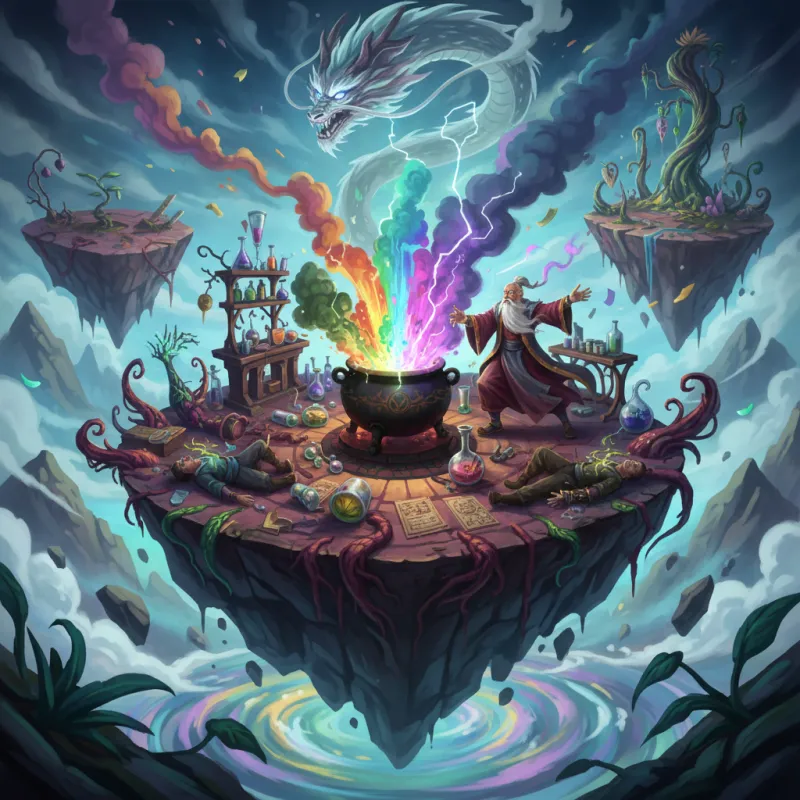
The explosion that killed Alchemist Feng wasn't particularly loud. Just a muffled whump from his workshop, followed by a spray of purple smoke through the windows and the acrid smell of burnt spiritual herbs mixed with something far worse—burnt flesh. His neighbors found him three hours later, his body fused to the remains of his pill furnace, still clutching a half-formed Heaven Mending Pill that had cost him everything. He was the third alchemist to die that month in Cloudpeak City alone. In cultivation fiction, alchemy (炼丹 liàndān, literally "refining pills") isn't just dangerous—it's a profession with a mortality rate that makes demon hunting look safe.
The Fundamental Problem: You're Playing With Spiritual Napalm
Western readers think "alchemy" and picture medieval Europeans puttering around with lead and mercury, trying to make gold. Chinese cultivation alchemy shares exactly one thing with its European counterpart: the name. Everything else is catastrophically different. European alchemy was proto-chemistry wrapped in mystical language. Cultivation alchemy is genuine supernatural science where your ingredients have wills of their own, your fuel source is cosmic fire that can burn souls, and a single miscalculation doesn't just ruin the batch—it can level city blocks.
The core process sounds deceptively simple: gather rare spiritual herbs, beast cores, and exotic materials. Process them in a spiritually charged cauldron (丹炉 dānlú) using controlled flames and precisely channeled spiritual energy. Produce pills that can heal mortal wounds, break through cultivation bottlenecks, or grant temporary godlike power. The reality is that you're essentially performing controlled nuclear reactions using your own life force as the containment field.
Consider the ingredients themselves. A thousand-year-old Crimson Flame Ginseng doesn't just sit there passively. It's absorbed a millennium of fire-attribute spiritual energy and developed a rudimentary consciousness. It resists being refined. The Dragon's Blood Grass actively tries to escape the cauldron. The Nine-Transformation Serpent Core contains the concentrated resentment of a Foundation Establishment realm beast that died violently. You're not mixing chemicals—you're forcing hostile spiritual entities into an arranged marriage while standing at ground zero.
The Three Ways Alchemy Kills You (And Why You Can't Avoid Any of Them)
Qi Deviation During Refinement: Every alchemist's nightmare. You're channeling your spiritual energy into the cauldron for hours, maintaining precise temperature control, managing ingredient fusion timing, and suppressing the natural conflicts between opposing elements. One moment of lost concentration—a stray thought, a muscle cramp, a sudden noise—and your qi flow stutters. The reaction inside the cauldron destabilizes. In the best case, the pills are ruined and you suffer minor internal injuries. In the worst case, the accumulated spiritual energy backlashes through your meridians, crippling your cultivation base or killing you outright.
The novels are full of these deaths, usually relegated to background flavor. In Coiling Dragon, the narrative casually mentions that the Yulan Continent loses dozens of alchemists monthly to refinement accidents. A Record of a Mortal's Journey to Immortality features an entire subplot where the protagonist Han Li investigates a sect's alchemy division after three alchemists die in two weeks—and discovers they were actually the lucky ones, dying quickly instead of lingering with shattered meridians.
Cauldron Explosions: The signature alchemist death. When incompatible ingredients react too violently, when the spiritual fire gets out of control, when you attempt a pill formula beyond your skill level—the cauldron becomes a bomb. Not a chemical explosion, but a spiritual one. The blast doesn't just destroy matter; it annihilates spiritual energy in the vicinity, which means it can permanently damage a cultivator's foundation or even destroy their soul.
High-level alchemists learn to recognize the warning signs: the cauldron's spiritual resonance shifting to a discordant frequency, the sudden smell of ozone, the way the flames start flickering in patterns that hurt to look at. They have maybe three seconds to either stabilize the reaction or abandon the cauldron and run. Most don't make it. The truly tragic cases are the alchemists who do stabilize it, only to have the cauldron explode during the final pill condensation stage when they've already invested days of continuous refinement and are too exhausted to react.
Slow Poisoning: The insidious killer that gets the careful ones. Every refinement session exposes you to trace amounts of spiritual toxins, medicinal vapors, and corrupted qi. Your body can handle small doses. But alchemists don't do small doses—they spend decades in workshops saturated with these substances. The toxins accumulate in your meridians, your organs, your bone marrow. By the time symptoms appear, it's often too late.
This is why cultivation novels frequently feature alchemists who look ancient despite being relatively young, or who have strange discolorations in their skin, or who cough up black blood during refinement sessions. In Martial World, the protagonist Lin Ming encounters a Pill Emperor who appears to be in his eighties but is actually only forty-seven—his body ravaged by decades of exposure to pill refinement byproducts. The man can create pills that extend others' lifespans by centuries, but he'll be lucky to see fifty.
Why Anyone Does This Job (The Economics of Suicide)
Given the horrific risks, why does anyone become an alchemist? Three reasons: desperation, greed, and the cultivation world's most vicious catch-22.
Desperation: Most cultivators hit bottlenecks. Your talent runs out, your cultivation method has limitations, or you simply lack the resources to advance. Pills can break through bottlenecks that would otherwise be permanent. But high-quality pills are ruinously expensive—a single Foundation Establishment Pill might cost more than a mortal family earns in ten generations. The only way most cultivators can afford the pills they need is to make them themselves. So they learn alchemy, knowing the risks, because the alternative is watching their cultivation stagnate while their enemies advance.
Greed: A skilled alchemist is worth their weight in spirit stones. A master alchemist is worth more than most sects' entire treasuries. If you can reliably produce high-grade pills, you have every major power in the cultivation world competing for your services. You can name your price, demand rare cultivation resources, gain access to secret techniques, and accumulate wealth that would take a combat cultivator centuries to earn. The temptation is overwhelming—especially for cultivators from poor backgrounds who see alchemy as their only path to the resources they need.
The Catch-22: Here's the cruel joke at the heart of cultivation alchemy. To safely refine high-level pills, you need a high cultivation base—the stronger your spiritual energy, the better you can control the refinement process and resist backlash. But to advance your cultivation, you need pills. To afford pills, you need to be an alchemist. To be a safe alchemist, you need high cultivation. The circle is vicious and inescapable.
This is why so many alchemists die in the Foundation Establishment and Core Formation realms. They're strong enough to attempt intermediate-level pills but not strong enough to handle the failures safely. They're trapped in the gap between ambition and capability, and the only way forward is to keep refining increasingly dangerous pills until either their cultivation advances or they die trying.
The Social Dynamics: Why Other Cultivators Treat Alchemists Like Ticking Time Bombs
In cultivation fiction, alchemists occupy a strange social position. They're simultaneously revered and feared, protected and isolated. Visit any major sect and you'll find the alchemy division located in a separate compound, far from other facilities, surrounded by defensive formations. This isn't to protect the alchemists—it's to protect everyone else from the alchemists.
The smart sects enforce strict regulations. Alchemists must register their refinement schedules. High-risk pill attempts require supervision and evacuation of nearby areas. Some sects mandate that alchemists above a certain level can only refine pills in specially constructed underground chambers designed to contain explosions. The really paranoid sects—usually those that have lost important facilities to alchemy accidents—require alchemists to work in isolated pocket dimensions that can be sealed off if something goes wrong.
But here's the problem: alchemists are too valuable to restrict too heavily. A sect with skilled alchemists has a massive advantage in recruiting disciples, healing injured members, and preparing for conflicts. So sects walk a tightrope between safety and utility, usually erring on the side of utility until a catastrophic accident forces them to tighten regulations. Then, after a few years without incidents, the regulations gradually loosen again. The cycle repeats.
Individual cultivators treat alchemists with a mixture of respect and wariness. You're polite to alchemists because you might need their services someday. You're wary because alchemists tend to be paranoid, secretive, and prone to sudden violent death—often taking bystanders with them. The cultivation world has an unwritten rule: never surprise an alchemist during refinement, never insult an alchemist's pills, and never, ever stand directly outside an alchemist's workshop.
The Skill Ceiling: Why Master Alchemists Are Rarer Than Immortals
The attrition rate in alchemy is staggering. Of every hundred people who begin learning alchemy, perhaps twenty survive to become competent apprentices. Of those twenty, maybe five reach journeyman level. Of those five, one might become a master. And of the thousands of masters across the cultivation world, only a handful ever reach the legendary Pill Emperor or Pill Saint level.
The skill requirements are absurd. You need precise spiritual energy control—the kind that takes decades to develop. You need encyclopedic knowledge of spiritual herbs and materials, including how they interact under different conditions. You need the ability to maintain perfect concentration for hours or days during long refinement sessions. You need the judgment to know when to push through difficulties and when to abandon a failing refinement. You need the experience to recognize thousands of subtle warning signs. And you need the luck to survive long enough to accumulate that experience.
This is why master alchemists can make outrageous demands and get away with it. In Tales of Demons and Gods, the Alchemist Association's grandmaster refuses to refine pills for the city lord—a Legendary rank cultivator who could kill him with a thought—because the city lord once insulted his technique. The city lord apologizes. Because what's he going to do, kill the only person in the region who can refine Spiritual Rebirth Pills? There are three other Legendary rank cultivators in the city who would immediately kill him for eliminating their only source of life-extending medicine.
The truly exceptional alchemists—the ones who can reliably produce ninth-grade pills or achieve pill clouds (丹云 dānyún, the phenomenon where successfully refined pills attract heavenly recognition)—are treated like strategic resources. Sects go to war over them. Empires offer them noble titles and vast estates. Other alchemists study their techniques like scripture. And they still die in workshop explosions, because even at the highest levels, alchemy remains fundamentally dangerous.
The Protagonist Exception: Why Main Characters Make It Look Easy
Of course, if you're reading cultivation fiction, you've probably noticed that protagonist alchemists seem to have a much better survival rate. Han Li from A Record of a Mortal's Journey to Immortality refines countless pills without major incidents. Nie Li from Tales of Demons and Gods casually produces high-grade pills despite being in a low cultivation realm. Lin Ming from Martial World picks up alchemy as a side hobby and immediately starts succeeding where masters fail.
This is partly plot armor, but it's also usually explained in-universe. Protagonist alchemists typically have some advantage: a mysterious inheritance with superior techniques, a past life's memories, a special constitution that makes them resistant to backlash, or simply protagonist-level talent that lets them learn in months what takes others decades. They still face dangers—the good novels make sure of that—but they have tools to mitigate risks that normal alchemists lack.
The contrast actually highlights how dangerous alchemy is for everyone else. When the protagonist with their cheat abilities and plot armor still has close calls with cauldron explosions, when they still need to take elaborate precautions and occasionally fail refinements, it emphasizes that normal alchemists are working without a safety net. Every successful pill they produce is a minor miracle. Every day they survive is borrowed time.
The Final Irony: Pills That Extend Life, Alchemists Who Die Young
The ultimate irony of cultivation alchemy is that alchemists spend their lives creating pills that extend lifespan, heal injuries, and enhance vitality—and they're among the shortest-lived cultivators in their realm. A Foundation Establishment cultivator might normally live three hundred years. A Foundation Establishment alchemist is lucky to see two hundred. The very profession dedicated to defying mortality has one of the highest mortality rates in the cultivation world.
Yet they persist. Every generation produces new alchemists, drawn by necessity or ambition or the simple human tendency to believe that bad things happen to other people. They set up their workshops, light their spiritual fires, and begin the dangerous dance of pill refinement. Some will succeed and become legends. Most will become cautionary tales—names mentioned briefly when teaching the next generation about the importance of proper technique and safety precautions.
And somewhere, right now, in a workshop filled with the scent of spiritual herbs and the glow of cauldron fire, an alchemist is attempting a refinement just slightly beyond their skill level. They're confident in their preparation, certain of their technique, convinced that they've accounted for every variable. The ingredients are bubbling in the cauldron. The spiritual fire is responding to their control. Everything is proceeding perfectly.
Until it isn't.
Related Reading
- The Enchantment of Chinese Cultivation Fiction: Immortal Aspirations and Alchemical Journeys
- Spirit Stones: The Currency and Fuel of the Cultivation World
- The Alchemist's Arsenal: Cauldrons, Furnaces, and Essential Equipment
- The Art of Pill Refinement: Alchemy in Cultivation Fiction
- Dual Cultivation: Partnership in the Path to Immortality
- Mystical Beasts in Chinese Cultivation Fiction: Guardians of the Immortal Spiritual Realms
- Unraveling the Mysteries of Chinese Cultivation and Xianxia Fiction