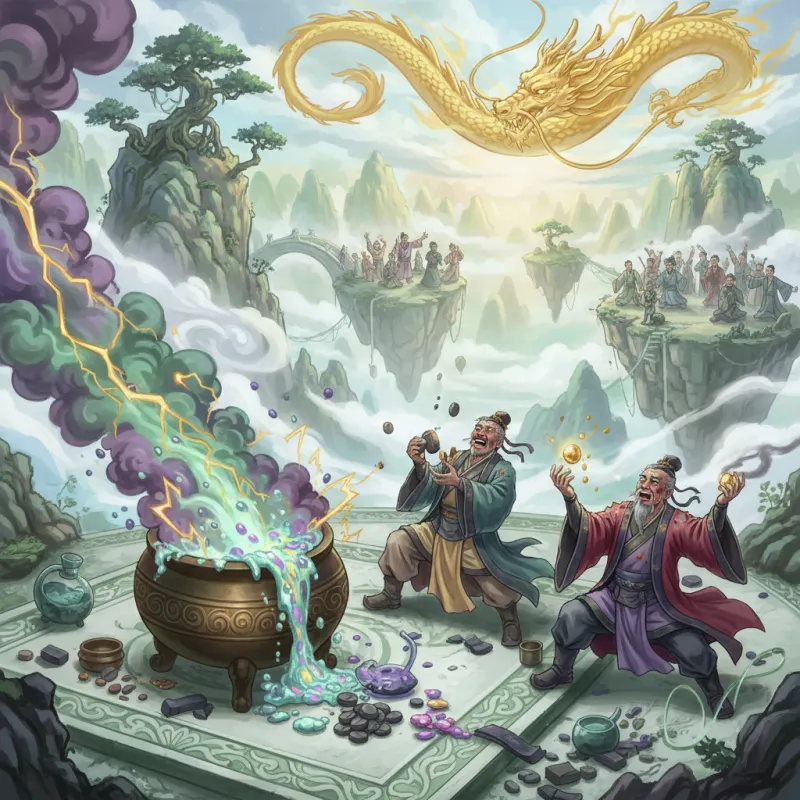
The explosion rattles the windows three courtyards away. Senior Brother Chen stumbles out of his alchemy pavilion, eyebrows singed off, robes smoking, clutching what remains of a cauldron that cost him three years of sect contribution points. In his other hand: a lump of charcoal that was supposed to be a Foundation Establishment Pill. Every alchemist has been there. Most have been there repeatedly. And somehow, despite the constant threat of immolation, alchemy remains the most coveted profession in the cultivation world.
The Physics of Failure
Cauldron explosions aren't random acts of cosmic spite — though it certainly feels that way to the alchemist scraping medicinal paste off the ceiling. The mechanics are brutally precise. Pill refining (炼丹 liàndān) requires balancing spiritual energy flows that would rather do anything except balance. You're essentially convincing incompatible materials to merge by threatening them with fire until they comply.
The typical explosion sequence goes like this: spiritual energy enters the cauldron, heats the medicinal ingredients, begins extracting their essence. So far, so good. But each ingredient has its own spiritual signature, its own preferred temperature, its own timeline for breaking down. A Crimson Fire Lotus wants to release its energy immediately. A Thousand Year Ginseng hoards its essence like a miser. Force them together too quickly, and the conflicting energies don't merge — they detonate.
Temperature control is where most novices fail. The difference between a perfect pill and a smoking crater is often just ten degrees. Maintain 800 degrees for the initial extraction, drop to 650 for the fusion phase, spike to 900 for crystallization. Miss any of these windows by more than a breath's time, and you're shopping for a new cauldron. And new eyebrows.
Then there's the spiritual energy input from the alchemist themselves. You're not just heating ingredients — you're infusing them with your own qi (气 qì), guiding the transformation with your spiritual sense. Too much qi and you overwhelm the delicate balance. Too little and the ingredients won't fuse properly. It's like trying to thread a needle while juggling torches. Blindfolded. During an earthquake.
The Economics of Explosion
Here's the part that makes cauldron explosions tragic rather than merely comedic: the cost. A basic alchemy cauldron runs about 500 spirit stones. A decent one costs 5,000. A truly good cauldron — the kind that won't crack after your third explosion — starts at 50,000 spirit stones and goes up from there. Way up.
And that's before we discuss ingredients. That Crimson Fire Lotus? 200 spirit stones, and it only grows in volcanic regions guarded by fire-attribute spirit beasts. The Thousand Year Ginseng? 800 spirit stones if you're lucky, 2,000 if you're not. A single batch of Foundation Establishment Pills requires a dozen rare ingredients, and the success rate for a novice alchemist is roughly 10%. Do the math. It's horrifying.
This is why alchemy sects are simultaneously the wealthiest and most debt-ridden organizations in cultivation fiction. Yes, a successful alchemist can name their price for pills. But getting to "successful" requires exploding your way through enough spirit stones to buy a small mountain. Most aspiring alchemists wash out not from lack of talent, but from lack of funding. You can't practice if you can't afford to fail, and in alchemy, failure is the curriculum.
The smart ones find sponsors. The desperate ones take loans from merchant associations at interest rates that would make loan sharks blush. The truly unfortunate ones try to gather ingredients themselves, which is how you end up as spirit beast food. There's a reason the Alchemy Pavilion has the highest dropout rate of any sect division.
The Taxonomy of Failure
Not all explosions are created equal. Experienced alchemists can diagnose what went wrong based on the type of explosion — assuming they survive to analyze it.
The Flashfire: Quick, bright, relatively harmless. This happens when spiritual energy disperses too rapidly during the initial heating phase. You lose the ingredients, but the cauldron usually survives. Novice mistake. Embarrassing but not catastrophic.
The Pressure Burst: The cauldron cracks or shatters from built-up internal pressure. This means you sealed the cauldron too early, before the volatile gases could escape. The ingredients are ruined, the cauldron is scrap metal, and you're picking shrapnel out of your robes for a week. Intermediate mistake. Expensive.
The Backlash Detonation: The spiritual energies don't just fail to merge — they actively reject each other and explode outward. This is what happens when you try to combine fundamentally incompatible ingredients, like mixing yin and yang essences without a proper mediating agent. The cauldron is destroyed, the room is destroyed, you're probably injured, and everyone within a hundred meters knows you screwed up. Advanced mistake. Humiliating.
The Cascade Failure: The rarest and most terrifying. One ingredient's failure triggers a chain reaction through the entire batch. The explosion is massive, sustained, and can level buildings. This only happens with high-grade pills using extremely potent ingredients. If you survive a cascade failure, you either learn from it or quit alchemy forever. Most quit.
In Tales of Demons and Gods, Nie Li experiences a cascade failure while attempting to refine a Soul Tempering Pill using ingredients from his previous life's memories. The explosion destroys three alchemy rooms and sends him to the medical pavilion for a month. The novel treats this as a learning experience. In reality, it would be grounds for expulsion and possibly criminal charges.
The Psychology of Repeated Failure
Here's what the novels rarely explore: the mental toll of constant explosions. Imagine spending six months gathering ingredients, three weeks preparing them, and six hours carefully refining them — only to watch everything literally go up in smoke because you misjudged the temperature by five degrees. Then doing it again. And again. And again.
Successful alchemists aren't just talented. They're psychologically resilient to a degree that borders on masochistic. The ability to fail spectacularly, lose a fortune, and immediately start planning the next attempt requires a specific personality type. Optimistic to the point of delusion, stubborn to the point of obsession, and wealthy enough to afford the tuition that failure demands.
This is why alchemist characters in cultivation fiction tend toward certain personality traits. They're either serene to the point of being unflappable (because they've learned emotional control through repeated trauma) or manic and obsessive (because that's the only way to maintain motivation through constant failure). The middle ground doesn't survive the profession.
The truly great alchemists develop what could be called "explosion intuition." They can sense when a batch is about to fail, sometimes with enough warning to seal their spiritual energy and minimize the blast. This isn't a technique you can learn from a manual — it's pattern recognition earned through hundreds of failures. Your body learns to recognize the subtle signs: the slight tremor in the cauldron, the shift in spiritual energy flow, the moment when balance tips toward catastrophe.
When Explosions Aren't Accidents
Not every cauldron explosion is a mistake. Sometimes they're sabotage.
Alchemy competitions are cutthroat affairs where careers are made and destroyed. Slipping a conflicting ingredient into a rival's materials, using spiritual sense to disrupt their energy control, or simply startling them at a critical moment — all are time-honored traditions of alchemy sect politics. The explosion provides plausible deniability. "Oh, how unfortunate that Senior Brother's cauldron exploded during the critical fusion phase. Clearly his foundation is unstable."
Then there are the deliberate explosions. A cornered alchemist with a cauldron full of volatile ingredients is essentially holding a bomb. Detonate it at the right moment, and you can take out enemies, destroy evidence, or create a distraction for escape. It's a desperation move — you're destroying valuable materials and probably injuring yourself — but it's effective.
In Martial God Asura, Chu Feng weaponizes alchemy explosions multiple times, deliberately creating unstable pill batches and detonating them when enemies approach. The novel treats this as clever tactics. Other characters treat it as wasteful insanity. Both are correct.
The Success That Makes It Worthwhile
Despite everything — the explosions, the cost, the constant failure — alchemists persist. Because when it works, when the spiritual energies finally align and the pill forms perfectly, the result is worth every exploded cauldron.
A perfect pill isn't just medicine. It's condensed spiritual energy in stable form, a breakthrough bottleneck in physical form, years of cultivation compressed into something you can swallow. A single perfect Foundation Establishment Pill can sell for 100,000 spirit stones. A Nascent Soul Pill? Name your price. The buyer will pay it.
This is the gamble that keeps alchemists coming back. Yes, you might explode a hundred cauldrons. Yes, you might spend a fortune on ingredients. But that one perfect pill — that one success that makes cultivators line up outside your door with spirit stones in hand — that makes it all worthwhile.
The explosion rate never really improves, even for masters. A 50% success rate is considered excellent. 70% is legendary. Nobody achieves 100%, because alchemy is fundamentally about controlling chaos, and chaos occasionally wins. The difference between a novice and a master isn't fewer explosions — it's knowing which explosions to risk and which to avoid.
The Explosion as Metaphor
Cauldron explosions work as storytelling devices because they're perfect metaphors for cultivation itself. You're taking incompatible elements (mortal body, spiritual energy), forcing them together through controlled violence (cultivation techniques), and hoping the result is transformation rather than destruction. Sometimes you break through to the next realm. Sometimes you explode.
The alchemist's willingness to risk explosion after explosion mirrors the cultivator's willingness to risk qi deviation, tribulation lightning, and inner demons. Both are gambling that the potential reward justifies the catastrophic risk. Both are probably slightly insane. Both are absolutely necessary for advancement.
Every exploded cauldron is a lesson. Every failed pill teaches something about energy control, timing, or ingredient compatibility. The alchemists who succeed aren't the ones who never fail — they're the ones who fail forward, learning from each explosion and adjusting their technique accordingly.
So the next time you read about a cauldron explosion in a cultivation novel, remember: that's not just comic relief or plot convenience. That's the sound of someone learning the most expensive lessons in the cultivation world, one explosion at a time. And somewhere, an alchemist is already gathering ingredients for the next attempt, because the only thing stronger than an alchemist's cauldron is their refusal to quit.
The explosion rate remains "concerning." The alchemists remain undeterred. And the cycle continues, one boom at a time.
Related Reading
- The Alchemist's Arsenal: Cauldrons, Furnaces, and Essential Equipment
- The Art of Pill Refinement: Alchemy in Cultivation Fiction
- The Enchantment of Chinese Cultivation Fiction: Immortal Aspirations and Alchemical Journeys
- Alchemy in Cultivation Fiction: Why Pill-Making Is the Most Dangerous Profession
- Spiritual Herbs and Ingredients: The Raw Materials of Cultivation
- Formation Arrays: The Magical Engineering of the Cultivation World
- Body Refinement: The Physical Path to Power
- Beast Taming in Cultivation Fiction: Your Pet Dragon and You