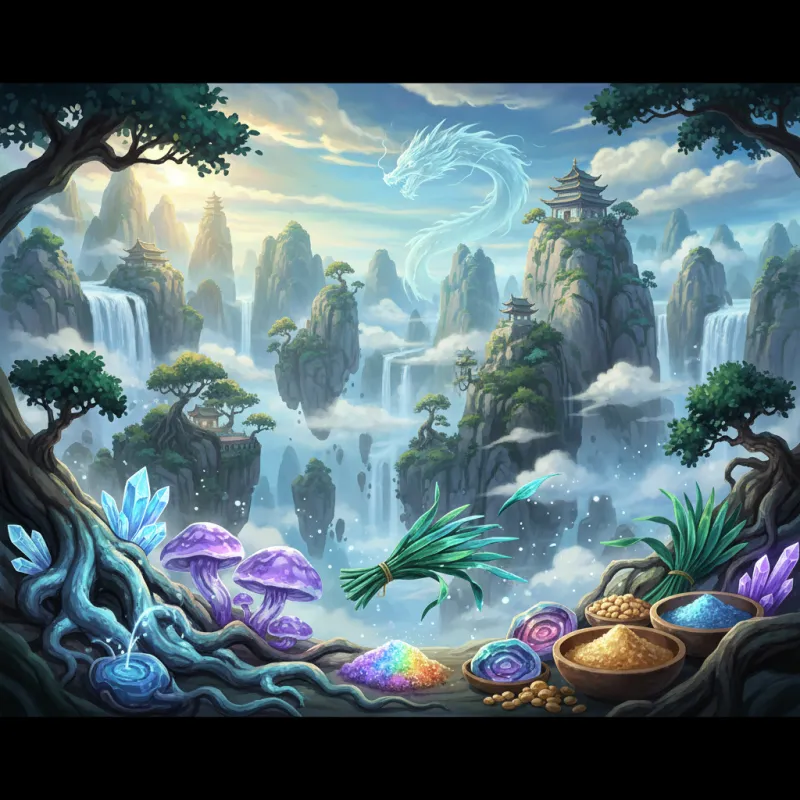
A Foundation Establishment cultivator once told me he'd rather face a Nascent Soul elder in combat than compete for a mature Spirit Gathering Grass in the wild. When I asked why, he showed me the scars. Seventeen separate wounds from "fellow daoists" who'd decided sharing wasn't part of the cultivation path. The herb? He never got it. Someone poisoned the whole group while they were fighting and took everything. That's the spiritual herb economy in a nutshell — brutal, efficient, and absolutely central to every cultivator's advancement.
The Fundamental Nature of Spiritual Materials
Here's what separates a spiritual herb (灵草 língcǎo) from the cabbage in your garden: spiritual roots (灵根 línggēn). Just as cultivators need spiritual roots to sense and absorb qi, plants require them to transform from mundane vegetation into cultivation resources. A regular ginseng plant might live thirty years and develop some minor medicinal properties. A ginseng with spiritual roots can live three thousand years, absorbing heaven and earth spiritual energy (天地灵气 tiāndì língqì) until its roots glow with concentrated power.
The absorption process isn't passive. Spiritual herbs actively draw qi from their surroundings, which is why they cluster in places with dense spiritual energy — mountain peaks, ancient forests, sites of great battles where cultivators died and their energy seeped into the earth. The Coiling Dragon series gets this right when it describes how magical beasts guard spiritual herbs; the beasts aren't being altruistic, they're camping near a qi source that benefits their own cultivation.
Age determines potency in a roughly exponential relationship. A ten-year Spirit Grass might help a Qi Condensation cultivator stabilize their foundation. A hundred-year specimen could push someone through a minor bottleneck. A thousand-year treasure? That's the difference between Foundation Establishment and Core Formation, between mortality and genuine immortality. This is why cultivators in I Shall Seal the Heavens treat millennium-old herbs like nuclear weapons — because functionally, they are.
Categories That Actually Matter
The classification systems in most novels are unnecessarily complicated, but three categories cover ninety percent of what you'll encounter:
Foundation herbs (筑基灵药 zhùjī língyào) help establish and strengthen a cultivator's base. These include Spirit Gathering Grass, Foundation Building Pills' primary ingredients, and anything that purifies or expands meridians. They're common enough that sects can cultivate them in gardens, though wild specimens are still superior. The difference between a fifty-year cultivated herb and a fifty-year wild herb of the same species can be dramatic — the wild version absorbed varied qi types and adapted to environmental pressures, making it more robust.
Breakthrough materials (突破材料 tūpò cáiliào) are the real killers, literally. These rare specimens contain concentrated enough energy to help a cultivator smash through realm barriers. Blood Ginseng, Heavenly Yang Fruit, Nine Revolutions Spirit Mushroom — the names vary by novel, but the function is identical. They're rare, valuable, and worth murdering your own sect members over. Martial World handles this well, showing how even righteous sects become ruthless when breakthrough herbs appear.
Specialized ingredients (特殊材料 tèshū cáiliào) serve specific purposes: healing, poison crafting, artifact refinement, or addressing particular cultivation problems. A cultivator with fire-attribute spiritual roots might need Yin-balancing herbs to prevent qi deviation. Someone practicing a body cultivation technique needs bone-strengthening materials. These create entire sub-economies within the cultivation world.
The Geography of Growth
Spiritual herbs don't grow randomly. They require specific conditions that create natural hierarchies of value and danger. The safest herbs grow in sect-controlled gardens where disciples can harvest them without risking death. These are also the weakest — cultivated in artificial environments, fed controlled amounts of spiritual energy, harvested young to maximize yield over quality.
Mid-tier herbs grow in contested territories: forest edges, minor secret realms, areas where sect influence is weak but not absent. These zones generate constant low-level conflict. In A Record of a Mortal's Journey to Immortality, Han Li spends entire arcs navigating these contested spaces, and the novel accurately portrays how exhausting it is. You're not fighting dramatic battles; you're in constant tension, watching for ambushes, making temporary alliances that dissolve the moment something valuable appears.
The truly precious materials grow in places that want to kill you. Volcanic calderas where fire-attribute herbs absorb yang energy so intense it melts flesh. Frozen peaks where ten-thousand-year Ice Spirit Flowers bloom once per century. Underwater caves guarded by demonic beasts that consider cultivators a dietary supplement. The spiritual beasts protecting these locations aren't there by accident — they're cultivating too, and they chose these spots for the same reasons you want to harvest them.
The Timing Problem
Most novels gloss over this, but harvest timing is critical. Spiritual herbs have optimal maturity windows, sometimes measured in hours. Harvest too early and you get a fraction of the potency. Wait too long and the accumulated energy disperses back into the environment, or the herb advances to a new stage that makes it useless for your purposes.
This creates fascinating strategic problems. You find a 990-year Blood Ginseng. Do you harvest it now and get tremendous but not maximal benefits? Or do you guard it for ten more years, risking that someone else discovers it, that a beast eats it, that environmental changes ruin it? Desolate Era actually explores this dilemma when Ji Ning has to decide whether to harvest herbs immediately or risk waiting for perfect maturity.
The seasonal aspect matters too. Some herbs only bloom during specific celestial alignments. Others require particular weather conditions. The Heavenly Tribulation Grass supposedly only matures during actual heavenly tribulations, forcing cultivators to harvest during someone else's breakthrough — while lightning is actively trying to kill everyone in the vicinity. The risk-reward calculation on that one is genuinely insane.
Cultivation vs. Wild Harvesting
Every major sect runs spiritual herb gardens, and every protagonist eventually establishes their own. The economics make sense: controlled environment, predictable yields, no risk of death during harvest. But cultivated herbs are always inferior to wild specimens of the same age.
The reason is environmental pressure. A wild herb competes with other plants for spiritual energy, adapts to seasonal variations, survives beast attacks, and develops resilience that translates to potency. Cultivated herbs are pampered. They're the trust fund kids of the spiritual plant world — adequate for basic needs but lacking the edge that comes from genuine struggle.
This creates a two-tier system. Sects use cultivated herbs for routine cultivation, feeding them to outer disciples and using them in common pills. Wild herbs are reserved for critical moments: breaking through major realms, healing severe injuries, crafting treasures. The protagonist in Martial God Asura constantly seeks wild herbs specifically because he knows cultivated versions won't cut it for his aggressive cultivation speed.
Some sects try to split the difference by "semi-wild" cultivation — planting herbs in dangerous areas and letting them grow naturally. This works until a demonic beast eats your entire crop or a rival sect harvests it first. The security costs often exceed the value gained.
The Alchemy Connection
Spiritual herbs rarely get consumed raw. That's wasteful and dangerous — the concentrated energy can damage meridians or cause qi deviation if not properly processed. This is where alchemy becomes essential. An alchemist can combine multiple herbs, balance their properties, and refine them into pills that deliver maximum benefit with minimum risk.
The synergy between herbs matters enormously. A Foundation Building Pill might require seven different ingredients, each contributing specific properties: one provides raw energy, another stabilizes the foundation, a third prevents qi deviation, and so on. Get the ratios wrong and you create poison instead of medicine. Use inferior substitutes and the pill's effectiveness drops by half or more.
This is why alchemists command such respect and resources. A skilled alchemist can take a collection of mid-grade herbs and produce a pill superior to what a novice could make with premium ingredients. They understand not just recipes but principles — how different qi types interact, which combinations amplify effects, how processing methods alter properties.
The Dark Side of Herb Economics
Let's be honest about what spiritual herbs do to cultivator society: they make everyone worse. The scarcity creates a zero-sum mentality where cooperation is temporary and betrayal is expected. Righteous sects preach about virtue while their disciples murder each other over herbs in "accidents" during training missions. Demonic cultivators are at least honest about their intentions.
The really dark part? Cultivators become the herbs. Body cultivation techniques, blood refinement methods, soul cultivation — these all concentrate spiritual energy in human flesh. A Core Formation cultivator who's absorbed decades of spiritual herbs becomes, functionally, a mobile treasure trove. This is why demonic cultivation exists and why it's so effective. Why spend centuries gathering herbs when you can just kill other cultivators and take their accumulated energy?
Reverend Insanity explores this logic ruthlessly. Fang Yuan treats other cultivators as resources to be harvested, and the novel doesn't pretend this is aberrant behavior — it's the natural conclusion of a system built on spiritual resource scarcity. Most novels avoid this implication, but it's always there, lurking beneath the surface of every "righteous" sect's moral philosophy.
Finding Your Own Path
For cultivators starting out, herb knowledge is survival knowledge. Learn to identify common spiritual plants before you need them. Understand which herbs grow in your region and their harvest seasons. Build relationships with alchemists who can process your findings. Most importantly, develop the judgment to know when a herb is worth fighting for and when walking away is the smarter choice.
That 500-year Spirit Mushroom growing in the cave? Probably has a guardian beast. The herb garden you stumbled across in the forest? Someone planted it, and they'll be back. The ancient herb mentioned in that treasure map? Dozens of cultivators stronger than you are already searching for it. Knowing what you can't obtain is as valuable as knowing what you can.
The cultivation world runs on spiritual herbs. They're currency, power, and motivation rolled into one. Understanding them means understanding the fundamental economics of cultivation itself — and why that Foundation Establishment cultivator preferred facing a Nascent Soul elder to competing for a single plant. At least with the elder, he knew who was trying to kill him.
Related Reading
- Alchemy in Cultivation Fiction: Why Pill-Making Is the Most Dangerous Profession
- The Alchemist's Arsenal: Cauldrons, Furnaces, and Essential Equipment
- The Enchantment of Chinese Cultivation Fiction: Immortal Aspirations and Alchemical Journeys
- Spirit Stones: The Currency and Fuel of the Cultivation World
- Cauldron Explosions and Failed Pills: The Comedy and Tragedy of Alchemy
- Unraveling the Mysteries of Formations in Chinese Cultivation and Xianxia Fiction
- Pill Refining: The Alchemist's Art in Cultivation
- The Allure of Chinese Cultivation Fiction: A Journey Through Immortal Realms