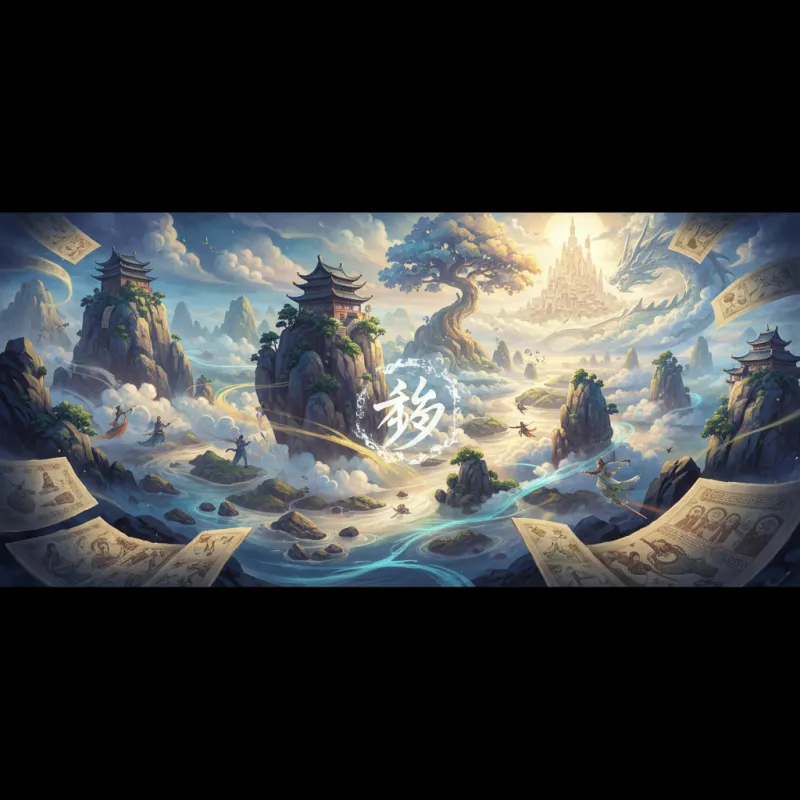
You're about to read a cultivation novel when suddenly the protagonist "breaks through to Golden Core" and "condenses their nascent soul." Wait—what's a nascent soul? Why is everyone freaking out about this "heavenly tribulation"? And why does the villain keep talking about "defying the heavens"? If you've ever felt lost in the jargon-heavy world of xianxia fiction, you're not alone. These 50 essential terms will transform you from confused newcomer to confident reader who actually understands what's happening when someone "comprehends the Dao."
Foundation: Energy and the Body
Qi (气, qì) — The lifeblood of cultivation. This spiritual energy permeates everything in xianxia worlds—mountains, rivers, even the air itself. Cultivators absorb qi from their surroundings, refine it within their bodies, and use it to power techniques, extend their lifespan, and eventually transcend mortality. Think of it as the fundamental currency of power. Without qi, you're just a regular human. With it, you can split mountains and drain seas.
Dantian (丹田, dāntián) — Your spiritual battery. Located in the lower abdomen (though some systems include middle and upper dantians at the chest and forehead), this is where cultivators store and refine their qi. A cracked dantian is basically a death sentence for a cultivator—it's like having your hard drive corrupted after years of saving progress. The size and quality of your dantian often determines your cultivation potential.
Meridians (经脉, jīngmài) — The highways for qi circulation. These channels run throughout the body, connecting the dantian to every part of your physical form. Blocked meridians mean sluggish cultivation progress. Damaged meridians mean excruciating pain and potential cultivation deviation. Opening all your meridians is usually a major milestone in early cultivation stages.
Spiritual Roots (灵根, línggēn) — Your genetic lottery ticket. These innate qualities determine your affinity for cultivation and specific elements. Someone with "heavenly spiritual roots" is basically born with a cheat code—they'll cultivate ten times faster than normal people. Poor spiritual roots? You might spend decades stuck at the first realm while geniuses zoom past you. The five basic types align with wood, fire, earth, metal, and water, though rare variants like lightning, ice, or darkness exist.
Divine Sense (神识, shénshí) — Spiritual radar on steroids. This mental perception extends far beyond normal senses, letting cultivators "see" without eyes, detect hidden enemies, and examine objects in minute detail. At higher levels, divine sense can crush weaker cultivators' minds or communicate across vast distances. It's why sneaking up on a powerful cultivator is nearly impossible.
The Path: Cultivation and Advancement
Dao (道, dào) — The ultimate truth and your personal path to it. In cultivation fiction, the Dao represents both the fundamental laws governing reality and each cultivator's unique understanding of those laws. Someone might follow the "Dao of the Sword," dedicating their entire existence to sword mastery, while another pursues the "Dao of Alchemy." Comprehending the Dao means grasping a piece of universal truth—and that understanding translates directly into power. For more on how different groups approach the Dao, check out Cultivation Sects Explained: Schools, Clans, and Holy Lands.
Cultivation Realms (境界, jìngjiè) — The ladder to immortality. Most xianxia novels divide the path into distinct stages: Qi Condensation, Foundation Establishment, Golden Core, Nascent Soul, and so on. Each realm represents a qualitative leap in power—a Golden Core cultivator could slaughter a hundred Foundation Establishment cultivators without breaking a sweat. The exact names and number of realms vary wildly between novels, but the concept remains constant: climb higher or get left behind.
Breakthrough (突破, tūpò) — The moment of transformation. Breaking through to a new realm isn't just about accumulating enough qi—it requires insight, perfect conditions, and often a bit of luck. Fail a breakthrough and you might suffer cultivation deviation, crippling injuries, or death. Succeed and you'll experience a surge of power, extended lifespan, and new abilities. High-level breakthroughs often trigger heavenly tribulations.
Bottleneck (瓶颈, píngjǐng) — Every cultivator's nightmare. These barriers prevent advancement to the next realm, sometimes for decades or centuries. You can have perfect spiritual roots, unlimited resources, and still hit a bottleneck that refuses to budge. Breaking through often requires a moment of enlightenment, a life-or-death battle, or consuming rare treasures. Some cultivators spend their entire lives stuck at a bottleneck, watching their lifespan tick away.
Cultivation Deviation (走火入魔, zǒuhuǒ rùmó) — When cultivation goes catastrophically wrong. Rush your practice, use forbidden techniques, or suffer emotional turmoil during a breakthrough, and you risk deviation. Symptoms range from qi running rampant through your meridians to complete mental collapse. Mild cases might set back your cultivation by years. Severe cases turn you into a mindless demon or explode you from the inside out.
Resources: Pills, Herbs, and Treasures
Dan (丹, dān) — Cultivation pills that compress months of progress into a single swallow. Created through alchemy, these pills range from basic Qi Gathering Pills that help beginners to legendary Nine Revolutions Golden Pills that can resurrect the dead. Quality matters enormously—a poorly refined pill might contain impurities that damage your foundation, while a perfect pill leaves no side effects. The pill's "grade" usually corresponds to cultivation realms.
Spirit Stones (灵石, língshí) — Crystallized qi and the standard currency. Low-grade spirit stones might help a Qi Condensation cultivator train for a day. High-grade spirit stones contain enough energy to power formations or serve as breakthrough aids for advanced cultivators. Top-tier spirit stones are so valuable that sects go to war over veins that produce them.
Heavenly Materials and Earthly Treasures (天材地宝, tiāncái dìbǎo) — Rare natural resources infused with spiritual energy. A thousand-year-old ginseng, a phoenix feather, dragon blood—these materials serve as ingredients for pills, weapons, and formations. The rarer and older the treasure, the more powerful its effects. Wars have been fought over a single mature spiritual herb.
Spiritual Herbs (灵药, língyào) — Plants that have absorbed qi over decades or centuries. Unlike mundane herbs, these possess genuine supernatural properties. A hundred-year-old Blood Ginseng might restore severe injuries. A thousand-year-old Immortal Grass could extend your lifespan by decades. Age directly correlates with potency, which is why cultivators guard their medicine gardens so jealously.
Artifacts (法宝, fǎbǎo) — Weapons and tools refined with spiritual energy. These range from simple flying swords to reality-warping treasures. Artifacts have grades—Mortal, Spirit, Treasure, Immortal—with each tier exponentially more powerful. A cultivator with a superior artifact can punch above their weight class, which makes artifact refiners incredibly valuable.
Combat: Techniques and Abilities
Cultivation Technique (功法, gōngfǎ) — Your instruction manual for absorbing and refining qi. Not all techniques are equal—a heaven-grade technique might let you cultivate ten times faster than an earth-grade one. Powerful sects guard their core techniques fanatically because they represent centuries of accumulated knowledge. Stealing a sect's cultivation technique is grounds for a blood feud.
Martial Technique (武技, wǔjì) — Combat skills powered by qi. These range from basic sword strikes to reality-bending ultimate moves. Techniques also have grades, and mastering them requires practice and comprehension. A cultivator with perfect technique mastery can defeat someone a realm higher through pure skill.
Secret Technique (秘术, mìshù) — Powerful moves with serious drawbacks. These techniques might burn your lifespan, damage your foundation, or require forbidden sacrifices. Cultivators typically reserve secret techniques for desperate situations—using one means you're either winning decisively or dying trying.
Forbidden Technique (禁术, jìnshù) — The nuclear option. These techniques are banned by righteous sects for good reason: they might require human sacrifice, corrupt your soul, or destroy your cultivation base. Demonic cultivators love them. Everyone else fears them.
Domain (领域, lǐngyù) — A personal reality bubble. High-level cultivators can project their comprehension of the Dao into physical space, creating an area where their will becomes law. Inside your domain, you're nearly invincible. Inside someone else's domain, you're at their mercy. Domain clashes between equal opponents are spectacular and devastating.
Tribulations and Ascension
Heavenly Tribulation (天劫, tiānjié) — The universe's quality control system. When you advance to certain realms or defy natural law, the heavens send down lightning tribulation to destroy you. Survive and you're tempered into something stronger. Fail and you're ash. The tribulation's strength scales with your talent and the magnitude of your breakthrough—geniuses face harder tribulations because the heavens fear their potential.
Thunder Tribulation (雷劫, léijié) — The most common form of heavenly tribulation. Nine waves of increasingly powerful lightning strike down from the sky. Each bolt tests your body, qi, and will. Cultivators prepare for tribulations with protective treasures, healing pills, and formations, but ultimately you must face the lightning yourself. Outside interference usually makes the tribulation stronger.
Ascension (飞升, fēishēng) — Graduating to a higher plane of existence. When you've reached the peak of your current world's cultivation system, you can ascend to a realm with denser qi, stronger cultivators, and higher limits. Ascension usually involves a final tribulation. Fail and you're stuck forever. Succeed and you start over as a weakling in a world where your former peak strength is merely average.
Social Structure and Organizations
Sect (宗门, zōngmén) — The backbone of cultivation society. These organizations control territories, resources, and knowledge. Joining a sect provides protection, techniques, and resources in exchange for loyalty and service. Sect hierarchy is strict: outer disciples get scraps, inner disciples get real training, and core disciples are groomed for leadership. For a deeper dive into how sects function, see Cultivation Sects Explained: Schools, Clans, and Holy Lands.
Cultivation Family (修仙家族, xiūxiān jiāzú) — Bloodline-based power structures. Unlike sects that recruit outsiders, families pass down techniques and resources through generations. Powerful families can rival sects in influence. Family politics are often brutal—weak descendants get minimal resources while geniuses receive everything.
Holy Land (圣地, shèngdì) — The apex organizations. These ancient powers have existed for thousands or tens of thousands of years, controlling vast territories and possessing techniques that lesser sects can only dream of. Offending a Holy Land means your sect, family, and everyone you know might be erased from existence.
Rogue Cultivator (散修, sǎnxiū) — The lone wolves. These cultivators lack sect backing, which means no protection, no systematic training, and constant resource struggles. Most rogue cultivators are weak, but the rare ones who reach high realms through sheer determination are often terrifyingly capable—they've survived without safety nets.
Morality and Paths
Righteous Path (正道, zhèngdào) — The "good guys," theoretically. Righteous sects claim to uphold justice and protect mortals, but they're often hypocritical, arrogant, and willing to commit atrocities when it suits them. They just have better PR than demonic cultivators.
Demonic Path (魔道, módào) — The "evil" cultivators who use forbidden techniques, harvest others' cultivation, and generally don't care about collateral damage. Some are genuinely psychotic. Others are just pragmatists who refuse to be bound by righteous hypocrisy. The line between righteous and demonic is often thinner than either side admits.
Karma (因果, yīnguǒ) — Cosmic cause and effect. In many cultivation worlds, your actions accumulate karmic weight. Slaughter innocents and you'll face harsher tribulations. Save lives and the heavens might show mercy. Some cultivators obsess over karma; others ignore it and face the consequences.
Special Constitutions and Talents
Special Physique (特殊体质, tèshū tǐzhì) — Born with cheat codes. These rare constitutions grant enormous advantages: faster cultivation, natural immunity to certain attacks, or unique abilities. Examples include the "Heavenly Dao Body" that comprehends techniques instantly or the "Primordial Chaos Body" that can cultivate any technique. Possessing a special physique makes you either a genius everyone wants to recruit or a treasure everyone wants to harvest.
Bloodline (血脉, xuèmài) — Inherited power from divine or demonic ancestors. A dragon bloodline might grant you scales, fire breath, and natural dominance over lesser beings. Bloodlines can be awakened, purified, or even stolen through forbidden techniques. Powerful bloodlines are both blessing and curse—they attract attention from those who want to exploit or eliminate you.
Reincarnation (转世, zhuǎnshì) — Starting over with memories intact. Some cultivators who died in their previous lives are reborn with their knowledge preserved. This explains why some "trash" suddenly becomes a genius—they're actually an ancient expert in a new body. Reincarnators have unfair advantages but also attract heavenly jealousy.
Mystical Concepts
Fate (命运, mìngyùn) — The predetermined path versus free will. Some cultivators believe fate is absolute; others dedicate themselves to defying it. "Defying the heavens" means refusing to accept your destined outcome, even if the universe itself opposes you. This theme drives countless xianxia plots.
Comprehension (悟性, wùxìng) — Your ability to understand profound truths. Two cultivators with identical resources might progress at vastly different rates based on comprehension. High comprehension means you grasp techniques faster, break through bottlenecks easier, and comprehend the Dao more deeply. It's the difference between memorizing formulas and understanding mathematics.
Intent (意境, yìjìng) — The spiritual weight behind your actions. Sword intent, for example, represents your understanding of the sword's essence. Cultivators with powerful intent can make ordinary attacks devastating. Intent develops through experience, comprehension, and dedication to your path.
Soul (灵魂, línghún) — Your consciousness and spiritual essence. Stronger souls mean better divine sense, resistance to mental attacks, and easier comprehension. Soul cultivation is often separate from body cultivation, creating specialists who are physically weak but mentally overwhelming.
Primordial Spirit (元神, yuánshén) — Your true self, refined beyond the mortal soul. At high realms, cultivators condense their primordial spirit, which can survive even if their body is destroyed. Primordial spirit attacks bypass physical defenses entirely, striking at your very existence.
Spatial and Temporal Concepts
Spatial Ring (储物戒, chǔwù jiè) — Pocket dimension jewelry. These rings contain internal space for storing items, from a few cubic meters to entire mountains. High-grade spatial rings are incredibly valuable—imagine never worrying about carrying supplies or treasure again.
Secret Realm (秘境, mìjìng) — Pocket dimensions left behind by ancient cultivators. These realms contain treasures, techniques, and dangers. When a secret realm opens, cultivators flood in to compete for opportunities. Many never return. Secret realms often have entry restrictions—only those below a certain cultivation level can enter, giving younger cultivators chances to obtain fortunes.
Time Dilation (时间流速, shíjiān liúsù) — Spaces where time flows differently. A cultivation chamber with 10:1 time dilation lets you train for ten days while only one day passes outside. These treasures are horrendously expensive but can compress decades of cultivation into years.
Alchemy and Refinement
Alchemist (炼丹师, liàndān shī) — Pill crafters who transform spiritual herbs into concentrated power. Good alchemists are worth their weight in spirit stones. Master alchemists can demand favors from sect leaders. Alchemy requires precise control, deep knowledge, and often a special flame. The success rate for high-level pills is abysmal, making successful alchemists incredibly wealthy.
Pill Tribulation (丹劫, dānjié) — When you refine a pill so perfect that the heavens get jealous. High-grade pills attract lightning tribulation that tries to destroy them. Alchemists must protect their pills during tribulation, which adds another layer of difficulty to an already challenging process.
Artifact Refiner (炼器师, liànqì shī) — Blacksmiths who forge spiritual weapons and treasures. Like alchemists, skilled refiners are highly valued. They need understanding of materials, formations, and the Dao itself to create truly powerful artifacts.
Pill Furnace (丹炉, dānlú) — Specialized cauldrons for alchemy. Quality matters enormously—a trash furnace might explode or ruin your ingredients. Legendary furnaces can increase success rates and pill quality dramatically.
Final Terms
Lifespan (寿元, shòuyuán) — Your remaining time before natural death. Mortals live decades. Cultivators can live centuries, millennia, or eternally depending on their realm. Running out of lifespan is a constant pressure driving cultivators to advance or find life-extending treasures.
Foundation (根基, gēnjī) — The quality of your cultivation base. A solid foundation means stable advancement and higher peak potential. A damaged foundation from rushing cultivation or using too many pills creates permanent limitations. Many geniuses ruin themselves by prioritizing speed over stability.
Face (面子, miànzi) — Reputation and dignity. In cultivation society, face is everything. Losing face can be worse than losing a fight. Cultivators will risk death rather than suffer humiliation. This concept drives countless conflicts—someone "doesn't give face" to a young master, and suddenly entire sects are at war.
Young Master (少爷, shàoye) — The spoiled sons of powerful families or sects. These characters exist to be face-slapped by protagonists. They're arrogant, entitled, and inevitably underestimate the hero. When defeated, they call in their elders, escalating conflicts to absurd levels.
Jade Beauty (玉人, yùrén) — Impossibly beautiful female characters, often described with flowery metaphors about jade skin and celestial features. They're typically talented cultivators who become love interests, rivals, or both. The term has become somewhat mocking in the community due to overuse.
Now you're equipped to dive into any xianxia novel without constantly checking wikis. These terms form the foundation of cultivation fiction—master them and you'll understand not just what's happening, but why it matters. The next time someone mentions "condensing their nascent soul" or "facing heavenly tribulation," you'll know exactly what's at stake. Happy reading, and may your comprehension be swift and your tribulations merciful.
Related Reading
- Xianxia vs. Wuxia vs. Xuanhuan: What's the Difference?
- The Glossary Problem: Why Cultivation Fiction Is Hard to Translate
- Essential Cultivation Terms: The Complete Xianxia Glossary
- Face-Slapping and Other Essential Xianxia Tropes
- The Enigmatic Beasts of Chinese Cultivation Fiction: A Journey Through the Spiritual Realms
- Rune and Inscription Systems in Cultivation Fiction
- The Essence of Immortality: Understanding Chinese Cultivation and Xianxia Fiction