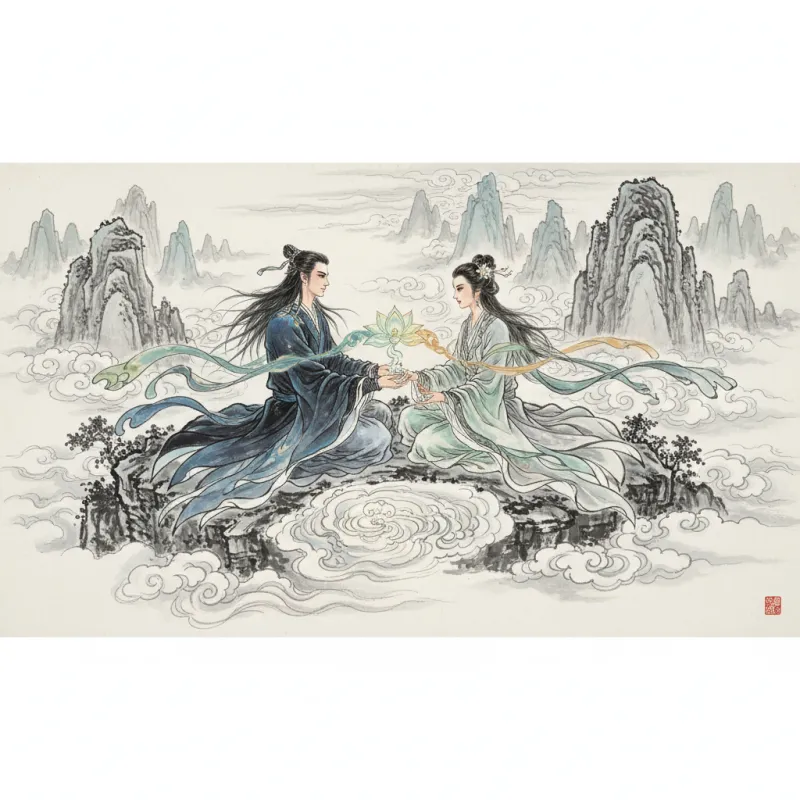
Dual Cultivation Explained: Partners on the Path to Immortality
In the vast tapestry of Chinese cultivation fiction, few practices spark as much fascination—and misunderstanding—as dual cultivation (双修, shuāngxiū). Far from being merely a narrative device for romantic subplots, dual cultivation represents a profound philosophical concept rooted in Daoist alchemy, yin-yang cosmology, and the ancient Chinese understanding of how complementary forces can accelerate spiritual transformation. When two cultivators join their energies in harmonious practice, they don't simply add their powers together—they create something exponentially greater, a synergy that can shatter bottlenecks, refine spiritual roots, and propel both partners toward the ultimate goal of immortality.
The Philosophical Foundations of Dual Cultivation
To understand dual cultivation, we must first grasp the fundamental principle of yin and yang (阴阳, yīn yáng) that permeates all Chinese metaphysics. The universe itself, according to Daoist cosmology, emerged from the interplay of these two primordial forces—yin representing the receptive, cool, feminine principle, and yang embodying the active, warm, masculine principle. Neither is superior; both are essential. Like the iconic taiji symbol shows, each contains the seed of the other, and true power lies in their dynamic balance.
In cultivation novels, this philosophy manifests in the concept that solitary cultivation, while possible, is inherently incomplete. A male cultivator accumulating pure yang energy (纯阳之气, chún yáng zhī qì) may reach impressive heights, but without the tempering influence of yin, his foundation becomes unstable—like a fire burning too hot, eventually consuming itself. Similarly, a female cultivator rich in yin essence (阴元, yīn yuán) may find her progress slowing at critical junctures, lacking the dynamic yang force to break through barriers.
Dual cultivation offers the solution: two cultivators, typically of opposite genders (though some novels explore same-gender variations through unique constitutions), engage in synchronized practice that allows their energies to circulate between them, creating a complete yin-yang cycle. This isn't merely about physical intimacy—though that can be one method—but about achieving a state of profound energetic resonance where both partners' cultivation bases strengthen simultaneously.
Historical and Literary Roots
The concept of dual cultivation didn't originate in modern web novels. Its roots stretch back to actual Daoist practices documented in texts like the Huangdi Neijing (黄帝内经, Huángdì Nèijīng, The Yellow Emperor's Classic of Internal Medicine) and various Daoist alchemical manuals from the Tang and Song dynasties. These historical texts discussed the cultivation of jing (精, vital essence), qi (气, energy), and shen (神, spirit)—the Three Treasures of Daoist internal alchemy—and how the interaction between male and female practitioners could refine these substances.
In classical Chinese literature, we see hints of these concepts in works like Journey to the West (西游记, Xīyóu Jì), where various demons seek to consume Tang Sanzang's yang essence, and in Strange Tales from a Chinese Studio (聊斋志异, Liáozhāi Zhìyì), where fox spirits engage in energy exchange with human lovers. Modern xianxia fiction has taken these scattered references and developed them into comprehensive cultivation systems.
Types and Methods of Dual Cultivation
The Orthodox Path (正道双修, Zhèngdào Shuāngxiū)
In righteous cultivation sects, dual cultivation is treated as a sacred practice reserved for committed partners, often married couples or dao companions (道侣, dàolǚ). The orthodox method emphasizes mutual benefit, emotional connection, and spiritual harmony.
A classic example appears in Er Gen's (耳根) novel I Shall Seal the Heavens (我欲封天, Wǒ Yù Fēng Tiān), where the protagonist Meng Hao and Xu Qing's relationship, while not explicitly focused on dual cultivation, embodies the principle of two cultivators whose connection strengthens both their resolves and cultivation bases. Their emotional bond creates a form of spiritual resonance that helps Meng Hao overcome tribulations.
Orthodox dual cultivation typically involves:
- Synchronized meditation where partners sit facing each other, circulating qi through connected meridians (经脉, jīngmài)
- Complementary technique practice where one partner's technique naturally enhances the other's
- Shared tribulation facing where both partners endure heavenly tribulations (天劫, tiānjié) together, their combined strength greater than the sum of parts
- Essence exchange through various methods, not necessarily physical, where pure yin and yang energies balance each other
The Demonic Path (魔道双修, Módào Shuāngxiū)
In contrast, demonic cultivators often practice predatory dual cultivation, where one partner deliberately drains the other's essence to strengthen themselves. This is the dark mirror of orthodox practice—instead of mutual growth, it's parasitic consumption.
In I Eat Tomatoes' (我吃西红柿) Coiling Dragon (盘龙, Pánlóng), various antagonists employ techniques that steal life force and cultivation base from victims. While not always explicitly called dual cultivation, these methods represent the corrupted version of the practice—taking without giving, destroying one life to extend another.
The Cauldron Furnace Method (鼎炉之法, dǐnglú zhī fǎ) represents the most notorious demonic dual cultivation technique. In this practice, one cultivator (usually male in traditional narratives, though modern novels subvert this) treats their partner as a mere vessel—a "cauldron" or "furnace"—to refine their own cultivation. The victim, drained of their vital essence, often suffers crippled cultivation or death. This method appears frequently as a villainous technique that righteous protagonists must combat.
The Balanced Exchange (平衡交换, Pínghéng Jiāohuàn)
Some novels present a middle path where dual cultivation partners maintain a careful equilibrium. In Grandmaster of Demonic Cultivation (魔道祖师, Módào Zǔshī) by MXTX, while not focusing heavily on cultivation mechanics, the relationship between Wei Wuxian and Lan Wangji demonstrates how two cultivators with different approaches (demonic cultivation vs. orthodox cultivation) can complement and strengthen each other through their bond.
The Mechanics: How Dual Cultivation Works
Energy Circulation and Meridian Connection
In most xianxia systems, the human body contains numerous meridians through which qi flows. Dual cultivation creates a circuit between two bodies, forming what's called a Great Heavenly Cycle (大周天, dà zhōutiān) that encompasses both partners.
The process typically unfolds as follows:
-
Initial Resonance (共鸣, gòngmíng): Partners must first achieve spiritual harmony, their cultivation frequencies aligning like tuning forks vibrating at the same pitch.
-
Meridian Opening (开脉, kāimài): Specific meridians open to allow qi flow between bodies, often through the palms, the dantian (丹田, energy center), or other cultivation-relevant points.
-
Yin-Yang Exchange: Yang qi flows from the yang-dominant partner while yin qi flows from the yin-dominant partner, each tempering and refining the other's energy.
-
Mutual Refinement (互炼, hùliàn): As energies circulate, impurities are burned away, bottlenecks dissolve, and both cultivation bases solidify and expand.
-
Breakthrough Synergy: At critical moments, the combined force of two aligned cultivators can overcome barriers that would stop a solitary practitioner.
The Importance of Compatibility
Not any two cultivators can successfully dual cultivate. Spiritual root compatibility (灵根相合, línggēn xiānghé) is crucial. In many novels, protagonists discover they possess rare constitutions that make them ideal dual cultivation partners:
- Pure Yin Body (纯阴之体, chún yīn zhī tǐ) and Pure Yang Body (纯阳之体, chún yáng zhī tǐ) represent the most compatible pairing
- Special constitutions like the Heavenly Yin Physique or Nine Yang Divine Body create powerful synergies
- Complementary elemental affinities—a fire cultivator and water cultivator might seem opposed, but their balance can create steam, representing transformation
In Against the Gods (逆天邪神, Nì Tiān Xié Shén) by Mars Gravity, the protagonist Yun Che's encounters with various female characters often involve unique physiques that create cultivation opportunities, demonstrating how constitution compatibility drives dual cultivation narratives.
Dual Cultivation in Modern Xianxia Narratives
Beyond the Harem Trope
While dual cultivation has unfortunately been reduced to a harem-building justification in some lower-quality novels, sophisticated xianxia fiction treats it with more nuance. The best examples explore:
Emotional Depth: True dual cultivation requires trust, vulnerability, and genuine connection. In Martial World (武极天下, Wǔ Jí Tiānxià), the protagonist Lin Ming's relationships with his companions involve deep emotional bonds that make their cultivation synergy believable and earned.
Narrative Consequences: Dual cultivation creates lasting bonds. Partners become vulnerable to each other—if one is injured, the other may suffer backlash through their connected cultivation bases. This raises the stakes in combat and creates compelling drama.
Character Development: The practice forces characters to confront intimacy, trust, and interdependence—themes that drive character growth beyond simple power escalation.
Female Agency and Modern Interpretations
Contemporary xianxia increasingly features female protagonists who engage in dual cultivation on their own terms. Novels like The Grandmaster Strategist (一代军师, Yīdài Jūnshī) and various female-led cultivation stories present women as active participants rather than passive cauldrons, choosing partners strategically and maintaining agency throughout the process.
Some modern works even explore:
- Female cultivators with multiple male dual cultivation partners
- Same-gender dual cultivation through unique constitutional arrangements
- Non-romantic dual cultivation between sworn siblings or master-disciple pairs (though this remains controversial)
The Dao Companion Bond (道侣之约, Dàolǚ Zhī Yuē)
The ultimate expression of dual cultivation is the dao companion relationship—a bond deeper than marriage, where two cultivators pledge to walk the path to immortality together. This commitment carries weight in xianxia worlds:
- Shared karma (因果, yīnguǒ): Dao companions' fates intertwine; harming one brings retribution from the other
- Cultivation oaths (修道誓言, xiūdào shìyán): Breaking a dao companion bond can damage one's cultivation foundation or invite heavenly punishment
- Eternal partnership: Unlike mortal marriages ending at death, dao companions aspire to achieve immortality together, spending eternity side by side
In A Record of a Mortal's Journey to Immortality (凡人修仙传, Fánrén Xiūxiān Zhuàn), the protagonist Han Li's cautious approach to relationships reflects the serious implications of forming such bonds—they're not entered lightly, as they can become either the greatest asset or most devastating weakness on the cultivation path.
Controversies and Criticisms
Dual cultivation remains one of xianxia's most debated elements. Critics argue it often serves as thinly-veiled justification for explicit content or harem dynamics, reducing female characters to cultivation resources. These concerns have merit—many novels do treat dual cultivation superficially.
However, when handled with sophistication, dual cultivation explores profound themes: the balance of opposing forces, the power of genuine partnership, and the idea that some peaks cannot be climbed alone. It asks whether the solitary pursuit of power is truly the highest path, or whether connection and interdependence might offer something greater.
Conclusion: The Path Forward Together
Dual cultivation, at its philosophical core, represents a beautiful truth: that we are stronger together than apart, that complementary forces create something greater than their sum, and that the journey to immortality need not be walked alone. Whether manifested through romantic partnership, deep friendship, or spiritual resonance, the principle remains—two cultivators in harmony can achieve what one cannot.
As xianxia continues evolving, dual cultivation narratives are maturing beyond simple power-ups or romantic subplots. The best contemporary works use this concept to explore trust, vulnerability, balance, and the question of what we're willing to share—and risk—on the path to transcendence. In a genre often focused on solitary protagonists crushing enemies and breaking heavens, dual cultivation reminds us that even immortals need companions on the endless road ahead.
The dao (道, the Way) is long, and the heavens are vast. Perhaps walking it with another makes the journey not just easier, but more meaningful—and that itself is a form of cultivation worth pursuing.