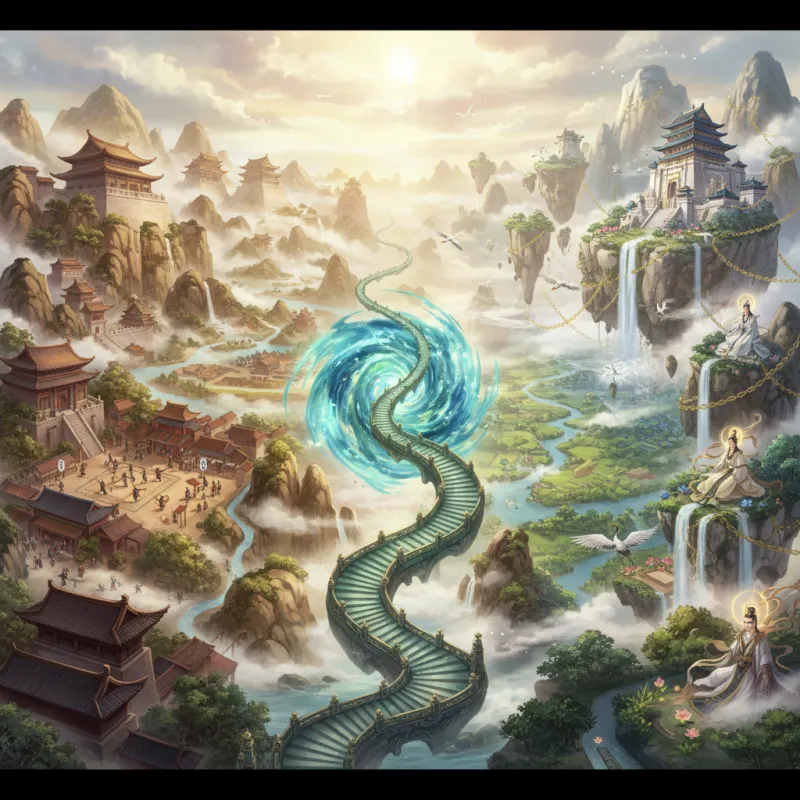
The first time a cultivator breaks through the void and glimpses the realm above, they realize everything they knew was a lie. The "world" they spent centuries mastering? Just a training ground. The "immortals" they worshipped? Merely foundation-level cultivators in the grand scheme. That mountain that touched the sky? Barely a foothill compared to what awaits beyond the barrier.
This moment of cosmic horror-slash-enlightenment appears in nearly every xianxia novel, and it's not just a plot device. It's the fundamental architecture of cultivation fiction: the idea that reality itself has levels, and power means climbing them.
The Vertical Universe
Walk into any cultivation world and you'll find the same basic structure, though the names change. At the bottom sits the Mortal Realm (凡界, fán jiè), where ordinary humans and low-level cultivators struggle with limited spiritual energy. Above that, the Spirit Realm or Cultivation Realm (修真界, xiū zhēn jiè), where true cultivation begins. Higher still, the Immortal Realm (仙界, xiān jiè), home to beings who've transcended mortality. And sometimes, even above that, the Divine Realm (神界, shén jiè) or Primordial Realm, where the truly ancient powers dwell.
Each realm has its own rules. Spiritual energy (灵气, líng qì) grows denser as you ascend. Time flows differently—a year in the Immortal Realm might equal a century in the Mortal Realm. The laws of physics themselves become more "solid," which is why an Immortal Realm cultivator can't simply descend and dominate the lower realms—the weaker world literally can't contain their power without shattering.
This isn't just worldbuilding flavor. It's the engine that drives cultivation narratives forward. The protagonist can't just get stronger; they must transcend their entire plane of existence, again and again.
Daoist Cosmology's Fingerprints
The multi-realm structure has deep roots in Chinese religious thought, though not quite in the way you might expect. Daoist cosmology does describe multiple heavens—the Thirty-Three Heavens (三十三天, sān shí sān tiān) appear in texts like the Shangqing scriptures from the 4th century CE. But these weren't really "levels" you climbed through cultivation. They were bureaucratic divisions, different departments in the celestial government.
What cultivation novels borrowed was the principle of hierarchical transcendence. Daoist internal alchemy (内丹, nèi dān) texts describe the practitioner's body as a microcosm of the universe, with different "fields" (丹田, dān tiān) corresponding to different levels of refinement. The practitioner doesn't just get stronger—they fundamentally transform their existence, moving from coarse to refined, from mortal to immortal.
Buddhist cosmology contributed too, particularly the concept of the Three Realms (三界, sān jiè): the Desire Realm, Form Realm, and Formless Realm. Each represents a level of spiritual refinement, and beings can be reborn into higher or lower realms based on their karma. Cultivation novels secularized this—instead of waiting for rebirth, you force your way up through sheer willpower and technique.
The Shushan Revolution
But the direct ancestor of modern cultivation geography? That's The Legend of the Swordsmen of the Mountains of Shu (蜀山剑侠传, Shǔshān Jiànxiá Zhuàn), written by Huanzhulouzhu between 1932 and 1948. This sprawling epic—over five million characters—established many conventions that xianxia still uses today.
Huanzhulouzhu didn't invent the idea of immortal realms, but he systematized it. His world had clear geographical divisions: the mortal world, various cave-heavens (洞天, dòng tiān) and blessed lands (福地, fú dì) where immortals dwelt, and higher celestial realms. More importantly, he established that these weren't just different places—they were different levels of reality, and accessing them required corresponding levels of cultivation.
The novel also introduced the idea that the mortal world was declining, its spiritual energy depleting. This created narrative urgency: cultivators couldn't just stay in the comfortable mortal realm forever. They had to ascend or stagnate. Sound familiar? It's the same pressure that drives protagonists in I Shall Seal the Heavens, A Record of a Mortal's Journey to Immortality, and countless others.
The Web Novel Economics
Here's where it gets interesting: the multi-realm structure isn't just mythologically sound, it's economically brilliant for serialized fiction.
Think about the problem facing any web novel author. You need to keep readers hooked for thousands of chapters. If your protagonist just gets stronger in the same world, you hit diminishing returns. The hundredth fight scene in the same sect gets boring. Power scaling becomes absurd—how many times can you describe someone as "unimaginably powerful" before it loses meaning?
The realm-ascension structure solves this elegantly. Every time the protagonist ascends, you hit the reset button. They're a big fish in a small pond? Boom, now they're a small fish in a bigger pond. All those enemies they defeated? Irrelevant—they're in a lower realm now. The author can recycle the same basic story beats (underestimated newcomer rises through the ranks) while maintaining the illusion of progress.
A Record of a Mortal's Journey to Immortality (凡人修仙传, Fánrén Xiūxiān Zhuàn) by Wang Yu perfected this formula. Han Li spends hundreds of chapters in the mortal world, then ascends to the Spirit Realm for hundreds more, then finally reaches the Immortal Realm. Each transition feels earned, and each new realm introduces fresh conflicts, factions, and power systems. The geography literally structures the narrative.
The Barrier Between Worlds
One of the most interesting aspects of cultivation geography is the barrier itself—the mechanism that separates realms. In most novels, it's not just empty space. It's a fundamental law of reality, often called the Realm Barrier (界壁, jiè bì) or Heavenly Barrier (天障, tiān zhàng).
Breaking through requires specific conditions. Sometimes it's purely about cultivation level—reach a certain stage and you automatically trigger ascension, whether you want to or not. Other times it requires special treasures, specific locations, or even permission from higher powers. In Stellar Transformations (星辰变, Xīngchén Biàn), ascending requires surviving a tribulation that literally tries to kill you, as if the universe itself resists your transcendence.
This creates interesting narrative tension. Ascending means leaving everything behind—friends, family, sect, enemies. Some novels play this for drama: the protagonist must choose between staying with loved ones or pursuing the Dao. Others treat it more pragmatically: everyone you care about is also cultivating, so you'll meet them again in the higher realm eventually.
The barrier also explains why higher-realm cultivators can't just descend and interfere. The world's laws won't support their power. If they force it, they might damage the lower realm or even harm themselves. This is narratively convenient—it prevents the "why doesn't a god just solve this problem?" issue—but it's also philosophically interesting. It suggests that power and environment are inseparable, that you can't just impose higher-realm logic on a lower-realm world.
Regional Variations
Not every cultivation novel uses the exact same structure. Some variations are worth noting.
Single-Realm Novels: Some stories, like Coiling Dragon (盘龙, Pánlóng), keep everything in one continuous world but divide it into regions of increasing danger and power. The effect is similar—the protagonist moves from weak areas to strong areas—but without the metaphysical separation.
Horizontal Expansion: Instead of ascending vertically, some protagonists explore horizontally. Desolate Era (莽荒纪, Mǎnghuāng Jì) features multiple "chaosworlds" at roughly the same level, each with its own characteristics. The protagonist travels between them rather than ascending through them.
Reverse Descent: A few novels flip the script. The protagonist starts in a higher realm, gets knocked down to a lower one, and must climb back up. This adds a revenge narrative to the standard progression structure.
Pocket Dimensions: Many novels include small worlds (小世界, xiǎo shìjiè) or pocket dimensions that exist outside the main hierarchy. These might be ancient ruins, secret realms created by powerful cultivators, or fragments of destroyed worlds. They're useful for treasure hunts and training arcs without disrupting the main geographical structure.
The Philosophy of Ascension
Here's what makes cultivation geography more than just a plot device: it embodies a fundamentally optimistic worldview. No matter where you start, no matter how weak you are, transcendence is possible. The universe has levels, yes, but they're not locked. You can climb.
This contrasts sharply with traditional Chinese cosmology, where your position was largely determined by karma, fate, or the Mandate of Heaven. Cultivation novels democratize transcendence. Anyone with sufficient willpower, talent, and luck can ascend. The geography is hierarchical, but it's not a caste system.
Of course, this optimism has limits. Most cultivation novels acknowledge that ascending gets exponentially harder at each level. The jump from Mortal Realm to Spirit Realm might take decades; the jump from Spirit Realm to Immortal Realm might take millennia. And there's always a higher realm, always another level. True transcendence—escaping the cycle entirely—remains elusive, perhaps impossible.
Some novels explore this explicitly. In I Shall Seal the Heavens (我欲封天, Wǒ Yù Fēng Tiān), Meng Hao eventually learns that even the highest realms are constrained by deeper laws, and true freedom means transcending the entire system. The geography itself becomes a prison, and the ultimate cultivation is to break free from it entirely.
Why It Works
The multi-realm structure endures because it solves multiple problems simultaneously. It provides narrative structure for extremely long stories. It creates natural stakes and goals. It allows for power scaling without breaking the world's logic. And it taps into deep cultural ideas about transcendence, hierarchy, and self-improvement.
But more than that, it captures something essential about the cultivation fantasy: the idea that reality itself has levels, and that you can climb them through effort and understanding. The geography isn't just a setting—it's a promise. No matter how vast the universe seems, no matter how powerful the beings above you, there's always a path forward. You just have to be willing to leave your current world behind and step into the unknown.
That first moment when a cultivator breaks through the void and sees the realm above? It's terrifying and exhilarating in equal measure. Everything they knew was small. But everything they could become is vast. The journey from mortal to immortal isn't just about gaining power—it's about expanding your understanding of what reality can be, one realm at a time.
And that's why, thousands of chapters later, readers are still hooked. Because somewhere out there, beyond the Immortal Realm, beyond the Divine Realm, beyond whatever comes next, there's always another level. Always another mystery to uncover. Always another sky to break through.
Related Reading
- Cultivation World Geography: Understanding the Maps of Xianxia Fiction
- Mortal vs. Immortal Realm: The Two Worlds of Cultivation Fiction
- Cultivation Worlds: How Web Novels Build Entire Universes
- The Dao and Heavenly Laws: The Cosmic Rules of Cultivation
- Yin-Yang Dual Cultivation: Philosophy Behind the Practice
- Spiritual Herbs and Ingredients: The Raw Materials of Cultivation
- The Philosophical Underpinnings of Chinese Cultivation Fiction and Immortal Realms