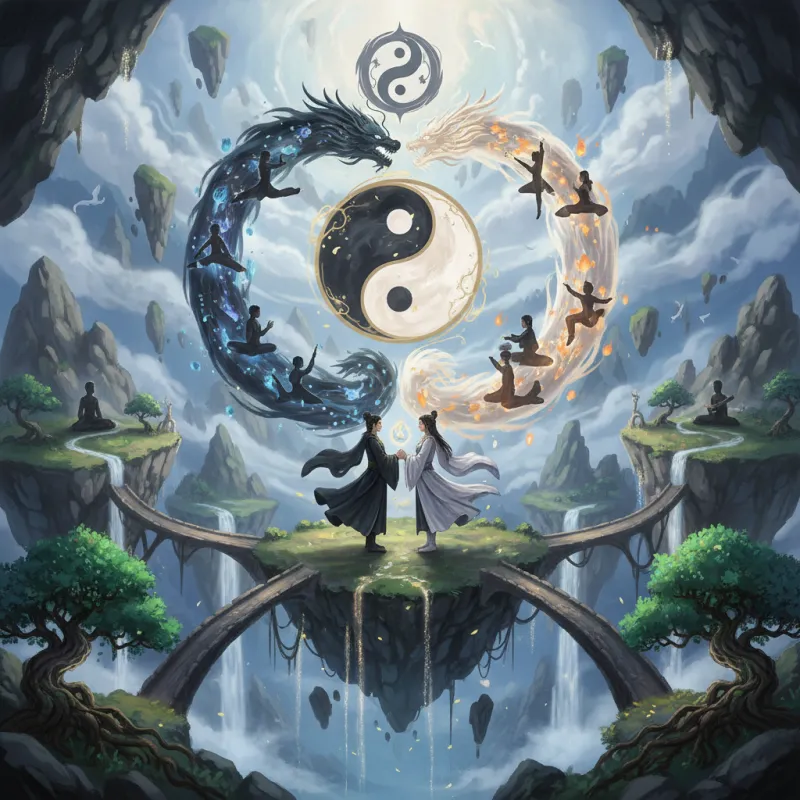
The moment a cultivator realizes their spiritual root is purely yang, they face a problem older than the Dao itself: how do you advance when your energy is fundamentally incomplete? The answer, according to texts like the Huangdi Neijing (黄帝内经, Huángdì Nèijīng) from around 100 BCE, isn't to fight harder or cultivate faster. It's to find balance. This is where dual cultivation stops being a convenient plot device and becomes something far more interesting: a practical application of cosmological law.
The Philosophy Everyone Misreads
Yin-yang (阴阳, yīn yáng) gets butchered in translation more than any other Chinese concept. Western readers see the symbol and think: opposites. Male versus female. Light versus dark. Good versus evil. But the Daodejing (道德经, Dàodéjīng) never frames it that way. Chapter 42 states: "The myriad things carry yin and embrace yang; through the blending of qi they achieve harmony." Not opposition. Not conflict. Blending.
Here's what the philosophy actually says: yin and yang are complementary forces that define each other through relationship. You can't have shadow without light, but shadow isn't the enemy of light — it's the proof that light exists. Cold isn't the opposite of heat; it's the absence of heat, and both are necessary for the concept of temperature to mean anything. The Yijing (易经, Yìjīng, Book of Changes) builds an entire divination system on this principle: every hexagram contains both yin lines (broken) and yang lines (solid), and the wisdom comes from understanding their arrangement, not picking a side.
This matters for cultivation fiction because it explains why purely yang or purely yin cultivation paths are portrayed as dangerous. A cultivator who only develops yang energy becomes like fire without water — powerful, destructive, and ultimately self-consuming. The Cantong Qi (参同契, Cāntóng Qì), a 2nd-century alchemical text, warns that imbalanced cultivation leads to "deviation" (走火入魔, zǒuhuǒ rùmó) — literally "walking into fire and entering demons." The body needs both forces in dynamic equilibrium, not static balance.
Why Dual Cultivation Makes Philosophical Sense
Internal alchemy (内丹, nèidān) traditions, which form the backbone of most xianxia cultivation systems, explicitly describe the body as a microcosm of the universe. The Xingming Guizhi (性命圭旨, Xìngmìng Guīzhǐ), published in 1615, maps yin and yang to specific organs, energy channels, and cultivation stages. The heart is yang; the kidneys are yin. The upper dantian is yang; the lower dantian is yin. Daytime practice emphasizes yang; nighttime practice emphasizes yin.
Dual cultivation (双修, shuāngxiū) enters this framework as a method for balancing these forces through partnership. The logic is straightforward: if one cultivator has excess yang and another has excess yin, practicing together allows both to regulate their energy through exchange. The Sunu Jing (素女经, Sùnǚ Jīng), a Han dynasty text on bedroom arts, describes this as "returning the essence to nourish the brain" (还精补脑, huán jīng bǔ nǎo) — a process where sexual energy is refined and circulated rather than depleted.
This isn't unique to Daoism. Buddhist tantra has similar practices (双身法, shuāngshēn fǎ), though the philosophical justification differs. Tibetan Buddhism frames it as uniting wisdom (prajna, feminine) with compassion (upaya, masculine) to achieve enlightenment. The mechanics change, but the underlying principle remains: two incomplete forces becoming complete through union.
What makes this compelling in fiction is that it creates genuine stakes. In Against the Gods (逆天邪神, Nì Tiān Xié Shén), Yun Che's cultivation benefits from dual cultivation not because of lazy writing, but because his Phoenix flames are purely yang — he literally needs yin energy to prevent his body from burning itself out. When done well, dual cultivation techniques become plot-relevant rather than gratuitous.
The Medical Framework Behind the Fiction
Chinese medicine (中医, zhōngyī) provides the anatomical roadmap that cultivation fiction borrows. The Huangdi Neijing divides the body into twelve primary meridians (经络, jīngluò), each associated with either yin or yang. The Conception Vessel (任脉, rènmài) runs along the front of the body and is yin; the Governing Vessel (督脉, dūmài) runs along the spine and is yang. Completing the "small heavenly circuit" (小周天, xiǎo zhōutiān) means circulating qi through both vessels in a continuous loop.
Dual cultivation, in this medical context, uses the partner's energy to complete circuits that would be difficult or impossible alone. The Yufang Mijue (玉房秘诀, Yùfáng Mìjué), another Han dynasty text, describes specific breathing techniques and visualization practices designed to guide energy exchange during intimacy. The goal isn't pleasure — it's circulation. The partner becomes a living catalyst for internal transformation.
This is why serious cultivation novels distinguish between dual cultivation and mere sexual activity. In Martial World (武极天下, Wǔ Jí Tiānxià), Lin Ming's dual cultivation with his partners involves synchronized breathing, coordinated energy circulation, and mutual refinement of their cultivation bases. It's closer to partner yoga than anything else — physically intimate, yes, but primarily focused on energetic exchange.
The medical framework also explains why dual cultivation is portrayed as risky. If one partner's cultivation is significantly higher, the energy imbalance can damage the weaker cultivator's meridians. If the circulation isn't properly synchronized, both partners risk deviation. The Xiuzhen Shijie (修真世界, Xiūzhēn Shìjiè, World of Cultivation) by Fang Xiang handles this well: dual cultivation requires trust, compatibility, and careful preparation, not just mutual attraction.
Where Philosophy Meets Power Scaling
Here's where it gets interesting for readers who care about cultivation systems: yin-yang philosophy provides a logical framework for power progression. If balance is the goal, then each breakthrough requires integrating increasingly refined levels of yin and yang energy. The Zhong Lü Chuan Dao Ji (钟吕传道集, Zhōng Lǚ Chuándào Jí), a Song dynasty text, describes nine stages of internal alchemy, each requiring deeper integration of opposing forces.
This creates natural bottlenecks. A cultivator might reach Foundation Establishment with pure yang energy, but advancing to Core Formation requires incorporating yin. Without it, the "core" remains unstable — all fuel, no structure. Dual cultivation becomes one method (not the only method) for acquiring the necessary yin or yang energy to stabilize the breakthrough.
I Shall Seal the Heavens (我欲封天, Wǒ Yù Fēng Tiān) uses this principle brilliantly. Meng Hao's cultivation path involves balancing multiple opposing forces — not just yin and yang, but also the five elements, life and death, creation and destruction. His relationships aren't just romantic subplots; they're philosophically necessary for his advancement. Xu Qing provides yin to his yang, but more importantly, she represents stillness to his motion, patience to his aggression.
The philosophy also explains why some cultivation novels feature "pure yang bodies" (纯阳之体, chúnyáng zhī tǐ) or "pure yin bodies" (纯阴之体, chúnyīn zhī tǐ) as special constitutions. These aren't just rare — they're incomplete by definition. A pure yang body has tremendous explosive power but poor recovery and stability. A pure yin body has excellent defense and endurance but lacks offensive capability. Dual cultivation with the opposite constitution doesn't just boost power; it completes the cultivator's fundamental nature.
The Daoist Sexual Alchemy Tradition
Let's address the elephant in the room: yes, there's a historical tradition of sexual cultivation in Daoism, and no, it doesn't look like most web novels portray it. The Dongxuan Zi (洞玄子, Dòngxuán Zǐ), written during the Tang dynasty, describes bedroom techniques as part of yangsheng (养生, yǎngshēng) — life nourishment practices that include diet, exercise, meditation, and sexual activity.
The key principle is "returning the essence" (还精, huán jīng) — preventing ejaculation while circulating sexual energy through the body's meridians. For male practitioners, this meant learning to separate orgasm from ejaculation, redirecting the energy upward through the spine to nourish the brain. For female practitioners, the focus was on regulating menstruation and cultivating "internal elixir" (内丹, nèidān) through similar circulation practices.
The Sunu Jing is explicit about this being a mutual practice. Both partners benefit when both understand the circulation methods. The text describes the woman as the "teacher" because yin energy is considered more stable and easier to cultivate initially, while yang energy is more volatile. This is why some cultivation novels feature female masters teaching male disciples dual cultivation techniques — it's not just titillation, it's based on actual textual tradition.
But here's what the texts emphasize that fiction often ignores: this practice was considered advanced cultivation, not beginner material. The Xingming Guizhi places sexual alchemy in the later stages of internal alchemy, after the practitioner has already refined their qi, stabilized their spirit, and achieved significant control over their body's energy. Jumping straight to dual cultivation without foundation is like trying to run before you can walk — dangerous and counterproductive.
Why Modern Fiction Gets It Wrong (And Sometimes Right)
Most xianxia novels treat dual cultivation as a power-up mechanic: protagonist meets beautiful woman, they dual cultivate, protagonist's cultivation soars. This isn't philosophically wrong so much as incomplete. The yin-yang framework suggests that dual cultivation should be transformative, not just additive. It's not about gaining your partner's energy; it's about using their energy to complete your own.
Tales of Demons and Gods (妖神记, Yāo Shén Jì) actually handles this well in places. Nie Li's relationships involve genuine energy exchange and mutual cultivation advancement. His partners aren't just batteries for his progression — they have their own cultivation paths that benefit from the balance he provides. When the story focuses on this mutual transformation, it feels philosophically grounded.
Compare that to novels where dual cultivation is just sex with cultivation benefits. No synchronized breathing, no energy circulation, no philosophical framework — just "they dual cultivated and both advanced a level." That's not yin-yang philosophy; that's lazy writing with a Chinese aesthetic.
The best cultivation fiction treats dual cultivation as one tool among many for achieving balance. Renegade Immortal (仙逆, Xiān Nì) rarely features dual cultivation, but when it does, it's portrayed as a serious decision with lasting consequences. Wang Lin's cultivation path emphasizes self-reliance and solitary refinement, so dual cultivation represents a significant philosophical shift — accepting that some transformations require partnership.
The Practical Takeaway for Readers
Understanding the yin-yang philosophy behind dual cultivation changes how you read cultivation fiction. When a novel describes a protagonist with a "pure yang body" seeking a "pure yin constitution" partner, you're not just reading about a power-up quest — you're reading about a cultivator seeking cosmological completion. When dual cultivation is portrayed as dangerous or requiring deep trust, that's not arbitrary drama; it's reflecting the philosophical principle that imbalanced energy exchange can harm both partners.
The philosophy also explains why the best cultivation novels treat relationships as cultivation paths in themselves. Partnership, in the yin-yang framework, isn't a distraction from cultivation — it's a method of cultivation. The challenge is finding balance: a partner who complements rather than completes, who provides the opposing force necessary for transformation without overwhelming your own nature.
This is why dual cultivation, done well, is more than a plot device or wish fulfillment. It's an exploration of one of Chinese philosophy's core insights: that growth comes not from perfecting one aspect of yourself, but from integrating opposing aspects into dynamic harmony. The universe doesn't operate through pure forces. Neither should cultivators.
Related Reading
- Dual Cultivation: The Most Misunderstood Concept in Cultivation Fiction
- Cultivation and Romance: How Love Affects Power in Xianxia
- Partner Cultivation: Romance and Power
- Body Cultivation vs. Soul Cultivation: Two Paths to Power
- Righteous vs. Demonic Sects: The Great Divide in Cultivation Fiction
- The Philosophical Underpinnings of Chinese Cultivation Fiction and Immortal Realms
- Unraveling the Mysteries of Formations in Chinese Cultivation and Xianxia Fiction