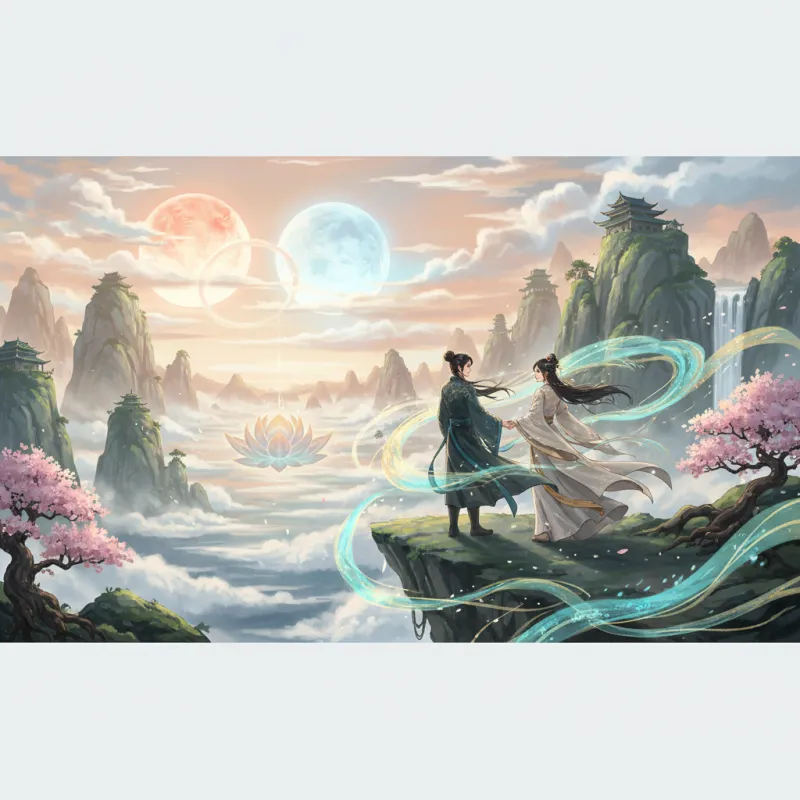
When Lin Feng's beloved died in his arms at the end of Against the Gods, he didn't just lose his companion — he lost three minor realms of cultivation progress and nearly shattered his foundation. This isn't melodrama. In xianxia fiction, heartbreak has a measurable power level, and it can kill you faster than any sword technique.
Romance in cultivation (修仙 xiūxiān) novels operates under different physics than regular fiction. It's not emotional seasoning sprinkled over the plot. It's a fundamental force that interacts with your spiritual root (灵根 línggēn), influences your dao heart (道心 dàoxīn), and can either accelerate your ascension or trap you at a bottleneck for centuries. The genre's most compelling tension isn't "will they get together?" — it's "will getting together destroy their cultivation, or complete it?"
The Mechanics of Heart Demons
Heart demons (心魔 xīnmó) are the primary mechanism through which romance affects power. They're not metaphorical. In cultivation fiction, they're actual spiritual entities that form from unresolved emotional attachments and manifest during heavenly tribulation (天劫 tiānjié) to kill you.
The classic example appears in I Shall Seal the Heavens when Meng Hao faces his tribulation to reach Spirit Severing realm. His heart demon takes the form of Xu Qing, the woman he loves, and attacks him with the one question that could shatter his dao heart: "If you had to choose between me and the dao, which would you pick?" This isn't a relationship quiz. Get the answer wrong and the tribulation lightning vaporizes you.
The mechanics work like this: emotional attachment creates spiritual weight. That weight either grounds your cultivation or drags it down, depending on whether the attachment aligns with your dao. A cultivator pursuing the Ruthless Dao (无情道 wúqíngdào) who falls in love has just created a fundamental contradiction in their spiritual foundation. That contradiction becomes a heart demon. During tribulation, when your entire being is tested, that demon manifests and exploits the weakness.
But here's where it gets interesting — heart demons aren't always bad. Some cultivation paths require them. The Emotion Dao (情道 qíngdào) specifically cultivates through emotional experience. For these practitioners, suppressing love would create the heart demon, not experiencing it. The system is morally neutral but mechanically precise.
When Love Becomes a Cultivation Resource
Dual cultivation (双修 shuāngxiū) is the most obvious example of romance as power mechanism, but it's far from the only one. For a deeper dive into how this works, see Dual Cultivation: The Most Misunderstood Concept in Cultivation Fiction.
Some cultivation methods explicitly require emotional bonds. The Yin-Yang Harmony Scripture (阴阳和合经 yīnyáng héhé jīng) that appears in multiple novels can only be practiced by partners with genuine emotional connection. Fake it, and the technique backfires, damaging both practitioners' foundations. The system has a built-in authenticity detector.
A Record of Mortal's Cultivation to Immortality handles this with characteristic pragmatism. Han Li encounters several cultivation techniques that would benefit from partnership, but he's too paranoid about betrayal to pursue them. This isn't a character flaw — it's a strategic calculation. The power boost from partnership techniques might be less valuable than the security of solo cultivation. He's running a cost-benefit analysis on romance.
The most sophisticated treatment appears in Forty Millenniums of Cultivation, where Li Yao and Ding Lingdang's relationship directly affects their combat effectiveness. When they fight together, their spiritual energy synchronizes, creating combination attacks impossible for either alone. But this synchronization also means they feel each other's pain. If one is injured, both are weakened. The novel treats their romance as a tactical decision with measurable combat implications.
The Dao Heart Paradox
Your dao heart (道心 dàoxīn) is your spiritual will — the unshakeable conviction that allows you to advance through realms. Romance can either strengthen it or crack it, and the difference often isn't clear until it's too late.
The paradox: a dao heart must be unshakeable, but complete emotional detachment often makes it brittle. Cultivators who sever all attachments in pursuit of the Ruthless Dao frequently discover they've created a different vulnerability. When they finally encounter something that moves them — and they always do, usually at the worst possible moment — they have no emotional framework to process it. The resulting heart demon is catastrophic.
Renegade Immortal explores this through Wang Lin's character arc. He starts by trying to suppress all emotion after his family's death, believing this will strengthen his dao heart. It doesn't. His suppressed grief becomes a festering heart demon that nearly kills him multiple times. His breakthrough comes when he accepts that his love for his dead family isn't a weakness — it's the foundation of his dao. His path is revenge and protection, which requires emotional connection to have meaning.
The novels that handle this best treat the dao heart not as emotional absence but as emotional clarity. You don't eliminate feelings; you integrate them into your cultivation path without letting them control you. This is much harder than simple suppression, which is why most cultivators fail at it.
Tribulation Romance: The Worst Possible Timing
Heavenly tribulation (天劫 tiānjié) has a sadistic sense of timing. The moment you're trying to break through to the next major realm, when you're most vulnerable, is exactly when your heart demons manifest. And they always take the form of your romantic attachments.
The tribulation tests whether your dao heart is genuine or performative. If you've been lying to yourself about your feelings — either pretending you don't care when you do, or pretending you care when you don't — the tribulation exposes it. The lightning doesn't care about your excuses.
Martial World features a particularly brutal example when Lin Ming faces his tribulation to reach Divine Sea realm. His heart demon manifests as a scenario where he must choose between saving his loved ones and completing his cultivation. The trick is that there's no right answer — the test is whether he can make a choice and accept the consequences without his dao heart shattering. Hesitation kills you. Regret kills you. Only absolute conviction in your choice, whatever it is, lets you survive.
This creates a fascinating narrative pressure. Cultivators can't afford to be emotionally confused during tribulation, which means they need to resolve their romantic situations before attempting breakthrough. But resolving romantic situations often creates new emotional turbulence. The timing is impossible, which is the point.
The Longevity Problem
Here's the issue nobody talks about: cultivation extends lifespan dramatically, but not everyone cultivates at the same rate. Fall in love with a mortal, and you'll watch them age and die while you're still young. Fall in love with a fellow cultivator who's less talented, and you face the same problem on a longer timescale.
Coiling Dragon addresses this directly. Linley's relationship with Delia works because they cultivate at similar rates and reach similar realms. But the novel shows multiple side characters whose relationships fail because of cultivation disparity. One partner reaches Deity realm and essentially becomes a different species while the other is stuck at Saint level. The relationship doesn't survive the transformation.
This creates a brutal selection pressure: cultivators tend to partner with people at similar power levels, not because of shallow status-seeking, but because it's the only way the relationship can survive long-term. Romance becomes another form of cultivation resource competition. You're not just looking for emotional compatibility — you're looking for someone whose cultivation speed matches yours.
Some novels treat this as tragedy. Others treat it as simple mechanics. Reverend Insanity takes the coldest possible view: Fang Yuan deliberately avoids romantic attachment specifically because of the longevity problem. He's planning to cultivate for millions of years. Any relationship he forms now is temporary by definition, so why create the emotional vulnerability? It's ruthless, but the math checks out.
When the System Rewards Love
Not all cultivation systems punish romance. Some explicitly reward it, creating interesting strategic implications.
The Emotion Dao (情道 qíngdào) paths require emotional experience to advance. Practitioners must genuinely feel love, loss, joy, and grief to progress through realms. Faking it doesn't work — the cultivation method can detect authenticity. This creates a bizarre situation where cultivators pursuing this path must genuinely fall in love as a cultivation requirement, but they're also aware they're doing it for power. The self-awareness creates a recursive loop that the best novels explore in depth.
Tales of Demons and Gods features cultivation techniques that grow stronger based on the depth of emotional bonds. Nie Li's power explicitly increases when he's protecting people he cares about. This isn't metaphorical motivation — it's a measurable combat multiplier. The system rewards emotional investment with mechanical power increases.
The most interesting version appears in novels where couple cultivation techniques (双修功法 shuāngxiū gōngfǎ) require emotional synchronization. Partners must genuinely trust and understand each other for the technique to work. This creates a situation where emotional intimacy is a prerequisite for power, but pursuing power can corrupt emotional intimacy. The novels that explore this tension seriously are doing something sophisticated with the romance-power dynamic.
The Strategic Marriage Problem
When romance affects power, marriage becomes strategy. This is where cultivation fiction gets uncomfortably close to historical reality.
Cultivation clans arrange marriages to combine bloodline abilities, merge spiritual roots, or create alliance bonds. The participants' feelings are secondary to the mechanical benefits. Martial God Asura features this extensively — Chu Feng constantly encounters situations where powerful families want him to marry their daughters specifically to access his cultivation talent or bloodline.
The interesting question is whether strategic marriages can develop genuine feeling, and whether that feeling then affects the power dynamics. Some novels say yes — the mechanical benefits of the marriage create proximity and shared experience that leads to real attachment. Others say no — marriages formed for power remain transactional, and trying to force genuine feeling creates heart demons.
The most cynical take appears in Warlock of the Magus World. Leylin treats relationships as pure resource optimization. He partners with people when it benefits his cultivation and discards them when it doesn't. The novel doesn't punish him for this because his dao is explicitly selfish. His dao heart is perfectly aligned with his actions, so no heart demon forms. It's emotionally cold but mechanically consistent.
The Ascension Separation
The final test of cultivation romance: ascension to higher realms. When you break through to Immortal realm and ascend to the higher planes, can your partner come with you? If not, do you wait for them, potentially stalling your own cultivation? Or do you ascend alone and hope to reunite later?
Stellar Transformations builds its entire emotional arc around this question. Qin Yu's relationship with Jiang Li is defined by the ascension problem. They're separated by realm barriers multiple times, and each separation tests whether their bond survives the distance and time. The novel treats ascension not as the end of the relationship but as a recurring challenge that either strengthens or breaks it.
The cruelest version: ascending to a higher realm sometimes erases memories of the lower realm. You forget your mortal attachments as part of the transformation. Some cultivation systems treat this as a feature, not a bug — it's the final severing of earthly ties. But it means your romance has an expiration date built into the power system itself.
For more on how partnership affects cultivation mechanics, see The Science Behind Dual Cultivation Techniques.
Romance in cultivation fiction isn't decoration. It's a force that interacts with every other system in the genre — tribulation, dao heart, longevity, ascension. The best novels treat it with the same mechanical rigor they apply to combat techniques and realm progression. Love isn't separate from power. It's another form of power, with its own costs and benefits, and you'd better understand the exchange rate before you commit.
Related Reading
- Partner Cultivation: Romance and Power
- Yin-Yang Dual Cultivation: Philosophy Behind the Practice
- Body Cultivation vs. Soul Cultivation: Two Paths to Power
- Storage Rings: Spatial Magic in Cultivation
- Pill Refining: The Alchemist's Art in Cultivation Fiction
- Righteous vs. Demonic Sects: The Great Divide in Cultivation Fiction