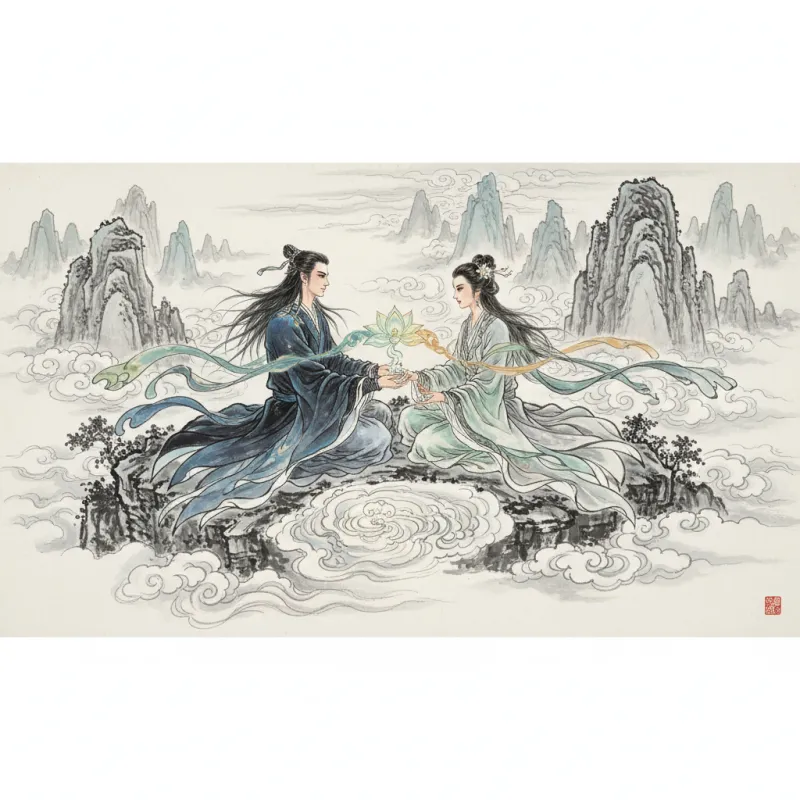
Most cultivation novels treat dual cultivation like a dirty secret—mentioned in hushed whispers, relegated to mature-rated chapters, or used as cheap plot device for power-ups. But here's what drives me crazy: the actual Daoist texts that inspired this concept? They're discussing one of the most sophisticated energy cultivation theories in Chinese philosophy. Somewhere between the Huangdi Neijing and modern web novels, we lost the plot entirely.
The Real Deal: What the Classics Actually Say
When Zhang Boduan wrote the Wuzhen Pian (悟真篇 Wùzhēn Piān, "Awakening to Reality") in 1075 CE, he wasn't being coy. He explicitly described dual cultivation (双修 shuāngxiū) as the harmonization of internal yin and yang energies—sometimes through partnership with another cultivator, sometimes through solo internal alchemy. The Song Dynasty Daoists understood something modern readers often miss: the "dual" in dual cultivation doesn't necessarily mean "two people." It means balancing two complementary forces.
The Cantong Qi (参同契 Cāntóng Qì), written around 142 CE by Wei Boyang, laid the groundwork. It describes the marriage of fire and water, lead and mercury, dragon and tiger—all metaphors for internal energy processes. Yes, some lineages interpreted this as requiring a physical partner. Others saw it as purely internal work. Both were considered valid paths, and neither was considered the "lesser" approach.
Here's where it gets interesting: the texts that do discuss partner-based cultivation treat it with the same clinical precision as modern chemistry textbooks. The Sūnǚ Jīng (素女经, "Classic of the Plain Girl") reads less like erotica and more like an instruction manual for synchronized meditation. Timing, breath control, energy circulation patterns, specific acupoint activation sequences—it's technical as hell.
Why Modern Novels Get It Wrong (And Right)
Walk into any cultivation novel, and dual cultivation appears in one of three flavors: the power-up excuse, the harem justification, or the rare gem that actually explores the philosophy. Against the Gods uses it as transparent plot armor. Martial God Asura treats it like collecting Pokemon. But then you get something like A Will Eternal, where Er Gen actually plays with the concept's comedic potential while respecting its theoretical foundation.
The problem isn't that novels include the physical aspect—that's textually supported. The problem is the laziness. Real dual cultivation theory requires:
Complementary cultivation bases. You can't just grab any random cultivator. The Huangting Jing (黄庭经 Huángtíng Jīng) specifies that partners need opposing but compatible energy signatures. A pure yang fire cultivator pairing with another fire cultivator? That's not dual cultivation, that's a house fire waiting to happen.
Equivalent cultivation levels. The energy exchange needs balance. When novels have a Nascent Soul cultivator "dual cultivate" with a Qi Condensation junior, that's not cultivation—that's exploitation with extra steps. The classical texts are explicit: significant realm gaps make true energy exchange impossible. One partner just becomes a resource.
Mutual benefit and consent. This should be obvious, but apparently needs stating. The Daoist texts frame dual cultivation as a mutual practice where both parties advance. The moment it becomes one-sided extraction, you've left cultivation territory and entered demonic practice. There's a reason the classics categorize forced or deceptive dual cultivation under xié xiū (邪修, evil cultivation).
The Solo Path: Internal Dual Cultivation
Here's what most readers don't realize: the majority of historical Daoist practitioners never had a partner for dual cultivation. They practiced nèidān (内丹, internal alchemy), which is essentially dual cultivation with yourself. You're balancing your own internal yin and yang, circulating energy through specific meridian pathways, and achieving the same harmonization without external partnership.
The Xingming Guizhi (性命圭旨, "Principles of Nature and Life") from the Ming Dynasty contains detailed diagrams showing solo cultivation methods that mirror partner-based techniques. Same energy theory, same goals, different methodology. In fact, many lineages considered solo cultivation the superior path because it eliminated variables and potential complications.
Think about it practically: if you need a perfectly compatible partner at the exact same cultivation level who you trust completely and who shares your cultivation goals—that's a tall order. Most cultivators historically just worked with what they had: themselves. The novels that ignore this option are missing out on interesting character development. Imagine a protagonist who chooses solo cultivation despite having potential partners, because they value independence or have trust issues from past betrayals.
When It Actually Works in Fiction
Coiling Dragon does something clever—it barely mentions dual cultivation at all, focusing instead on other partnership dynamics. Sometimes the best way to handle a controversial concept is to acknowledge it exists in-universe but isn't the protagonist's path. That's more realistic anyway. Not every cultivator practices every technique.
I Shall Seal the Heavens takes a different approach. Er Gen includes dual cultivation as part of the world's cultivation system but treats it with the gravitas it deserves. When it appears, it's a significant plot point with real consequences, not a throwaway power-up. The energy exchange mechanics actually follow logical rules consistent with the novel's established cultivation theory.
The best implementation I've seen? Forty Millenniums of Cultivation. It's sci-fi cultivation, so it reframes dual cultivation through a technological lens—synchronized cultivation chambers, energy frequency matching, neural link protocols. By stripping away the euphemistic language and treating it as the technical energy exchange it theoretically is, the novel makes the concept actually interesting again.
The Yin-Yang Philosophy Nobody Talks About
Let's get philosophical for a moment. The reason dual cultivation exists as a concept at all is because of fundamental Daoist cosmology. The universe operates through complementary opposites: yin and yang, stillness and motion, receptive and active. A cultivator seeking immortality needs to balance these forces within themselves.
The Daodejing (道德经 Dàodéjīng) says: "Know the masculine, keep to the feminine" (知其雄,守其雌 zhī qí xióng, shǒu qí cí). This isn't gender essentialism—it's about energy qualities. Yang energy is expansive, active, hot. Yin energy is contractive, receptive, cool. Every human has both, regardless of gender. Cultivation requires balancing them.
Partner-based dual cultivation, in theory, allows cultivators to experience and integrate the opposite energy more directly. A yang-dominant cultivator partners with a yin-dominant cultivator, and through careful energy exchange, both become more balanced. It's elegant in theory. In practice, as the classical texts acknowledge, it's incredibly difficult to do correctly and safely.
This is why the Zhong-Lü Chuandao Ji (钟吕传道集, "Anthology of the Transmission of the Dao from Zhongli Quan to Lü Dongbin") spends more time warning about the dangers of dual cultivation than explaining its benefits. Energy deviation, cultivation base damage, even death—all possible outcomes if the practice goes wrong. The texts treat it like advanced chemistry: powerful when done right, catastrophic when done wrong.
What Good Dual Cultivation Writing Looks Like
If you're going to include dual cultivation in your story, here's the checklist from someone who's read way too many cultivation novels:
Establish the rules early. Don't suddenly introduce dual cultivation at chapter 847 as a convenient solution. Build it into your world's cultivation system from the start. Show us how it works, what the risks are, who practices it and why.
Make it meaningful. Dual cultivation should be a significant decision with lasting consequences, not a casual power-up. The classical texts treat it as a major cultivation milestone. Your story should too.
Show the preparation. Real dual cultivation requires meditation, energy alignment, specific timing, protective formations, and often supervision from a master. The novels that skip straight to the "good part" are missing the entire point. The preparation is the cultivation.
Include failure states. What happens when dual cultivation goes wrong? Energy deviation? Cultivation base damage? Karmic entanglement? The classics are full of warnings. Your story should acknowledge the risks.
Respect agency. Both parties should be willing, informed participants with clear understanding of what they're doing and why. Anything less isn't cultivation—it's assault with mystical window dressing.
For more on how energy exchange works in cultivation systems, check out Qi Condensation Realm. And if you're interested in how partnerships function in cultivation, Dao Companions explores the broader relationship dynamics beyond just dual cultivation.
The Uncomfortable Truth
Here's my hot take: most cultivation novels use dual cultivation as a crutch for bad writing. It's a shortcut to power progression, a justification for harem dynamics, or a way to add "mature content" without actually developing romantic relationships. The concept deserves better.
The original Daoist texts present dual cultivation as one path among many—not superior, not inferior, just different. It requires specific circumstances, compatible partners, and tremendous skill to execute safely. Most cultivators historically never practiced it. Those who did treated it with the seriousness it deserved.
Modern novels could learn from this. Dual cultivation doesn't need to be in every story. When it is included, it should be handled with the same care and detail as any other advanced cultivation technique. Show us the theory, the preparation, the risks, the consequences. Make it matter.
Or, radical idea: write a cultivation novel where dual cultivation exists in the world but the protagonist never practices it. Not because they're prudish or morally superior, but because it's not their path. They're focused on sword cultivation, or alchemy, or formation arrays. Dual cultivation is just one technique among thousands, and not every cultivator learns every technique.
That would be refreshing. That would be honest to the source material. That would be good writing.
Related Reading
- Partner Cultivation: Romance and Power
- Yin-Yang Dual Cultivation: Philosophy Behind the Practice
- Cultivation and Romance: How Love Affects Power in Xianxia
- Body Cultivation vs. Soul Cultivation: Two Paths to Power
- The Alchemist's Arsenal: Cauldrons, Furnaces, and Essential Equipment
- The Black Market: Forbidden Goods in the Cultivation World
- The Inscription Arts: Talismans, Runes, and the Written Word as Weapon