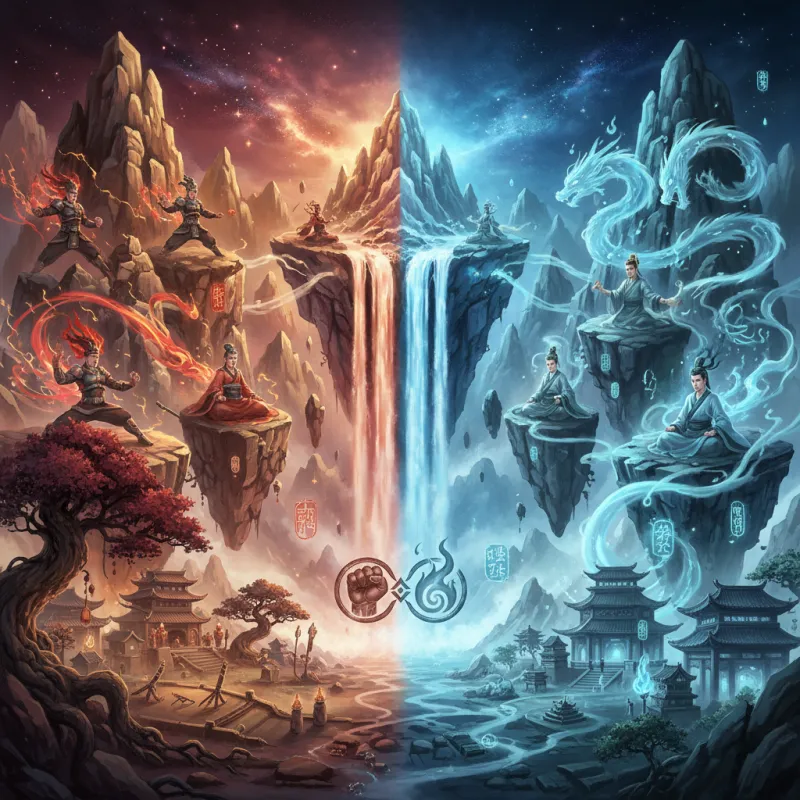
Every cultivation novel has that moment when the protagonist faces an opponent who shouldn't exist. The enemy's spiritual energy is pathetic — barely Foundation Establishment — but when your Nascent Soul attack hits them, it's like punching a mountain. Their body doesn't just resist; it devours your technique. That's a body cultivator (体修 tǐxiū), and they're about to ruin your day. Meanwhile, across the battlefield, someone with the physical presence of a scholar casually erases a Golden Core expert with a thought. Their body is fragile, but their soul cultivation (魂修 húnxiū) has reached a level where physical laws are merely suggestions. These aren't just different power systems — they're opposing philosophies about what it means to transcend mortality.
The Body Path: Forging Flesh Into Divinity
Body cultivation treats your physical form as both weapon and fortress. While soul cultivators circulate qi through meridians and condense it in their dantian, body cultivators force that same energy directly into their muscles, bones, and organs. It's alchemy performed on living tissue. The process is exactly as painful as it sounds.
The classic body cultivation method involves the Nine Transformations (九转 jiǔzhuǎn): Skin Tempering, Flesh Refinement, Bone Forging, Organ Strengthening, Marrow Cleansing, Blood Transformation, Meridian Expansion, Viscera Rebirth, and finally Physical Sanctification. Each stage requires breaking down your body and rebuilding it stronger. Skin Tempering alone typically involves bathing in medicinal decoctions that feel like liquid fire, then enduring strikes from increasingly powerful weapons until your skin develops the texture of spirit beast hide.
The payoff? A Foundation Establishment body cultivator can trade blows with a Golden Core soul cultivator. Their physical strength operates on a different scale entirely. When Han Li in A Record of a Mortal's Journey to Immortality encounters body cultivators from the Great Jin, he's shocked to discover they can shatter his defensive artifacts with bare hands despite being a full realm below him. That's the body cultivation advantage: your power is always on. No need to activate techniques, maintain formations, or worry about qi exhaustion. Your body itself is the technique.
The downside? Progress is glacially slow and requires resources that would bankrupt most sects. A single Body Tempering Pill might cost more than a soul cultivator spends on breakthrough materials for three realms. And the pain never stops. Soul cultivators meditate peacefully; body cultivators are constantly subjecting themselves to controlled torture. There's a reason most cultivation worlds have far fewer body cultivators than soul cultivators — most people simply can't endure it.
The Soul Path: Consciousness as Ultimate Weapon
Soul cultivation is the art of expanding and weaponizing consciousness itself. Your divine sense (神识 shénshí) becomes a blade sharper than any sword. Your spiritual pressure can crush weaker cultivators without physical contact. At high levels, soul cultivators can split their consciousness, possess others, or even survive the destruction of their physical body by existing as pure spiritual energy.
The foundation of soul cultivation is the sea of consciousness (识海 shíhǎi) — a metaphysical space within your mind where spiritual power accumulates. Soul cultivators spend decades expanding this space, strengthening its boundaries, and refining the quality of spiritual energy it contains. Unlike body cultivation's straightforward brutality, soul cultivation requires meditation, comprehension, and mental discipline. You're not just gathering power; you're fundamentally altering the structure of your consciousness.
The advantages are immediate and obvious. Soul cultivators can use divine sense to scan their surroundings for miles, detect hidden enemies, and perceive things invisible to normal sight. Their spiritual attacks bypass physical defenses entirely — what good is impenetrable skin when your enemy can directly assault your mind? In Renegade Immortal, Wang Lin's soul cultivation allows him to dominate opponents several realms above him through sheer spiritual pressure. His divine sense becomes so powerful it can materialize as physical force, crushing mountains and parting seas.
But soul cultivation has a critical weakness: the body remains mortal. A soul cultivator at Nascent Soul stage might have spiritual power that could level cities, but a well-placed arrow from a mortal archer could still kill them if they're caught off-guard. Their physical form is a liability, a fragile vessel containing immense power. This is why soul cultivators obsess over defensive artifacts, protective formations, and body doubles. They're glass cannons — devastating offensive power wrapped in tissue paper.
The Eternal Imbalance
Here's the dirty secret of cultivation worlds: these paths aren't actually balanced. Soul cultivation is objectively superior in most scenarios, which is why 90% of cultivators follow it. The resource investment is lower, the progress is faster, and the versatility is unmatched. A soul cultivator can fly, use ranged attacks, employ thousands of different techniques, and adapt to any situation. A body cultivator can... punch really hard and take a beating.
This imbalance is why body cultivation is often portrayed as the underdog path, the choice of those who lack spiritual roots or can't afford proper cultivation manuals. In Martial World, Lin Ming initially pursues body cultivation because his spiritual roots are mediocre. It's presented as making the best of a bad situation. The narrative treats body cultivation as the hard mode option — you'll struggle more, but if you succeed, you'll be uniquely powerful.
The few advantages body cultivation offers are significant but niche. Body cultivators excel in close combat, can operate in qi-depleted environments where soul cultivators are helpless, and their power can't be sealed or suppressed as easily. When a soul cultivator's dantian is damaged, they're crippled. When a body cultivator's dantian is damaged, they're... slightly inconvenienced. Their power is distributed throughout their entire physical form, making them incredibly difficult to permanently disable.
Dual Cultivation: Having Your Cake and Eating It
The obvious solution is to cultivate both paths simultaneously, creating a cultivator with no weaknesses. In practice, this is nearly impossible. Body and soul cultivation require different resources, different training methods, and different mental approaches. The time investment alone is prohibitive — most cultivators struggle to progress in one path, let alone two.
Yet dual cultivation (双修 shuāngxiū) remains the dream, and the truly exceptional protagonists usually manage it. The key is finding synergy between the paths rather than treating them as separate systems. When your body is strong enough to channel more qi without damage, your soul cultivation accelerates. When your divine sense is powerful enough to precisely control energy flow, your body tempering becomes more efficient. The paths can reinforce each other if you're clever about it.
The most successful dual cultivators don't split their focus 50/50. Instead, they establish a foundation in one path, then supplement it with the other. A soul cultivator might practice basic body tempering to eliminate their physical weakness without committing to the full Nine Transformations. A body cultivator might develop their divine sense just enough to detect ambushes and scan for treasures. This pragmatic approach is far more common than true dual cultivation mastery.
For those rare individuals who do achieve balance, the results are terrifying. They combine the soul cultivator's versatility and range with the body cultivator's durability and close-combat dominance. They have no obvious weakness to exploit. In Desolate Era, Ji Ning's dual cultivation allows him to fight opponents multiple realms above him — his body can withstand attacks that would vaporize normal cultivators, while his soul techniques give him the offensive power to threaten anyone.
The Philosophical Divide
Beyond mechanics, these paths represent fundamentally different worldviews. Body cultivation is materialist — power comes from the physical, the tangible, the real. Your body is the only thing you can truly rely on. Soul cultivation is idealist — consciousness is primary, and physical reality is just one manifestation of spiritual truth. The body is temporary; the soul is eternal.
This philosophical split creates cultural divisions within cultivation worlds. Body cultivators tend to be straightforward, valuing honesty and direct confrontation. They can't hide their power level as easily as soul cultivators, so they develop a culture of open strength. Soul cultivators are more likely to scheme, hide their true capabilities, and strike from the shadows. When your power is invisible and your body is weak, deception becomes survival.
The tension between these approaches drives countless cultivation novel plots. The body cultivator who refuses to use "cowardly" soul techniques and insists on face-to-face combat. The soul cultivator who views body cultivation as barbaric and inefficient. The rare dual cultivator who bridges both worlds and forces everyone to reconsider their assumptions. These aren't just power systems — they're character archetypes, narrative frameworks, and thematic explorations of different paths to transcendence.
Choosing Your Path
For cultivators in these fictional worlds, the choice between body and soul cultivation often isn't really a choice at all. Your spiritual roots, your resources, your sect's specialization, and your personal circumstances usually decide for you. But for readers, the question is more interesting: which path resonates with you?
Do you prefer the body cultivator's straightforward progression, where every gain is earned through visible suffering and your power is undeniable? Or the soul cultivator's elegant complexity, where comprehension and insight matter more than physical endurance? The answer reveals something about how you think power should work, what kind of strength you value, and what price you're willing to pay for transcendence.
The beauty of cultivation fiction is that both paths lead to the same destination: immortality, ultimate power, and freedom from mortal constraints. The journey just looks very different depending on whether you're tempering your flesh or expanding your consciousness. And for those ambitious enough to walk both roads simultaneously, well — that's what makes a protagonist worth reading about.
Related Reading
- Cultivation and Romance: How Love Affects Power in Xianxia
- Dual Cultivation: The Most Misunderstood Concept in Cultivation Fiction
- Yin-Yang Dual Cultivation: Philosophy Behind the Practice
- Partner Cultivation: Romance and Power
- Cultivation Worlds: How Web Novels Build Entire Universes
- Body Refinement: The Physical Path to Power
- The Most Famous Pills and Elixirs in Cultivation Fiction