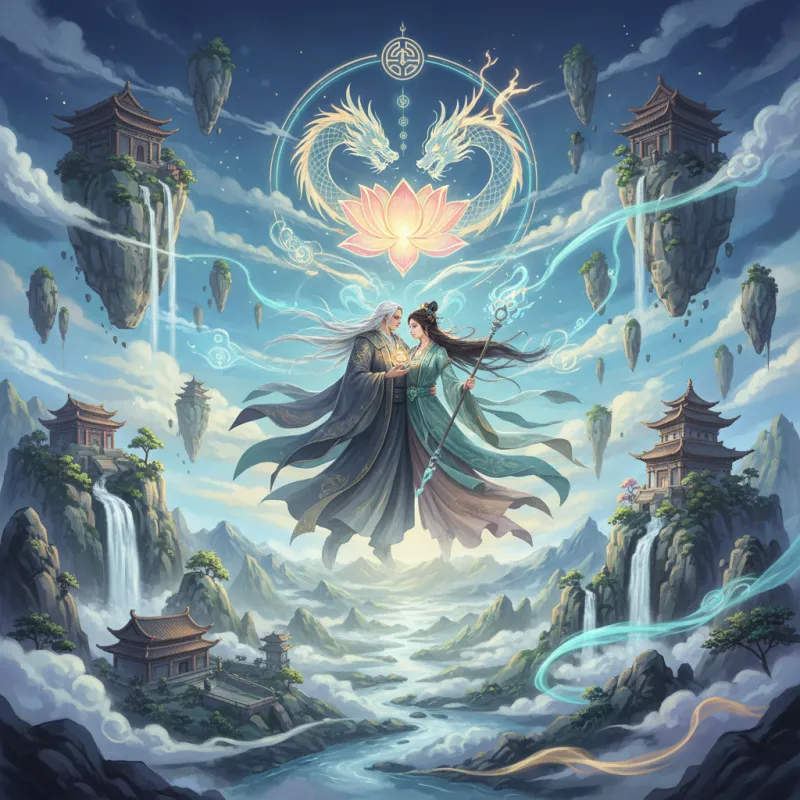
The first time Zhang Sanfeng's disciples asked him about dual cultivation, the legendary Wudang founder supposedly laughed for a full minute before answering. "You think it's about bedroom arts?" he said. "Then you understand nothing about yin and yang." That conversation — recorded in the Taiji Classics around 1340 CE — captures the eternal tension in dual cultivation (双修, shuāngxiū): a practice that's simultaneously one of the most profound concepts in Daoist cultivation and one of the most misunderstood, misused, and frankly, exploited tropes in xianxia fiction.
The Philosophy Nobody Wants to Hear About
Here's what dual cultivation actually means in classical Daoist texts: two practitioners harmonizing complementary energies to transcend limitations that solo cultivation imposes. The Huangting Jing (Yellow Court Classic) describes it as "two streams becoming one river" — the idea that yin and yang energies, when properly balanced, create something greater than their sum.
The key word is balance. Not dominance, not extraction, not one partner draining the other's cultivation base like some kind of spiritual vampire. Classical dual cultivation required:
- Equal cultivation levels (or close enough that neither overwhelms the other)
- Mutual consent and understanding of the technique
- Complementary energy types — usually yin-yang, but sometimes elemental opposites
- Years of preparation and trust-building
- A legitimate cultivation method, not just "let's have sex and call it training"
The Cantong Qi (The Seal of the Unity of the Three), written around 142 CE, devotes entire chapters to dual cultivation without once mentioning physical intimacy. Instead, it focuses on breath synchronization, energy circulation patterns, and the philosophical concept of neidan (内丹, inner alchemy) practiced in pairs.
Modern xianxia novels? They skip straight to the bedroom scene and slap a "dual cultivation" label on it.
When Romance Meets Power Leveling
The problem — or appeal, depending on your perspective — is that dual cultivation in fiction has become shorthand for "cultivation through intimacy." And look, I get it. The metaphor is right there. Yin and yang, masculine and feminine, two becoming one. It's not subtle.
Against the Gods handles this with all the grace of a sledgehammer. Yun Che's dual cultivation sessions are basically power-ups disguised as romance scenes, complete with realm breakthroughs mid-act. Tales of Demons and Gods at least tries to frame it as emotional connection mattering more than physical technique, though Nie Li's harem situation complicates that message.
The best treatment I've seen is in Martial World. Lin Ming's dual cultivation with his partners involves actual technique descriptions, energy circulation diagrams, and consequences when things go wrong. There's a scene where improper energy flow nearly cripples both practitioners — a reminder that this is supposed to be dangerous, advanced cultivation, not a convenient plot device for adding romance.
Compare this to Yin-Yang Balance in Cultivation, where the philosophical foundations actually matter to the practice.
The Consent Problem
Let's address the elephant in the cultivation cave: a disturbing number of xianxia novels treat dual cultivation as something that just happens to female characters. The protagonist "needs" to dual cultivate to break through a bottleneck, and conveniently, there's a beautiful woman whose yin energy is "perfectly compatible" with his yang energy.
This is garbage writing and worse philosophy.
Classical Daoist texts are explicit about this. The Sunu Jing (Plain Girl's Classic), despite being primarily about bedroom arts, emphasizes mutual benefit and mutual choice. The idea that one partner exists solely to boost the other's cultivation is antithetical to the entire concept of balance.
Good xianxia novels recognize this. In Coiling Dragon, Linley's relationship with Delia involves cultivation support, but it's mutual, consensual, and honestly kind of boring compared to the combat scenes — which is exactly how it should be. Their cultivation progress happens alongside their relationship, not because of manufactured dual cultivation scenarios.
Bad xianxia novels treat female characters as cultivation resources with extra steps. I'm looking at you, Martial God Asura. Chu Feng's approach to dual cultivation reads less like Daoist practice and more like a video game collecting power-ups.
The Harem Multiplication Problem
Once you introduce dual cultivation into a xianxia novel, the harem problem becomes inevitable. If dual cultivating with one partner provides benefits, why not two? Three? Seventeen?
The logic breaks down immediately if you think about it for more than five seconds. Classical dual cultivation requires deep synchronization between two practitioners. Adding more people doesn't multiply the benefits — it exponentially increases the complexity. Imagine trying to balance yin and yang energies between multiple partners simultaneously. The energy circulation patterns alone would be nightmarish.
Yet novels like Against the Gods and Martial God Asura treat dual cultivation like a stackable buff. Yun Che dual cultivates with multiple women, each providing different benefits, as if he's collecting Pokemon types. "This one has ice yin energy, this one has pure yin energy, this one has phoenix bloodline yin energy..."
The only novel I've seen address this honestly is Reverend Insanity. Fang Yuan explicitly notes that dual cultivation with multiple partners is inefficient and potentially dangerous, requiring separate techniques for each pairing. He mostly avoids it entirely, which tracks with his ruthlessly practical character.
When It Actually Works in Fiction
So what does good dual cultivation look like in xianxia novels?
Desolate Era gets it right. Ji Ning's relationship with Yu Wei involves cultivation support, but it's framed as partnership, not power-leveling. When they do practice together, it's described as meditation and energy harmonization, not thinly-veiled erotica. Their cultivation bases grow together because they support each other's understanding of the Dao, not because of magical sex energy.
Lord of the Mysteries takes a different approach by mostly avoiding dual cultivation entirely, instead focusing on Cultivation Through Enlightenment as a solo path. Klein's relationships exist separately from his cultivation progress, which honestly feels more authentic to the mystery-horror tone of the novel.
Forty Millenniums of Ghost deserves mention for actually exploring the logistics. Li Yao and Ding Lingdang's cultivation involves synchronized training, shared insights, and mutual support — but also arguments about technique, disagreements about cultivation direction, and the realistic friction of two strong-willed cultivators trying to harmonize their approaches.
The Historical Reality Check
Here's something most xianxia novels ignore: historical dual cultivation practices were rare, controversial, and often condemned by mainstream Daoist sects.
The Zhengyi (Orthodox Unity) school explicitly forbade dual cultivation practices, viewing them as corruptions of proper Daoist cultivation. The Quanzhen (Complete Reality) school, founded in the 12th century, required celibacy for serious practitioners. When dual cultivation was practiced, it was typically within established marriages, not as a cultivation technique for accelerating progress.
The Shangqing (Highest Clarity) school texts from the 4th-6th centuries mention dual cultivation, but frame it as advanced practice requiring decades of preparation. We're talking about cultivators who'd already achieved significant attainment attempting to reach even higher realms through partnership — not teenagers using it as a shortcut to Foundation Establishment.
Modern xianxia novels have essentially invented a version of dual cultivation that never existed in historical practice, then projected it backward as "ancient technique." It's historical fiction in the worst sense: fiction masquerading as history.
Making It Mean Something
The tragedy of dual cultivation in xianxia fiction is that the core concept — two people supporting each other's growth, combining strengths, achieving together what neither could alone — is genuinely beautiful. It's a metaphor for healthy partnership that happens to use cultivation terminology.
But most novels reduce it to a mechanical power-up system or, worse, a justification for harem-building. The philosophical depth gets lost in favor of wish-fulfillment fantasy.
The best xianxia novels treat dual cultivation as what it should be: a profound connection between two practitioners who've chosen to walk the cultivation path together. Not a shortcut, not a power-up, not a collection mechanic. A partnership.
When Martial World shows Lin Ming and his partners struggling to synchronize their energy circulation, nearly failing, having to rebuild trust after mistakes — that's dual cultivation done right. When Against the Gods treats it as "protagonist has sex, gains power" — that's lazy writing wearing a cultivation robe.
The difference matters. One explores what it means to truly harmonize with another person, to trust them with your cultivation base, to grow together. The other is just power fantasy with extra steps.
If you're interested in how cultivation partnerships work beyond the romantic angle, check out Master-Disciple Cultivation Bonds for a different perspective on shared cultivation progress.
Related Reading
- Dual Cultivation: The Most Misunderstood Concept in Cultivation Fiction
- Cultivation and Romance: How Love Affects Power in Xianxia
- Yin-Yang Dual Cultivation: Philosophy Behind the Practice
- Body Cultivation vs. Soul Cultivation: Two Paths to Power
- Mystical Beasts in Chinese Cultivation Fiction: Guardians of the Immortal Spiritual Realms
- Top 10 Cultivation Web Novels That Changed the Genre
- Unraveling the Mysteries of Formations in Chinese Cultivation and Xianxia Fiction