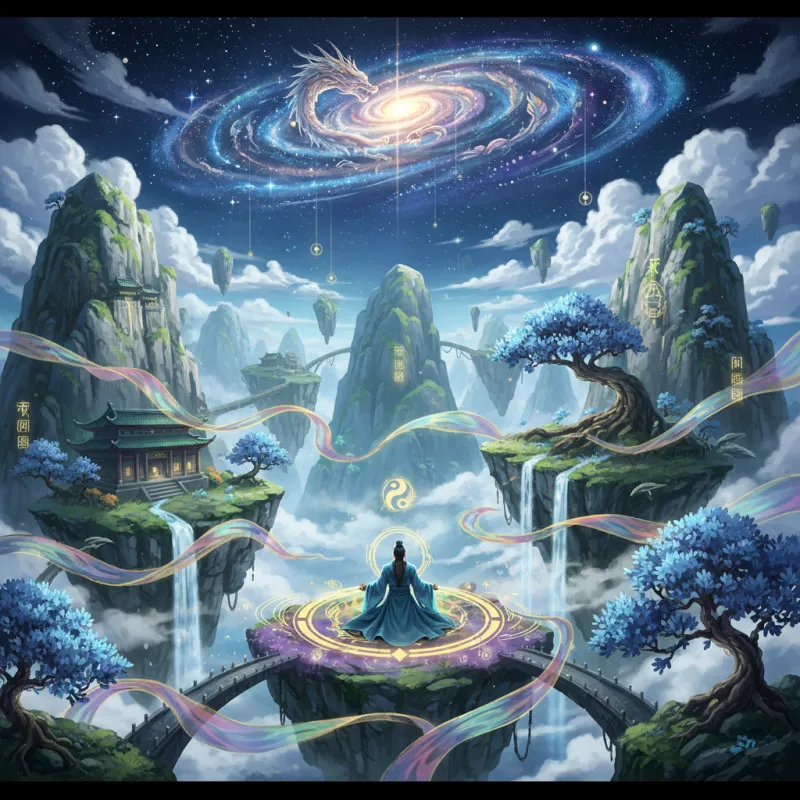
A cultivator stands at the peak of the Nascent Soul realm, capable of splitting mountains with a gesture and crossing oceans in a single breath. Yet when faced with the simplest question—"What is the Dao?"—they fall silent. This isn't ignorance. It's wisdom. Because the moment you think you've captured the Dao in words, you've already lost it. Laozi knew this 2,500 years ago when he opened the Tao Te Ching (道德经 dàodéjīng) with perhaps the most frustrating sentence in philosophical history: "The Dao that can be spoken is not the eternal Dao." And yet, every cultivation novel must somehow speak it anyway.
The Dao: The Ungraspable Foundation
The Dao (道 dào) predates cultivation fiction by millennia. When Laozi wrote about it in the 6th century BCE, he wasn't describing a power system for immortals—he was trying to articulate the fundamental nature of reality itself. The character 道 combines "head" and "movement," suggesting a path or way, but also the act of leading or guiding. In classical Daoist thought, the Dao is simultaneously the source of all things, the pattern underlying all existence, and the natural way things unfold when left to their own devices.
Cultivation novels inherited this concept and did something audacious: they made it tangible. In I Shall Seal the Heavens by Er Gen, the protagonist Meng Hao doesn't just philosophize about the Dao—he literally seals it, steals it, and eventually becomes it. In Renegade Immortal (仙逆 xiān nì), Wang Lin's entire journey revolves around defying the Dao itself, treating cosmic law as an opponent to be overcome rather than a truth to be accepted. This transformation from abstract philosophy to concrete power system is what makes xianxia fiction distinct from its philosophical roots.
But here's what the best novels understand: the Dao remains fundamentally mysterious even when characters are manipulating it. In A Record of a Mortal's Journey to Immortality (凡人修仙传 fánrén xiūxiān zhuàn), Han Li spends hundreds of chapters accumulating power, but his breakthrough moments always involve insight rather than brute force. The Dao isn't just spiritual energy (灵气 língqì) with a fancy name—it's the reason spiritual energy behaves the way it does in the first place.
Heavenly Laws: When the Universe Has Rules
If the Dao is the underlying nature of reality, then Heavenly Laws (天道 tiāndào or 天法 tiānfǎ) are its enforcement mechanisms. Think of them as cosmic physics—not suggestions, but inviolable rules that govern everything from cultivation realms to the behavior of spiritual roots.
The most visible manifestation of Heavenly Laws is the Heavenly Tribulation (天劫 tiānjié). When a cultivator attempts to break through to a higher realm—particularly during the transition to Nascent Soul or beyond—the heavens themselves respond with lightning tribulations designed to destroy them. This isn't punishment for arrogance, though many novels frame it that way. It's quality control. The universe has standards, and if you want to exist at a higher level of reality, you need to prove you can handle it.
Coiling Dragon by I Eat Tomatoes presents one of the most systematic explorations of Heavenly Laws in the genre. In that novel's cosmology, different planes of existence operate under different fundamental laws, and understanding these laws is more important than raw power. A deity-level expert in one plane might be helpless in another simply because they don't comprehend the local rules. This concept—that power is contextual and law-dependent—adds philosophical depth to what could otherwise be simple power escalation.
But Heavenly Laws aren't just about tribulations and restrictions. They also define what's possible. In Martial World (武极天下 wǔjí tiānxià), the protagonist Lin Ming's journey involves not just getting stronger, but understanding the fundamental laws governing martial arts, space, time, and life itself. Each major breakthrough comes from grasping a deeper layer of cosmic law. The novel suggests that ultimate power isn't about breaking the rules—it's about understanding them so thoroughly that you can work within them at a level others can't imagine.
The Relationship Between Dao and Law
Here's where it gets philosophically interesting: the Dao and Heavenly Laws aren't the same thing, but they're intimately connected. The Dao is the source; Heavenly Laws are the expression. The Dao is water; Heavenly Laws are the channels it flows through. The Dao is the music; Heavenly Laws are the instruments playing it.
In Desolate Era by I Eat Tomatoes, this distinction becomes crucial. The protagonist Ji Ning eventually realizes that Heavenly Laws—even the seemingly absolute ones—are actually just one interpretation of the Dao. They're the default settings, the standard configuration. But the Dao itself is deeper and more flexible than any particular set of laws. This realization allows him to transcend the Heavenly Laws without violating the Dao—he's not breaking reality, he's accessing a more fundamental layer of it.
This relationship mirrors classical Daoist philosophy more closely than you might expect. Laozi distinguished between the Dao itself and the "ten thousand things" that emerge from it. Heavenly Laws, in cultivation fiction, are essentially codified versions of how the ten thousand things interact. They're real and binding, but they're not ultimate. The Dao is ultimate; everything else is derivative.
Comprehending the Dao: The Real Cultivation
Physical cultivation—gathering spiritual energy, refining the body, forming a golden core—is the obvious path. But Dao comprehension (悟道 wùdào) is the hidden path that determines who actually reaches the peak. You can have infinite spiritual energy, but without understanding the Dao, you're just a battery with no idea how to discharge.
The best cultivation novels make Dao comprehension feel earned rather than arbitrary. In Lord of the Mysteries (诡秘之主 guǐmì zhī zhǔ), though it blends Western and Eastern elements, the protagonist's advancement depends on understanding the symbolic and mystical principles underlying each sequence pathway. Power without comprehension leads to loss of control and corruption. The novel treats knowledge and understanding as prerequisites for power, not just accessories to it.
Reverend Insanity (蛊真人 gǔ zhēnrén) takes this even further. The protagonist Fang Yuan's greatest advantage isn't his rebirth or his knowledge of future events—it's his willingness to comprehend any Dao, no matter how dark or unconventional. While other cultivators limit themselves to "righteous" paths, he understands that the Dao itself is amoral. Fire burns, water flows, and neither cares about human morality. This ruthlessly pragmatic approach to Dao comprehension makes him terrifying and philosophically consistent.
When Cultivators Defy Heaven
The phrase "defying heaven" (逆天 nìtiān) appears in virtually every cultivation novel, but what does it actually mean? If Heavenly Laws are absolute, how can anyone defy them? And if they're not absolute, why call it defying heaven?
The answer lies in understanding that "defying heaven" doesn't mean breaking the laws—it means refusing to accept the fate those laws would normally dictate. A mortal with no spiritual roots should never become an immortal; that's what the laws say. But cultivation itself is an act of defiance, a refusal to accept the limitations heaven has imposed. Every breakthrough, every tribulation survived, every impossible technique mastered—these are all small acts of defiance that accumulate into a larger rebellion against cosmic determinism.
Against the Gods (逆天邪神 nìtiān xiéshén) puts this concept right in the title. The protagonist Yun Che's entire journey is framed as a rebellion against heavenly fate. But the novel is smart enough to show that this defiance has costs. The heavens don't appreciate being defied, and the tribulations grow increasingly severe. Defying heaven isn't a one-time act—it's a permanent stance that requires constant vigilance and ever-increasing strength.
The Paradox at the Heart of Cultivation
Here's the central paradox that the best cultivation novels grapple with: to transcend the Dao, you must first perfectly understand it. To defy Heavenly Laws, you must first master them. The path to freedom runs directly through submission. This isn't a bug in the system—it's the point.
In A Will Eternal (一念永恒 yīniàn yǒngshēng), Bai Xiaochun's comedic journey actually explores this paradox more deeply than many serious novels. His constant attempts to avoid danger and preserve his life seem cowardly, but they reflect a profound understanding: the Dao of life is to continue living. His eventual transcendence comes not from rejecting this principle but from perfecting it. He doesn't overcome his nature; he becomes the ultimate expression of it.
This paradox reflects the original Daoist concept of wu wei (无为 wúwéi)—effortless action, or action in perfect harmony with the Dao. The greatest cultivators don't force their will upon reality; they align their will with reality's underlying patterns so perfectly that their desires and the Dao's flow become indistinguishable. At that point, are they defying heaven or fulfilling it? The question becomes meaningless.
Why This Matters Beyond the Story
Cultivation novels use the Dao and Heavenly Laws as narrative devices—ways to structure power systems, create dramatic tension, and justify plot developments. But the best ones do something more: they use these concepts to explore genuine philosophical questions about fate, free will, natural law, and human potential.
When Wang Lin in Renegade Immortal finally grasps his own Dao after hundreds of chapters of struggle, it's not just a power-up. It's the culmination of a philosophical journey about whether individuals can define their own meaning in a universe governed by impersonal laws. When Meng Hao in I Shall Seal the Heavens declares "I want the Heavens to no longer be able to cover my eyes," he's not just being dramatic—he's articulating a fundamentally humanistic vision of transcendence through understanding.
The Dao and Heavenly Laws give cultivation fiction its distinctive flavor, but they also connect it to thousands of years of Chinese philosophical thought. Every time a protagonist sits in meditation to comprehend the Dao, they're participating in a tradition that stretches back to Laozi, Zhuangzi, and countless Daoist practitioners who sought the same understanding through different means. The power fantasy is fun, but the philosophical depth is what makes these stories resonate beyond simple entertainment.
Related Reading
- Cultivation Worlds: How Web Novels Build Entire Universes
- Mortal vs. Immortal Realm: The Two Worlds of Cultivation Fiction
- Cultivation World Geography: Understanding the Maps of Xianxia Fiction
- Mortal Realm to Immortal Realm: The Geography of Cultivation Worlds
- Sword Intent: Understanding the Dao of the Blade
- Sect Hierarchy Explained: From Outer Disciple to Patriarch
- Alchemy in Cultivation Fiction: Why Pill-Making Is the Most Dangerous Profession