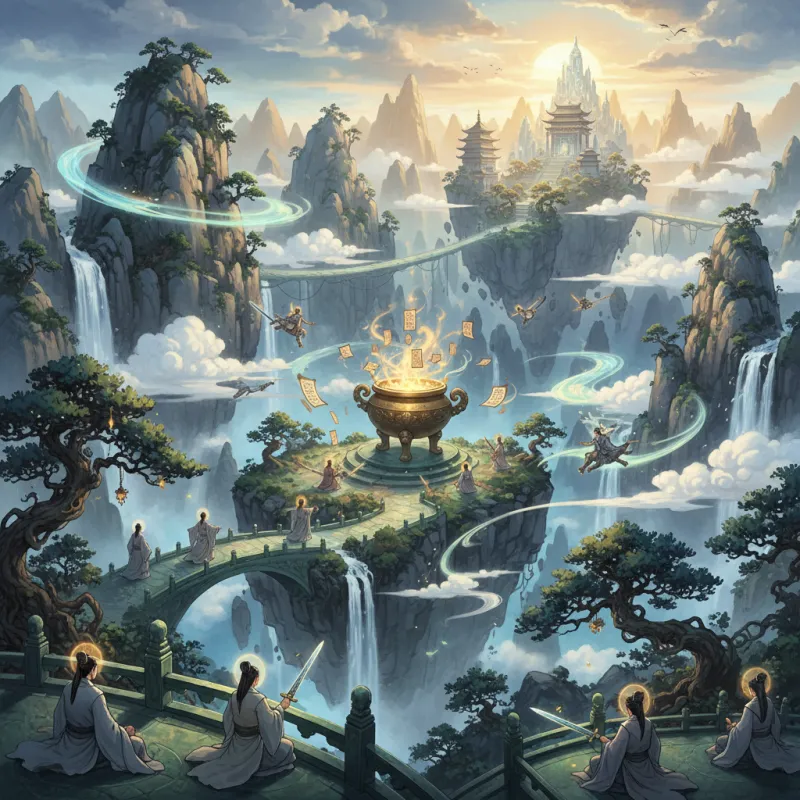
When Zhang Sanfeng first laid eyes on the Purple Cloud Sword in 1247 CE, he didn't just see a weapon—he saw a bridge between mortality and the heavens. This wasn't mere superstition. The blade had been forged during a celestial alignment, quenched in dragon blood, and inscribed with formations that could channel qi with terrifying efficiency. In xianxia fiction, artifacts aren't just magical items you loot from a dungeon. They're extensions of a cultivator's will, repositories of ancient wisdom, and sometimes, the difference between ascending to immortality or crumbling to dust.
What Makes an Artifact Different from a Magic Item
Here's where Western fantasy gets it wrong: artifacts in Chinese cultivation fiction aren't simply "enchanted." The term 法宝 (fǎbǎo, literally "dharma treasure") reveals something crucial—these objects embody universal laws. A sword isn't just sharp because someone cast a spell on it. It's sharp because a master smith understood the Dao of Metal, inscribed formation arrays that resonate with the Five Elements, and possibly sacrificed years of their own cultivation to bind their comprehension into the blade itself.
Compare this to the typical Western magic sword that glows and does +5 damage. A proper fǎbǎo in novels like I Shall Seal the Heavens or A Record of a Mortal's Journey to Immortality has personality, requirements, and consequences. Wang Lin's All-Seer from Renegade Immortal doesn't just help him see through illusions—it fundamentally alters his perception of reality and demands he understand the nature of truth itself. The artifact grows with the cultivator, or it rejects them entirely.
The Hierarchy of Treasures
Not all artifacts are created equal, and xianxia fiction loves its ranking systems. Most novels establish a clear hierarchy: Mortal-grade (凡品, fánpǐn), Spirit-grade (灵品, língpǐn), Treasure-grade (宝品, bǎopǐn), and Immortal-grade (仙品, xiānpǐn). Some authors get creative—Coiling Dragon has its own system with divine artifacts, while Desolate Era introduces Chaos treasures that predate the universe itself.
What matters isn't the specific terminology but the principle: artifacts reflect cultivation realms. A Foundation Establishment cultivator wielding a Nascent Soul-level treasure is like a child swinging a sledgehammer—dangerous to everyone, especially themselves. The qi requirements alone could drain their meridians dry or cause a cultivation deviation that leaves them crippled. This creates natural narrative tension. Finding a powerful artifact isn't an automatic win; it's a challenge to grow strong enough to use it properly.
The crafting process matters too. In Forty Millenniums of Heroes, artifact refiners spend chapters explaining how they layer formation arrays, select materials based on elemental affinities, and time their work to celestial events. A sword forged during a solar eclipse might excel at yang-based techniques, while one quenched in yin water from a ghost realm could channel death qi. These aren't arbitrary details—they're worldbuilding that makes artifacts feel earned and logical within their universe.
Swords, Pills, and Everything In Between
Swords dominate xianxia fiction, but they're far from the only artifacts worth discussing. Flying swords (飞剑, fēijiàn) are iconic—cultivators control them with spiritual sense, turning a single blade into a storm of cutting edges. Yet some of the most interesting artifacts are the weird ones.
Take storage rings (储物戒, chǔwù jiè), which seem mundane until you consider the spatial manipulation required. These aren't just bags of holding; they're pocket dimensions that require understanding the Dao of Space. In A Will Eternal, Bai Xiaochun's various bottles and cauldrons for alchemy become as important as any weapon. His pill furnace isn't just a cooking pot—it's a tool that amplifies his comprehension of medicinal properties and elemental interactions.
Defensive artifacts deserve mention too. Protective talismans (护身符, hùshēnfú), jade slips containing emergency techniques, and formation flags that create instant barriers—these items save more lives than flashy swords. The best xianxia authors understand that a well-timed defensive treasure creates better drama than another overpowered attack. When Meng Hao in I Shall Seal the Heavens uses his copper mirror to reflect an enemy's technique back at them, it's more satisfying than if he'd just overpowered them with raw strength.
The Soul-Bound Connection
Here's what separates artifacts from mere tools: the concept of blood-binding (认主, rènzhǔ, "recognizing a master"). A cultivator doesn't just pick up an artifact and use it. They forge a connection, often by dripping their blood essence onto it, creating a spiritual link that allows intuitive control. This bond means losing an artifact isn't just losing equipment—it's losing a part of yourself.
The implications run deep. A soul-bound artifact can be summoned from miles away, controlled with a thought, and grows stronger as its master advances in cultivation. But if the artifact is destroyed, the backlash can cripple or kill the cultivator. This creates stakes. When a protagonist's sword shatters in battle, it's not just a setback—it's a spiritual wound that might take years to heal.
Some artifacts develop spirits (器灵, qìlíng) after absorbing enough qi over centuries. These weapon spirits can communicate, offer advice, and sometimes rebel if they disagree with their master's choices. In Stellar Transformations, Qin Yu's relationship with his artifact spirits becomes as important as his human relationships. They're not just tools; they're companions on the path to immortality.
Artifacts as Plot Devices and Power Scaling
Let's be honest: artifacts solve a narrative problem. How do you keep power scaling interesting across hundreds of chapters when your protagonist goes from mortal to god? Artifacts provide intermediate power boosts without permanently inflating the character's base strength. A Qi Condensation cultivator with a Core Formation artifact can punch above their weight class temporarily, creating tension and excitement without breaking the story's logic.
The treasure hunt structure works because artifacts are rare and contested. Ancient ruins, secret realms, and inheritance grounds become battlegrounds where cultivators risk everything for a chance at a legendary item. These arcs allow authors to introduce new characters, showcase different cultivation systems, and create temporary alliances that inevitably collapse into betrayal. It's a formula, sure, but it works when executed well.
The best novels subvert expectations. In Lord of the Mysteries, Klein Moretti's artifacts often come with curses or hidden costs that make using them a calculated risk. Reverend Insanity takes it further—Fang Yuan treats artifacts as disposable resources, sacrificing priceless treasures without hesitation if it advances his goals. This ruthless pragmatism makes artifact acquisition feel different from the typical "collect them all" approach.
The Philosophy Behind the Metal
Strip away the fantasy elements, and artifacts in xianxia fiction represent something fundamental to Taoist and Buddhist thought: the idea that enlightenment requires tools, but tools aren't enlightenment itself. A sword can help you defend the Dao, but it can't teach you what the Dao is. The greatest cultivators in these stories eventually transcend their artifacts, achieving a state where they need nothing external to express their will.
This creates a beautiful narrative arc. Early chapters focus on acquiring artifacts, middle chapters on mastering them, and late chapters on surpassing them. When a character reaches the point where they can shatter mountains with a gesture, no longer needing their once-precious sword, it demonstrates genuine growth. The artifact becomes a symbol of their journey rather than the source of their power.
Yet even transcendent immortals keep a few treasures around—not because they need them, but because they represent memories, relationships, and hard-won understanding. That first sword, the one they used when they were weak and desperate, becomes more valuable than any Chaos-grade treasure. It's a reminder of where they started and why they cultivate in the first place.
Crafting Your Own Understanding
For readers new to xianxia, pay attention to how different authors handle artifacts. Some treat them as video game loot with stat bonuses. Others weave them into the cultivation system so thoroughly that artifacts become inseparable from the world's logic. The best novels do both—creating systems that feel game-like in their clarity while maintaining philosophical depth about what these objects represent.
If you're exploring cultivation realms or studying formation arrays, understanding artifacts provides crucial context. They're not separate from cultivation—they're expressions of it. Every artifact embodies someone's comprehension of the Dao, crystallized into physical form. When you read about a legendary sword, you're reading about a cultivator's life work, their understanding of sharpness, cutting, and the nature of separation itself.
The next time you encounter an artifact in a xianxia novel, look deeper than its immediate power. Ask what it reveals about the world's cultivation system, what philosophy it embodies, and what it costs to use. That's where the real magic lives—not in the glowing sword or flying treasure, but in the intricate web of meaning that makes these objects matter beyond their mechanical effects.
Related Reading
- Discovering the Fascinating Artifacts of Chinese Cultivation and Xianxia Fiction
- Storage Rings: Spatial Magic in Cultivation
- Formation Arrays: The Magical Engineering of the Cultivation World
- Cultivation Artifacts: Swords That Think, Rings That Store, and Robes That Protect
- Storage Rings and Spatial Equipment: Pocket Dimensions on Your Finger
- Essential Cultivation Terms: The Complete Xianxia Glossary
- 50 Cultivation Novel Tropes Every Reader Will Recognize
- Body Refinement: The Physical Path to Power