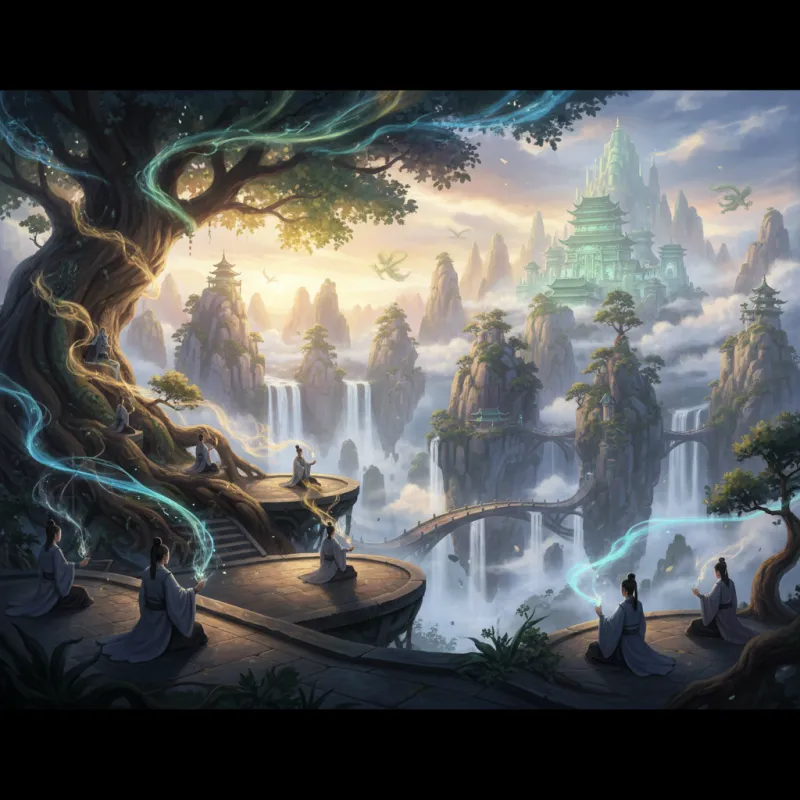
A lone cultivator stands at the mountain gate, cupping his fists in salute as thunder rumbles overhead. The sect elder's eyes narrow—this visitor's spiritual pressure suggests Foundation Establishment, yet something feels off. In that moment of tension lies the entire architecture of xianxia fiction: the sect as gatekeeper, judge, and crucible where mortals forge themselves into immortals. But these fictional institutions didn't spring from nowhere—they're rooted in centuries of Chinese religious history, Daoist monasteries, and martial arts schools that shaped how millions imagine the path to transcendence.
The Historical DNA of Cultivation Sects
The sects (宗门, zōngmén) that dominate xianxia fiction trace their lineage to real institutions that flourished during China's Tang and Song dynasties. Mount Longhu's Celestial Masters sect, established in 142 CE, pioneered the hierarchical structure you'll recognize in every cultivation novel: outer disciples grinding through menial tasks, inner disciples accessing secret techniques, and core disciples groomed for leadership. The Quanzhen School (全真教, Quánzhēn Jiào), founded by Wang Chongyang in 1170, introduced the concept of "internal alchemy" (内丹, nèidān)—transforming one's body into a furnace for spiritual refinement rather than mixing external elixirs. This single innovation became the backbone of cultivation systems in works like I Shall Seal the Heavens and A Record of a Mortal's Journey to Immortality.
What modern readers often miss is how these historical sects functioned as complete societies. They weren't just training grounds—they were economic powerhouses controlling trade routes, political entities negotiating with emperors, and knowledge repositories guarding texts that could take lifetimes to comprehend. Er Gen's Azure Mystic Sect in A Will Eternal captures this perfectly: disciples farm spirit herbs, manage beast taming operations, and engage in sect-versus-sect commerce that mirrors the Silk Road economics of medieval Daoist institutions.
The Nine Grades of Sect Classification
Xianxia authors have codified sect hierarchies with surprising consistency. At the apex sit Holy Lands (圣地, shèngdì)—institutions like the Ji Clan in Perfect World that have produced Immortal Emperors and possess cultivation techniques dating back millions of years. These aren't mere schools; they're civilizational anchors that define entire regions' spiritual ecosystems.
Below them, Ancient Sects (古宗, gǔzōng) like the Heaven Dao Sect in Renegade Immortal maintain legacies spanning tens of thousands of years. They've survived apocalyptic wars, dimensional collapses, and the rise and fall of cultivation eras. Their defining characteristic? Incomplete but authentic supreme techniques—the kind where mastering even one chapter can elevate you above your generation.
Great Sects (大宗, dàzōng) dominate regional politics. Think the Spirit Stream Sect from A Will Eternal or the Reliance Sect from I Shall Seal the Heavens. They field multiple Nascent Soul ancestors, control spirit stone mines, and maintain arrays that can repel demon beast tides. Most protagonists start here or aim to establish sects at this level.
Then come Ordinary Sects (普通宗门, pǔtōng zōngmén), where Foundation Establishment cultivators serve as elders and Core Formation represents the absolute peak. These are the sects that get wiped out in chapter three when demonic cultivators need to demonstrate their villainy. The harsh truth of xianxia: without a Nascent Soul ancestor, you're just a resource waiting to be harvested.
Spiritual Realms as Cosmic Real Estate
The concept of spiritual realms (灵界, língjiè) or minor worlds (小世界, xiǎo shìjiè) revolutionized xianxia world-building when authors realized they could stack dimensions like Russian dolls. In A Record of a Mortal's Journey to Immortality, Han Li spends 800 chapters in the "mortal realm" before discovering it's merely the ground floor of a cosmic skyscraper. The Spirit Realm above contains denser spiritual energy, more powerful cultivators, and—crucially—higher cultivation ceilings.
This isn't just creative geography; it's a narrative engine. Each realm transition resets the power scale, letting protagonists who dominated their previous world become underdogs again. Wang Lin in Renegade Immortal goes from feared devil cultivator to cautious newcomer when ascending to the Celestial Realm. The pattern mirrors Buddhist cosmology's thirty-three heavens, but xianxia authors weaponized it for plot longevity.
The mechanics matter too. Realms typically feature ascension tribulations (飞升天劫, fēishēng tiānjié)—catastrophic tests that kill 90% of candidates. Those who survive find themselves in worlds where yesterday's heaven-defying treasure is today's common commodity. The Azure Mystic Immortal Realm in I Shall Seal the Heavens operates on spiritual energy so dense that mortal realm cultivators would explode from a single breath. This creates natural barriers that justify why powerful beings don't just descend and solve every problem.
The Sect Hierarchy's Social Architecture
Inside any respectable sect, you'll find a structure more rigid than feudal Japan. Outer disciples (外门弟子, wàimén dìzǐ) handle manual labor—farming spirit fields, mining spirit stones, feeding spirit beasts. They receive basic cultivation techniques, often incomplete or deliberately flawed versions that ensure they'll never threaten the establishment. In Martial World, Lin Ming starts here, and the author doesn't shy from showing the brutal economics: outer disciples are expendable resources, their deaths barely meriting investigation.
Inner disciples (内门弟子, nèimén dìzǐ) have proven their talent, usually by reaching Qi Condensation before age thirty. They access the sect's true cultivation methods, can requisition formation flags and talismans, and most importantly—they get a master. This mentorship system, borrowed from Confucian educational traditions, creates loyalty chains that bind sects together. Your master's enemies become your enemies; their allies, your allies. When Meng Hao joins the Reliance Sect in I Shall Seal the Heavens, his relationship with Patriarch Reliance defines his trajectory for hundreds of chapters.
Core disciples (核心弟子, héxīn dìzǐ) represent the sect's future. They're typically Foundation Establishment cultivators under a hundred years old—prodigies who might reach Nascent Soul and become the next generation of elders. They receive personal instruction from sect ancestors, access to forbidden techniques, and resources that would bankrupt ordinary cultivators. The competition here turns vicious. In A Will Eternal, Bai Xiaochun's rivalry with other core disciples drives entire arcs, because everyone knows only one or two will ultimately inherit the sect's supreme legacy.
Sect Resources and the Cultivation Economy
What separates a thriving sect from a declining one? Resources. Spirit stone mines (灵石矿, língshí kuàng) provide cultivation currency—low-grade stones for outer disciples, high-grade for elders, and top-grade for sect-protecting formations. Control a mine, and you control your region's cultivation ecosystem. Lose it, and your disciples start defecting to rivals who can actually pay them.
Spirit herb gardens (灵药园, língyào yuán) grow ingredients for breakthrough pills. A single garden producing Foundation Establishment Pills can sustain a Great Sect's recruitment pipeline. In A Record of a Mortal's Journey to Immortality, Han Li's obsession with cultivating rare herbs isn't just personality quirk—it's survival strategy. Sects that can't produce their own pills become dependent on others, which means political subordination.
Then there are secret realms (秘境, mìjìng)—pocket dimensions left by ancient cultivators, filled with inheritance caves, spirit beast nests, and natural treasures. Sects guard access to these jealously. The Heavenvoid Hall in A Record of a Mortal's Journey to Immortality opens once every century, and the scramble for entry slots drives decades of political maneuvering. These realms serve double duty: they're both resource sources and proving grounds where disciples either advance or die trying.
The Demonic Sect Counterculture
Not all sects follow the "righteous path" (正道, zhèngdào). Demonic sects (魔宗, mózōng) practice cultivation methods that horrify orthodox cultivators—blood refinement, soul extraction, possession techniques. But here's what makes good xianxia interesting: demonic sects aren't always evil. They're often just pragmatic, willing to use methods that righteous sects publicly condemn while privately envying their efficiency.
The Blood Stream Sect in A Will Eternal exemplifies this complexity. Yes, they cultivate using blood essence. Yes, their techniques look horrifying. But they're also fiercely loyal to their own, maintain strict codes of conduct, and produce cultivators just as "righteous" as their orthodox rivals. Er Gen uses them to question the entire righteous-versus-demonic dichotomy that lesser authors treat as absolute.
Wang Lin's journey in Renegade Immortal takes this further. He's labeled a devil cultivator, hunted by righteous sects, yet his actions often show more integrity than the "heroes" pursuing him. The novel suggests that sect classification—righteous or demonic—matters less than individual character. It's a surprisingly mature take in a genre that often defaults to black-and-white morality.
Modern Innovations in Sect Dynamics
Recent xianxia novels have started deconstructing traditional sect structures. In Reverend Insanity, Fang Yuan treats sects as temporary resource extraction points—join, loot, leave. His mercenary approach exposes how sect loyalty often amounts to exploitation dressed in Confucian virtue language. Why spend centuries serving elders who'll never share their best techniques?
Lord of the Mysteries (though more xuanhuan than pure xianxia) introduces secret organizations that function like sects but operate across multiple worlds, with members who might never meet face-to-face. This reflects modern anxieties about distributed networks and digital communities—the sect reimagined for the internet age.
The trend toward sect-building narratives has also exploded. Protagonists don't just join sects; they establish their own, recruiting disciples and competing with ancient institutions. This power fantasy resonates because it lets readers imagine disrupting ossified hierarchies. In My Senior Brother is Too Steady, the protagonist carefully builds his sect's foundation, avoiding the reckless expansion that dooms so many upstart organizations. It's cultivation fiction meets startup culture—scale carefully, maintain quality, survive long enough to become the establishment you once challenged.
For more on how these sects organize their internal power structures and the cultivation realms that define their members' strength, the rabbit hole goes deep. The beauty of xianxia is that every sect, every realm, every hierarchy reflects some aspect of human organization—our tribes, our corporations, our nations—projected onto a cosmic canvas where the stakes are literal immortality.
Related Reading
- Cultivation Sects: The Corporations of the Immortal World
- Secret Realms: Hidden Dimensions of Power
- Secret Realms and Pocket Dimensions: Treasure Hunting in Cultivation Fiction
- Sect Hierarchy Explained: From Outer Disciple to Patriarch
- Sect Politics: Why Cultivation Sects Are Basically Corporations
- Dual Cultivation: The Most Misunderstood Concept in Cultivation Fiction
- Dual Cultivation: Partnership in the Path to Immortality
- Unraveling the Mysteries of Formations in Chinese Cultivation and Xianxia Fiction