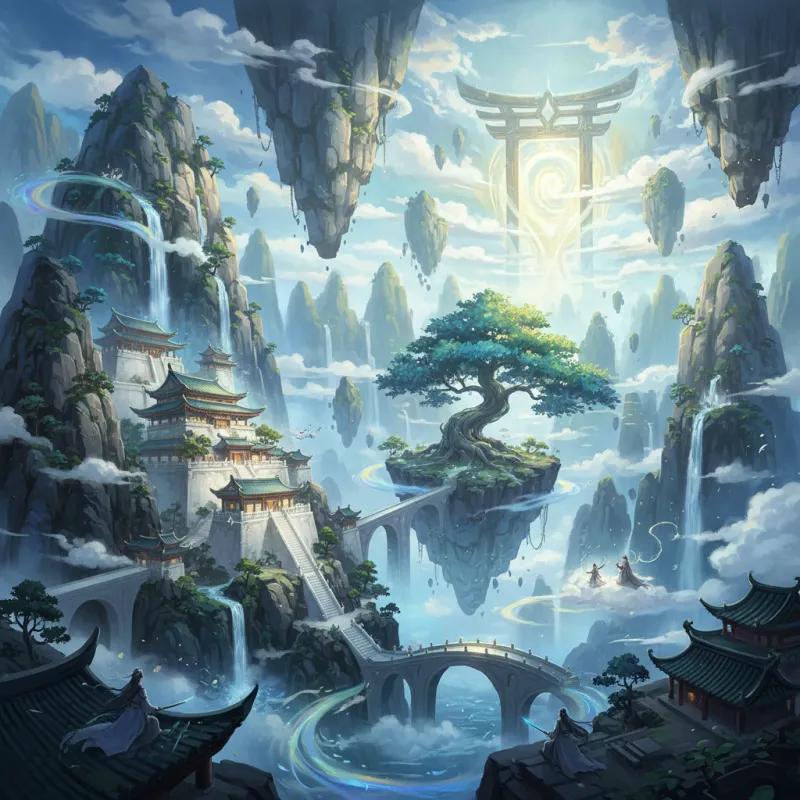
A cultivator stumbles through a shimmering portal, expecting treasure. Instead, they find themselves trapped in a pocket dimension where time flows backward, their cultivation base unravels with each breath, and the exit seal requires a technique they won't learn for another three hundred years. Welcome to secret realms—the most dangerous lottery tickets in xianxia fiction.
What Makes a Secret Realm Different from Regular Space
Secret realms (秘境, mìjìng) aren't just fancy dungeons with better loot. They're self-contained dimensional fragments, often remnants of shattered worlds or deliberately constructed pocket universes created by ancient powerhouses. The key distinction? Normal space follows consistent laws of physics and cultivation. Secret realms make their own rules.
In I Shall Seal the Heavens, Meng Hao encounters the Rebirth Cave secret realm where death isn't permanent—cultivators revive repeatedly, forced to relive their failures until they either breakthrough or go insane. Compare this to the Primordial Demon Immortal Plane in Renegade Immortal, which exists outside the normal flow of time entirely. Wang Lin spends centuries inside while mere days pass in the outside world. These aren't plot conveniences; they're fundamental properties of how these spaces were constructed.
The Tang Dynasty Daoist text Dongxuan Lingbao describes thirty-six "grotto-heavens" (洞天, dòngtiān) and seventy-two "blessed lands" (福地, fúdì)—real locations supposedly hidden within mountains and islands where immortals dwelled. Modern xianxia authors took this concept and ran with it, transforming religious geography into narrative goldmines.
The Three Types of Secret Realm Architecture
Not all secret realms serve the same purpose. Understanding their categories helps explain why protagonists risk their lives entering them.
Inheritance Realms are the most common. A dying expert creates a pocket dimension, stuffs it with their techniques, treasures, and usually some horrific trials to "test" worthy successors. The Violet Fate Sect's Pill Demon legacy in I Shall Seal the Heavens exemplifies this perfectly—Meng Hao must prove his alchemy talent through increasingly absurd challenges, like concocting pills while being attacked by the realm's defensive formations. The realm itself judges worthiness, often with lethal prejudice.
Natural Formation Realms occur when spatial tears or concentrated spiritual energy creates stable pocket dimensions spontaneously. These are unpredictable and often more dangerous because nobody designed safety measures. The Heavenly South Region's Scattered Star Seas in A Record of a Mortal's Journey to Immortality contains dozens of naturally-formed secret realms, each with unique ecosystems that evolved in isolation for millions of years. Han Li discovers one filled with sentient mist that devours cultivation bases—not maliciously, just because that's what it evolved to consume.
Prison Realms are exactly what they sound like. Ancient sects sealed their worst enemies, failed experiments, or forbidden techniques inside dimensional cages. The problem? Seals weaken over time. When modern cultivators stumble into these realms, they're not finding treasure—they're opening Pandora's box. Martial World's True Martial World contains the Eternal Demon Abyss, where the ancient Demon God was imprisoned. Spoiler: it doesn't stay imprisoned.
Time Dilation: The Secret Realm's Killer Feature
If secret realms only offered treasure, they'd be interesting. Time dilation makes them essential to cultivation progression. A realm where one year inside equals one day outside transforms a century of cultivation into three months of real-world time. For protagonists racing against enemies, pursuing loved ones, or trying to prevent apocalypses, this is invaluable.
But authors who understand cultivation systems know time dilation cuts both ways. In Lord of the Mysteries, Klein Moretti learns that accelerated time doesn't just speed up cultivation—it accelerates everything. Injuries that would heal in weeks fester for subjective years. Mental strain compounds. Loneliness becomes a cultivation demon more dangerous than any trial. The Forsaken Land of the Gods operates on distorted time, and its inhabitants have gone collectively insane from the temporal isolation.
Reverend Insanity takes this further. Fang Yuan deliberately seeks time-path secret realms not for cultivation speed but for strategic advantage. He uses them to outlive his enemies' lifespans, to wait out political upheavals, to let his investments mature while he remains young. Time becomes a weapon, not just a resource.
The historical inspiration comes from the Daoist concept of "grotto-heaven time" where immortals could spend centuries in meditation while mortal dynasties rose and fell outside. The Liexian Zhuan (Biographies of Exemplary Immortals) from the Han Dynasty describes Wang Zhi witnessing two immortals play a game of weiqi; when he returns home, three generations have passed. Xianxia authors weaponized this folklore into systematic power progression.
The Economics of Secret Realm Exploration
Here's what Western fantasy often misses: secret realms aren't just adventure locations. They're economic engines that determine sect hierarchy and geopolitical power.
Major sects control access to valuable secret realms the way nations control oil fields. The Profound Sky Continent's Four Great Sacred Grounds in Against the Gods maintain their dominance partly through monopolizing high-level secret realms. They permit limited access to subordinate sects, creating a feudal system where realm access equals political leverage.
This creates fascinating market dynamics. In A Record of a Mortal's Journey to Immortality, Han Li discovers that secret realm coordinates are traded commodities. Accurate maps sell for fortunes. False maps are sold to enemies. Some sects deliberately spread rumors about non-existent realms to waste rivals' resources. The information warfare around secret realms often proves more deadly than the realms themselves.
Independent cultivators form temporary alliances specifically for realm exploration, then immediately betray each other once inside. The genre's cynical view of human nature shines here—cooperation lasts exactly as long as mutual benefit, then it's every cultivator for themselves. Renegade Immortal's Wang Lin survives dozens of these expeditions by assuming everyone will betray him and planning accordingly.
The Dark Side: When Secret Realms Go Wrong
For every protagonist who gains enlightenment in a secret realm, a thousand nameless cultivators die horribly. The genre doesn't shy from this.
Spatial collapse is the most common disaster. Secret realms are fundamentally unstable—they're maintained by formations, arrays, or the residual will of their creators. When these fail, the realm implodes, and everyone inside gets compressed into spatial fragments. Stellar Transformations features an entire arc where Qin Yu must escape a collapsing realm while fighting other desperate cultivators who've realized there aren't enough exit portals for everyone.
Then there's temporal lock-in. Some realms only open their exits at specific intervals—every hundred years, when certain stars align, or when the realm's "trial" is completed. Miss the window, and you're trapped until the next cycle. Assuming you survive that long. The Heavenspan Realm in A Will Eternal contains sub-realms that open once per millennium. Bai Xiaochun finds skeletons of cultivators who entered, completed the trials, claimed the treasures, then starved to death waiting for the exit to reopen.
Worst are the sentient realms. Some secret realms develop consciousness after existing for eons, and their goals rarely align with visitors' survival. Desolate Era's Nihilum Zone actively hunts intruders, reshaping its internal geography to prevent escape. Ji Ning realizes the realm isn't testing him—it's playing with its food.
Modern Innovations in Secret Realm Storytelling
Recent xianxia novels have evolved beyond "protagonist enters realm, faces trials, gains power, exits." Contemporary authors explore more sophisticated concepts.
Reverend Insanity treats secret realms as investment opportunities. Fang Yuan doesn't just loot them—he analyzes their formation principles, replicates them, and creates his own pocket dimensions for resource cultivation. He turns from realm explorer to realm architect, fundamentally changing the power dynamic.
Lord of the Mysteries introduces the concept of corrupted secret realms where the original creator's madness has infected the space itself. These realms don't just kill visitors—they transform them into extensions of the realm's insanity. Klein must navigate spaces where the environment actively rewrites his memories and personality.
My Senior Brother is Too Steady subverts the entire trope. Li Changshou treats secret realms like toxic assets—the potential rewards rarely justify the risks. He develops elaborate schemes to send his enemies into dangerous realms while he cultivates safely at home. When forced to enter one himself, he spends more effort on escape contingencies than treasure hunting. It's a refreshing acknowledgment that maybe, just maybe, not every glowing portal needs to be entered.
The evolution reflects the genre's maturation. Early xianxia used secret realms as simple power-up locations. Modern works treat them as complex systems with their own logic, history, and consequences. The best contemporary novels make secret realms feel like characters themselves—ancient, alien, and operating on motivations humans can barely comprehend.
Why Secret Realms Matter Beyond Plot Devices
Strip away the fantasy elements, and secret realms represent something fundamental to the cultivation journey: the necessity of leaving comfort zones to achieve transformation. Every secret realm is a crucible where cultivators confront not just external dangers but their own limitations, fears, and assumptions about reality.
The genre's Buddhist and Daoist influences show clearly here. The Diamond Sutra teaches that enlightenment requires breaking through illusions about the nature of reality. Secret realms literalize this—they're spaces where normal rules don't apply, forcing cultivators to question their understanding of existence itself. When Wang Lin in Renegade Immortal realizes that multiple secret realms are actually fragments of a single shattered universe, it's not just a plot twist. It's a metaphor for how enlightenment reveals the interconnected nature of seemingly separate phenomena.
Western fantasy often treats magical locations as static backdrops. Xianxia secret realms are dynamic, dangerous, and deeply integrated into the cultivation system's philosophy. They're not just places to visit—they're transformative experiences that fundamentally alter those who survive them. The protagonist who exits a secret realm isn't just stronger; they've been remade by confronting a reality that operates on different principles than everything they previously knew.
That's the real secret of secret realms: they're not about the treasures you find inside. They're about whether you can maintain your sense of self when reality itself becomes negotiable.
Related Reading
- Sect Politics: Why Cultivation Sects Are Basically Corporations
- Sect Hierarchy Explained: From Outer Disciple to Patriarch
- Cultivation Sects: The Corporations of the Immortal World
- Ancient Sects and Spiritual Realms in Chinese Cultivation and Xianxia Fiction
- Secret Realms and Pocket Dimensions: Treasure Hunting in Cultivation Fiction
- Mystical Beasts in Chinese Cultivation Fiction: Guardians of the Immortal Spiritual Realms
- The Allure of Chinese Cultivation Fiction: A Journey Through Immortal Realms
- Weapon Spirits: When Your Sword Has a Personality