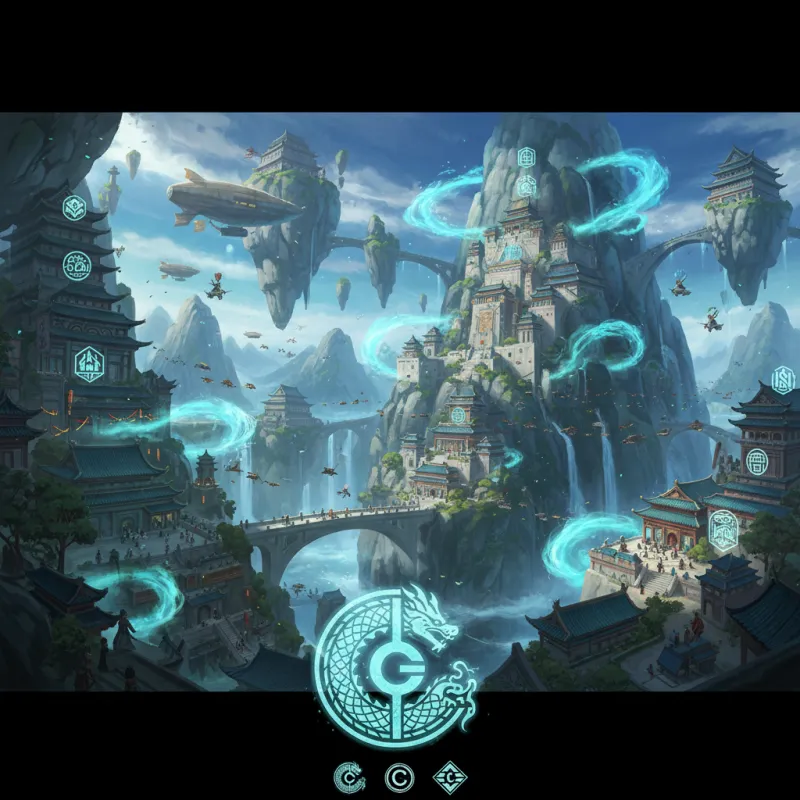
A disciple kneels before the Contribution Hall, clutching a jade slip worth three hundred contribution points—exactly enough to purchase the Foundation Establishment pill that took him five years to save for. The elder behind the desk barely glances up. "Price increased yesterday. Four hundred points now. Supply and demand." Welcome to the cultivation world, where enlightenment has a price tag and your sect operates with the ruthless efficiency of a Fortune 500 company that also happens to teach people how to split mountains with their bare hands.
The Contribution Point Economy: Spiritual Capitalism at Its Finest
Every major cultivation sect runs on contribution points (贡献点 gòngxiàn diǎn), an internal currency that would make any corporate rewards program look primitive. Complete a mission? Points. Donate rare herbs? Points. Defend the sect from demon beast attacks? Points. Kill a rival sect's disciple during a "friendly" tournament? Surprisingly, also points—though they don't advertise that one in the recruitment materials.
This system appears in virtually every cultivation novel from I Shall Seal the Heavens to A Record of a Mortal's Journey to Immortality, and it's not just narrative convenience. The contribution point economy mirrors the historical reality of Chinese merchant guilds and clan organizations during the Ming and Qing dynasties, where internal credit systems regulated resource distribution among members. The genius of this system is that it transforms every disciple into a profit center. You're not just a student—you're an independent contractor whose value to the organization is precisely quantified.
The Contribution Hall (贡献殿 Gòngxiàn Diàn) functions as the sect's central bank, treasury, and HR department rolled into one. Want that Earth-rank cultivation technique? That'll cost you. Need access to the Spirit Gathering Array for closed-door cultivation? Rent it by the hour. Even basic necessities like monthly spirit stone stipends are tiered based on your contribution point balance and cultivation realm. It's a meritocracy in the most literal sense—your merit is measured, recorded, and monetized.
Hierarchies That Would Make McKinsey Weep
The organizational structure of a cultivation sect makes corporate hierarchies look like amateur hour. At the top sits the Sect Master (宗主 zōngzhǔ), essentially the CEO with the power to level cities. Below them, the Grand Elders (太上长老 tàishàng zhǎnglǎo) form the board of directors—usually semi-retired powerhouses who emerge from seclusion only for existential threats or particularly juicy political maneuvering.
Then come the Peak Masters (峰主 fēngzhǔ), each controlling a mountain peak within the sect's territory and running it like a semi-autonomous division. The Sword Peak focuses on combat techniques, the Alchemy Peak on pill refinement, the Formation Peak on arrays and defensive systems. Each peak competes for resources, prestige, and talented disciples. The internal politics between peaks generate enough drama to fuel entire novel arcs—see the Azure Cloud Sect in Stellar Transformations for a masterclass in inter-peak backstabbing.
Below the Peak Masters, you have Core Elders, Inner Elders, and Outer Elders—middle management with varying degrees of actual power. Then the disciples themselves: Core Disciples (核心弟子 héxīn dìzǐ), Inner Disciples (内门弟子 nèimén dìzǐ), and Outer Disciples (外门弟子 wàimén dìzǐ). This three-tier system isn't arbitrary—it reflects the traditional Chinese educational model where students were ranked by examination performance and granted corresponding privileges.
Outer disciples are essentially interns. They get the worst cultivation resources, the most dangerous missions, and zero job security. Inner disciples are the regular employees—decent benefits, access to mid-tier techniques, and a realistic path to advancement. Core disciples are the executive track: personal mentorship from elders, access to the sect's vault of treasures, and protection that borders on nepotism. The protagonist of Renegade Immortal spends the first hundred chapters clawing his way from outer to inner disciple status, and the desperation feels visceral because the stakes are literally life and death.
Resource Allocation: The Real Cultivation Bottleneck
Here's what cultivation novels understand that most fantasy doesn't: talent means nothing without resources. You can have heaven-defying spiritual roots, but without spirit stones (灵石 língshí), cultivation pills, and access to high-grade techniques, you'll be overtaken by mediocre disciples with better funding. This is why sect affiliation matters so much—it's venture capital for immortality seekers.
Major sects control spirit stone mines, herb gardens, and beast-taming grounds. They maintain relationships with Alchemy Masters and the Pill Economy to ensure steady supplies of Foundation Establishment Pills, Golden Core Pills, and the countless other pharmaceutical aids that cultivation requires. They negotiate trade agreements with other sects, establish branch locations in mortal kingdoms, and occasionally go to war over particularly rich cultivation sites.
The Azure Profound Sect in Against the Gods controls an entire frozen wasteland rich in ice-attribute resources, giving their disciples natural advantages in ice-based cultivation techniques. The Heavenly Sword Sect in Coiling Dragon sits atop a mountain range with naturally dense spiritual energy, reducing their disciples' cultivation time by years compared to independent cultivators. Location, location, location—it matters as much in the cultivation world as it does in real estate.
This resource scarcity creates the fundamental tension in sect life: cooperation versus competition. Disciples must work together to defend the sect and complete missions, but they're simultaneously competing for limited resources. It's the Hunger Games meets corporate ladder-climbing, with the added twist that your competitors can literally kill you during "sparring accidents" and claim it was a cultivation deviation.
The Sect as Military-Industrial Complex
When two sects go to war, it's not a schoolyard brawl—it's a coordinated military campaign involving thousands of cultivators, strategic formations, and weapons that can reshape geography. The sect structure is explicitly designed for warfare, with clear chains of command, specialized combat units, and logistics networks that would impress any general.
Each peak typically maintains combat formations (战阵 zhànzhèn) that allow disciples to combine their power. Twenty Foundation Establishment cultivators in formation can threaten a Core Formation elder. This force multiplication is why sects can project power far beyond what their individual members could achieve. The Seven Slaughters Sect in Desolate Era maintains seven distinct battle formations, each optimized for different combat scenarios—siege warfare, defensive operations, pursuit and elimination.
Sects also maintain intelligence networks, conduct espionage against rivals, and plant spies in enemy organizations. The Shadow Sect in Reverend Insanity is essentially the CIA of the cultivation world, trading information as their primary commodity. When you join a sect, you're not just enrolling in school—you're being drafted into a standing army that happens to teach classes between military operations.
Succession Crises and Hostile Takeovers
The most dramatic moments in cultivation fiction often revolve around sect succession. When a Sect Master dies or ascends to a higher realm, the power vacuum can tear an organization apart. Rival factions back different candidates, Peak Masters make plays for supreme authority, and external enemies sense weakness and attack.
The Qing Yun Sect in Jade Dynasty nearly collapses during a succession crisis when the Sect Master is assassinated and three different factions support three different successors. The resulting civil war weakens the sect so severely that demon cultivators nearly wipe them out. This isn't just plot drama—it reflects real historical patterns in Chinese clan organizations and martial arts schools, where succession disputes frequently led to splits, violence, and organizational collapse.
Some sects try to prevent this through clear succession rules: the strongest disciple inherits, or the eldest Core Disciple, or the Sect Master's personal disciple. But cultivation adds a wrinkle—strength is constantly changing. A disciple who breaks through to a higher realm can suddenly become a viable candidate. An elder who emerges from closed-door cultivation after decades might challenge the current leadership. The meritocratic ideal of "the strong rule" creates constant instability.
Then there are hostile takeovers. A powerful external cultivator joins the sect, rapidly advances through the ranks, gathers supporters, and stages a coup. Or a rival sect infiltrates disciples over decades, waiting for the perfect moment to strike from within. The Blood Demon Sect in A Will Eternal specializes in this strategy, treating sect infiltration as a core competency. They've toppled three major sects in the novel's backstory through patient, methodical subversion.
The Sect as Family (Whether You Like It or Not)
Despite the corporate structure and military discipline, sects also function as surrogate families. Disciples call their teachers "Master" (师父 shīfu) and fellow disciples "Senior Brother" (师兄 shīxiōng) or "Junior Sister" (师妹 shīmèi). These aren't just polite titles—they carry real emotional and social weight. Your sect siblings are your primary social network, your support system, and often your only friends in a world where everyone else is a potential enemy or resource.
This familial aspect creates complex loyalties. When your sect goes to war with another sect, you might be ordered to kill someone who was your friend at an inter-sect tournament. When your Peak Master feuds with another Peak Master, you're expected to take sides even if you respect both. The tension between personal relationships and institutional loyalty generates endless narrative conflict.
The best cultivation novels explore this tension deeply. In Cradle, the protagonist's sect (the Wei clan) is more family than organization, with genuine bonds between members. But even there, resource scarcity and competition create friction. When only one disciple can receive the prize at a tournament, friendship takes a backseat to advancement. The cultivation world doesn't allow for pure relationships—everything is transactional, even love.
Why This Matters for Readers
Understanding sects as multi-functional organizations rather than simple schools transforms how you read cultivation fiction. When a protagonist joins a sect, they're not just enrolling in classes—they're entering a complex web of economic, political, military, and social relationships. Every interaction carries multiple layers of meaning. That friendly senior brother offering cultivation advice? He might genuinely want to help, or he might be recruiting you for his faction, or he might be setting you up to fail so his own advancement looks better by comparison.
The sect structure also explains why so many protagonists eventually leave their sects or destroy them. The organizational demands—the politics, the resource competition, the forced loyalty—constrain individual freedom. The path to true immortality often requires breaking free from institutional control, even if that institution gave you everything you needed to reach that point. It's the ultimate corporate burnout story: you climb the ladder, realize the ladder is a cage, and blow up the building on your way out.
For readers coming from Western fantasy traditions, this corporate-military-family hybrid takes adjustment. But once you grasp it, cultivation fiction's obsession with sect politics makes perfect sense. These aren't arbitrary power struggles—they're the natural result of combining resource scarcity, meritocratic advancement, military organization, and familial bonds in a world where power is everything and immortality is the ultimate prize. The sect isn't just the setting for the story. The sect is the story, and understanding its mechanics is understanding the genre itself.
Related Reading
- Righteous vs. Demonic Sects: The Great Divide in Cultivation Fiction
- Sect Hierarchy Explained: From Outer Disciple to Patriarch
- Sect Politics: Why Cultivation Sects Are Basically Corporations
- Secret Realms: Hidden Dimensions of Power
- The Rise of Sects in Chinese Cultivation Fiction: Paths to Immortality
- The Allure of Chinese Cultivation Fiction: A Journey Through Immortal Realms
- The Enchantment of Chinese Cultivation Fiction: Immortal Aspirations and Alchemical Journeys
- Pill Refining in Cultivation Fiction: Chemistry Meets Mysticism