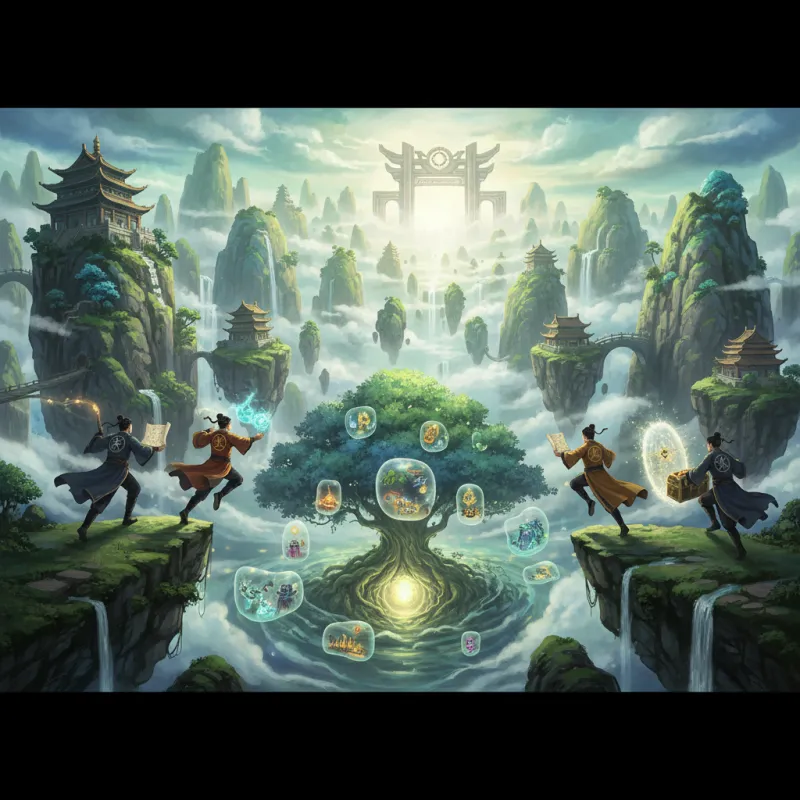
A spatial rift tears open above the sect's main plaza, and within seconds, a hundred disciples are scrambling for position. The elders haven't even finished explaining the rules before someone's already thrown a punch. Welcome to secret realm season — that glorious, chaotic period in every cultivation novel where the plot hits pause on political intrigue and goes full treasure-hunting mode. If you've read more than three xianxia novels, you've seen this scene play out dozens of times, and yet somehow it never gets old.
The Anatomy of a Pocket Dimension
Secret realms (秘境 mìjìng) are self-contained pocket dimensions, usually created by ancient cultivators who wanted to preserve their legacy without handing it to just anyone. Think of them as the cultivation world's version of a will — except instead of reading it in a lawyer's office, you have to fight through spatial distortions, solve formation puzzles, and probably watch a few fellow treasure hunters get crushed by traps.
The typical secret realm was established by someone at the Nascent Soul stage or higher, often right before they ascended or died. They'd fold space using formation arrays (阵法 zhènfǎ), create a stable dimensional pocket, stock it with their treasures and techniques, then seal it with conditions. Maybe it only opens once every hundred years. Maybe it requires a specific cultivation level to enter. Maybe it's keyed to a bloodline or a particular type of spiritual root (灵根 línggēn).
What makes these spaces fascinating is their temporal instability. Time often flows differently inside — a month in the secret realm might be three days outside, or vice versa. This isn't just a narrative convenience; it's rooted in Daoist concepts about the relativity of time in different realms. The Zhuangzi mentions how a day in heaven equals a year on earth, and cultivation fiction runs with this idea to create training montages that don't age characters out of their story arcs.
The Treasure Economy
Let's be honest about what secret realms really are: loot boxes. Extremely dangerous, narratively convenient loot boxes that let authors shower their protagonists with power-ups without breaking the world's economy.
The treasures inside typically include spirit herbs (灵药 língyào) that are extinct in the outside world, cultivation techniques that have been lost for millennia, and magical artifacts (法宝 fǎbǎo) that would start wars if anyone knew they existed. The protagonist always — and I mean always — finds something that perfectly matches their cultivation method or solves their current bottleneck. Stuck at Foundation Establishment? Here's a Nascent Soul breakthrough pill. Need a defensive technique? This ancient jade slip contains exactly that.
The best novels acknowledge this convenience and play with it. In A Record of a Mortal's Journey to Immortality (凡人修仙传 Fánrén Xiūxiān Zhuàn), Han Li approaches secret realms with methodical paranoia, assuming every treasure is trapped and every opportunity is bait. He's usually right. Wang Lin from Renegade Immortal (仙逆 Xiān Nì) treats secret realms as crime scenes, analyzing what killed the previous explorers before touching anything.
The economic impact of secret realms on cultivation worlds is rarely explored but fascinating. When a major secret realm opens, it temporarily floods the market with rare resources, crashes prices, and shifts power balances between sects and factions. Smart sects stockpile their secret realm harvests and release them slowly. Desperate ones sell everything immediately and regret it later.
The Competitive Bloodbath
Here's where secret realms get interesting: they're multiplayer dungeons with full PvP enabled and no respawns.
Most secret realms have entry restrictions — usually a cultivation level cap to prevent high-level cultivators from monopolizing everything. This creates a pressure cooker scenario where dozens or hundreds of cultivators at roughly the same power level are thrown together with limited treasures and no rules. The result is predictable: alliances of convenience, sudden betrayals, and a body count that would make a horror movie director proud.
The social dynamics are pure game theory. Do you team up with that guy from a rival sect to split the treasure, knowing he'll probably try to kill you once you find it? Do you help the injured cultivator, or do you finish them off and take their storage bag? The protagonist usually navigates this by being either overwhelmingly powerful (boring) or cleverly manipulative (interesting).
Reverend Insanity (蛊真人 Gǔ Zhēnrén) does this brilliantly. Fang Yuan enters secret realms with zero pretense of cooperation. He calculates the optimal moment to betray his "allies," often before they've even thought about betraying him. He treats other cultivators as mobile loot containers, which is horrifying but refreshingly honest about what these scenarios actually are.
The best secret realm arcs create temporary ecosystems where different cultivation styles clash. The sword cultivator who specializes in direct combat versus the formation master who can manipulate the environment versus the alchemist who brought a bag full of poison pills. It's rock-paper-scissors with magical powers and lethal stakes.
Inheritance Trials and Legacy Tests
Not all secret realms are free-for-all treasure hunts. Some are structured inheritance trials (传承试炼 chuánchéng shìliàn), where the ancient cultivator who created the realm left specific tests to find a worthy successor.
These trials usually test character as much as power. The ancient master wants someone who embodies their values — whether that's ruthless ambition, unwavering righteousness, or scholarly dedication to the Dao. The protagonist either genuinely passes these tests or cleverly games the system, depending on whether the novel is playing it straight or being subversive.
The inheritance trial format lets authors explore what different cultivation philosophies actually value. A demonic cultivator's (魔修 móxiū) inheritance might reward cruelty and cunning, testing whether candidates will sacrifice others to advance. A Buddhist cultivator's trial might test compassion and wisdom, requiring candidates to solve problems without violence. The protagonist's approach to these trials reveals their character more than any amount of internal monologue.
Coiling Dragon (盘龙 Pánlóng) uses inheritance trials effectively, with each trial teaching Linley something about the Profound Mysteries he's studying. The trials aren't just obstacles; they're lessons disguised as challenges. When done well, this format makes secret realms feel like more than just loot dispensers.
The Spatial Mechanics
Let's talk about how these pocket dimensions actually work, because the mechanics matter more than you'd think.
Secret realms exist in folded space, connected to the main world through spatial nodes or rifts. The stability of these connections varies — some secret realms have permanent entrances, while others only become accessible when spatial barriers weaken. This is usually tied to celestial events, formation cycles, or the gradual decay of the original sealing arrays.
Inside, the space itself is often hostile. Spatial storms can tear cultivators apart. Gravity might be wrong. The spiritual energy (灵气 língqì) density could be so high it's toxic to low-level cultivators, or so low that techniques don't work properly. The best novels use these environmental hazards creatively, forcing characters to adapt their combat styles and cultivation methods.
The concept draws from Buddhist cosmology's multiple realms and Daoist ideas about cave heavens (洞天 dòngtiān) — blessed spaces where immortals dwell, separated from the mortal world but not entirely disconnected. Historical Daoist texts describe these spaces as existing in mountains or islands, accessible only to those with sufficient cultivation. Xianxia fiction takes this framework and cranks it up to eleven.
When Secret Realms Go Wrong
The most memorable secret realm arcs are the ones where everything goes sideways. The ancient cultivator who created the realm turns out to be still alive and insane. The treasures are cursed. The exit closes early. The realm itself is collapsing and everyone's trapped inside.
These scenarios force characters to cooperate with enemies, make impossible choices, and reveal their true priorities. Does the righteous sect disciple abandon their principles to survive? Does the demonic cultivator show unexpected honor? The pressure-cooker environment strips away pretense and shows who people really are.
I Shall Seal the Heavens (我欲封天 Wǒ Yù Fēng Tiān) has several secret realm arcs where Meng Hao enters expecting a standard treasure hunt and ends up in increasingly bizarre situations. One realm is actually a living creature. Another is a trap set by his enemies. The novel uses secret realms to constantly subvert reader expectations, which keeps the format fresh even after dozens of iterations.
The Narrative Function
Here's the real reason secret realms appear in every cultivation novel: they're incredibly useful narrative devices.
They provide a contained environment where the protagonist can power up without the usual constraints. No sect elders watching. No political consequences. No need to explain where all these resources came from. The protagonist enters at one power level and exits at another, and the secret realm explains the gap.
They're also great for introducing new characters, eliminating old ones, and shuffling the power dynamics between factions. That annoying young master who's been causing problems? He dies in a secret realm, and his sect can't even prove the protagonist killed him. That mysterious beauty who becomes a love interest? She and the protagonist bond while fighting through trials together.
The time dilation aspect is particularly useful. The protagonist can spend months training inside while only days pass outside, preventing the plot from stagnating while still showing meaningful progression. It's a cheat code for pacing, and authors use it shamelessly.
Why We Keep Reading Them
Despite the formula being obvious, secret realm arcs remain popular because they deliver what cultivation fiction does best: progression, conflict, and the visceral satisfaction of watching someone overcome challenges and claim rewards.
There's something primal about the treasure hunt narrative. Ancient mysteries, deadly traps, rival treasure hunters, and a prize worth dying for — it's adventure fiction distilled to its essence. Add cultivation powers and Chinese mythology, and you have a format that works across hundreds of novels without getting stale.
The best authors understand that secret realms are about more than loot. They're about testing characters, forcing growth, and creating scenarios where the usual rules don't apply. They're pressure cookers that reveal who people really are when survival and opportunity collide. And sometimes, they're just an excuse to write a really fun dungeon crawl with flying swords and alchemy pills, which is perfectly fine too.
Related Reading
- Righteous vs. Demonic Sects: The Great Divide in Cultivation Fiction
- Sect Hierarchy Explained: From Outer Disciple to Patriarch
- The Rise of Sects in Chinese Cultivation Fiction: Paths to Immortality
- Secret Realms: Hidden Dimensions of Power
- Ancient Sects and Spiritual Realms in Chinese Cultivation and Xianxia Fiction
- Jade Slips: The USB Drives of the Cultivation World
- The Black Market: Forbidden Goods in the Cultivation World
- Cultivation Web Novels: The Genre That Conquered the Internet