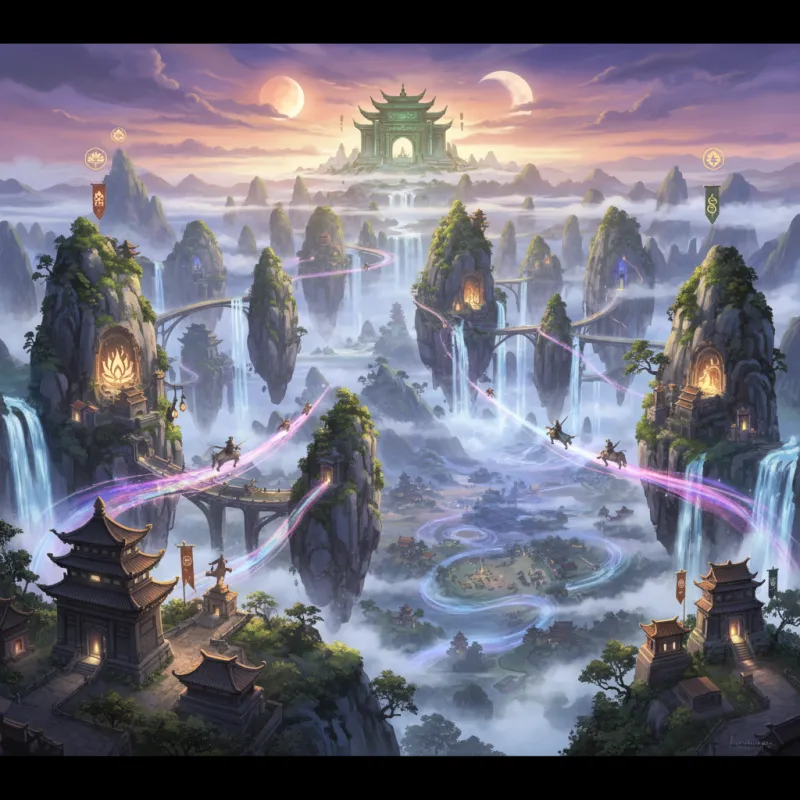
A young disciple stands at the mountain gate, gazing up at the towering peaks shrouded in mist. Behind those clouds lie the Heavenly Sword Sect's inner sanctums, where elders who've lived for centuries practice techniques that can split mountains. But he'll never see them—not unless he survives the outer sect's brutal competition, where nine out of ten disciples fail to even form their first golden core. This scene, repeated across thousands of cultivation novels, reveals a truth about xianxia fiction: sects aren't just schools or guilds. They're entire civilizations unto themselves, microcosms of power, hierarchy, and the ruthless pursuit of immortality.
The Sect as Cosmic Hierarchy
In Chinese cultivation fiction, sects function as the primary organizational structure of the immortal world, mirroring the rigid hierarchies of imperial China while adding layers of supernatural meritocracy. Unlike Western fantasy guilds where membership might be casual, a cultivation sect demands total allegiance. When Zhang Xiaofan joins the Qingyun Sect in Xiao Ding's Zhu Xian (诛仙, Zhū Xiān, 2003), he's not just enrolling in a school—he's entering a family structure that will define his identity, his enemies, and his path to power for the rest of his potentially eternal life.
The typical sect structure follows a pattern refined over decades of web novel evolution: outer disciples (外门弟子, wàimén dìzǐ) who perform menial tasks while competing for resources, inner disciples (内门弟子, nèimén dìzǐ) who've proven their talent, core disciples (核心弟子, héxīn dìzǐ) groomed for leadership, and elders (长老, zhǎnglǎo) who've reached the heights of cultivation. At the apex sits the sect master (掌门, zhǎngmén), often a figure of such overwhelming power that their mere presence can suppress entire regions. This hierarchy isn't arbitrary—it reflects the Daoist concept of natural order, where those who've cultivated longer and achieved higher realms naturally command authority over juniors.
Resource Wars and the Economics of Immortality
What makes sects compelling isn't just their structure but their function as resource-hoarding machines in a universe of scarcity. Immortality requires spirit stones (灵石, língshí), rare herbs, ancient techniques, and cultivation sites blessed with dense spiritual energy. Sects control these resources with an iron fist, creating the central tension in countless cultivation narratives. In I Shall Seal the Heavens by Er Gen, the protagonist Meng Hao's early struggles revolve entirely around scraping together enough spirit stones to purchase a single Foundation Establishment pill—a resource his sect's inner disciples receive freely.
This economic reality drives sect behavior in ways that feel startlingly modern despite the ancient Chinese trappings. Sects wage wars over spirit stone mines, form alliances to monopolize alchemy ingredients, and ruthlessly suppress smaller sects to prevent competition. The alchemy traditions controlled by major sects become strategic assets, with pill recipes guarded as jealously as nuclear codes. When a sect discovers a new secret realm filled with ancient treasures, the resulting conflict can reshape the entire cultivation world's power balance.
The genius of this system is how it creates natural story engines. A protagonist who offends a sect's young master doesn't just make a personal enemy—they challenge an institution with centuries of accumulated power, forcing them to grow stronger or perish. This escalation, where personal conflicts become sect-level wars, then regional catastrophes, then threats to the entire immortal realm, has become the signature rhythm of cultivation fiction.
Orthodox vs. Demonic: The Eternal Conflict
The division between righteous sects (正道, zhèngdào) and demonic sects (魔道, módào) provides cultivation fiction with its fundamental moral framework—though "moral" might be too generous a term. Righteous sects claim to follow heavenly principles, practice orthodox cultivation methods, and protect mortals. Demonic sects embrace forbidden techniques, often involving blood sacrifice, soul refinement, or cultivation methods that drain others' life force. In practice, the distinction often blurs into hypocrisy.
Reverend Insanity by Gu Zhen Ren pushes this ambiguity to its extreme, with protagonist Fang Yuan treating both righteous and demonic sects as equally self-serving institutions hiding behind different rhetoric. The righteous sects' "protection" of mortals often means treating them as resource farms, while demonic sects at least have the honesty to admit their ruthlessness. This cynical view reflects a broader trend in modern xianxia: questioning whether the sect system itself, regardless of alignment, is fundamentally exploitative.
The conflict between these factions drives some of cultivation fiction's most memorable arcs. The Righteous-Demonic War trope, where allied righteous sects unite to exterminate demonic practitioners, appears in everything from classic wuxia to contemporary web novels. These wars serve multiple narrative functions: they raise stakes, force protagonists to choose sides, and provide opportunities for massive battles where cultivation realms are tested against each other in spectacular fashion.
Sect Founding and the Protagonist's Path
One of cultivation fiction's most satisfying progressions is watching a protagonist grow from a bullied outer disciple to founding their own sect. This arc taps into deep wish-fulfillment: the ultimate revenge against those who looked down on you isn't just surpassing them, but creating an institution that makes their sect irrelevant. In Martial World by Cocooned Cow, Lin Ming's journey from the Seven Profound Valleys' outer sect to establishing his own faction spans hundreds of chapters and multiple realms of existence.
The sect-founding process reveals how these institutions actually work. A nascent sect needs a territory with good spiritual energy, defensive formations to protect against rivals, a cultivation technique to pass down, and most critically, enough powerful members to deter aggression. Early chapters of a new sect's existence read almost like base-building strategy games, with the protagonist recruiting talented disciples, securing resource nodes, and establishing the reputation that will attract future generations.
This progression also allows authors to critique the sect system from within. When protagonists found their own sects, they often try to correct the flaws they experienced: more equitable resource distribution, merit-based advancement, protection for weaker disciples. Of course, as these sects grow and face external pressures, they often replicate the same problems, suggesting the system itself might be the issue rather than individual bad actors.
The Sect as Family and Prison
The emotional core of sect-based cultivation fiction lies in the complex relationships these institutions foster. A sect is simultaneously a family, a military unit, a corporation, and a prison. Disciples form bonds that last millennia, with senior-junior relationships (师兄弟, shīxiōngdì) carrying weight that transcends blood ties. When a sect faces destruction, disciples are expected to die defending it—and many do, creating some of cultivation fiction's most tragic moments.
Yet this familial bond comes with suffocating obligations. Leaving a sect is often treated as betrayal punishable by death. Sect rules can forbid romance, restrict personal cultivation choices, or demand missions that serve the sect's interests over individual desires. In A Record of a Mortal's Journey to Immortality, Han Li's repeated conflicts with sect authority stem from his recognition that true immortality requires freedom from institutional control. His eventual departure from traditional sect structures to pursue independent cultivation represents a rejection of the system itself.
This tension between belonging and autonomy resonates because it mirrors real-world institutional relationships. Sects provide resources, protection, and community—but at the cost of individual agency. The most compelling cultivation protagonists navigate this trade-off, taking what they need from sects while maintaining enough independence to pursue their own path to immortality.
Modern Evolution and Meta-Commentary
Contemporary cultivation fiction increasingly treats sects with irony and subversion. Authors who grew up reading classic xianxia now write protagonists who game the sect system, exploit its rules, or bypass it entirely. In The Grandmaster Strategist, the protagonist uses his knowledge of sect politics to manipulate multiple factions against each other, treating the entire cultivation world as a strategic puzzle rather than a sacred hierarchy.
Some novels go further, questioning whether the sect system serves any purpose beyond perpetuating itself. If cultivation is ultimately an individual journey toward immortality, why do these massive institutions exist? The answer, these stories suggest, is that sects benefit those already at the top—elders who've achieved immortality use the system to extract resources from juniors, maintaining their power across eons. This reading transforms cultivation fiction from power fantasy into institutional critique, with sects as self-perpetuating hierarchies that consume generations of disciples to fuel the immortality of a few.
The rise of "system" novels, where protagonists receive game-like interfaces granting rewards and quests, represents another challenge to traditional sect structures. When a protagonist can level up through a personal system, sect resources become less critical, undermining the institution's primary leverage. These stories imagine cultivation as something that could be democratized, freed from the gatekeeping of ancient sects—a fantasy that resonates with readers frustrated by real-world institutional barriers.
The Enduring Appeal
Despite decades of repetition and increasing meta-awareness, sect-based cultivation fiction remains wildly popular because it taps into universal desires: belonging to something greater than yourself, rising through merit in a clear hierarchy, and eventually transcending the system that once constrained you. The sect provides structure for these fantasies, a ladder to climb and eventually kick away.
The best cultivation fiction uses sects not just as worldbuilding flavor but as genuine exploration of how institutions shape individuals and vice versa. When a protagonist joins a sect, they're entering a centuries-old system with its own logic, politics, and inertia. Their journey to immortality becomes inseparable from their relationship with that system—whether they reform it, destroy it, or transcend it entirely. In this way, the rise of sects in Chinese cultivation fiction mirrors the rise of institutions in human civilization: necessary, oppressive, and ultimately something each generation must navigate on their own path to whatever immortality they seek.
Related Reading
- Secret Realms and Pocket Dimensions: Treasure Hunting in Cultivation Fiction
- Ancient Sects and Spiritual Realms in Chinese Cultivation and Xianxia Fiction
- Secret Realms: Hidden Dimensions of Power
- Righteous vs. Demonic Sects: The Great Divide in Cultivation Fiction
- Sect Hierarchy Explained: From Outer Disciple to Patriarch
- Storage Rings and Spatial Equipment: Pocket Dimensions on Your Finger
- Dual Cultivation: Partnership in the Path to Immortality
- Unraveling the Mysteries of Formations in Chinese Cultivation and Xianxia Fiction