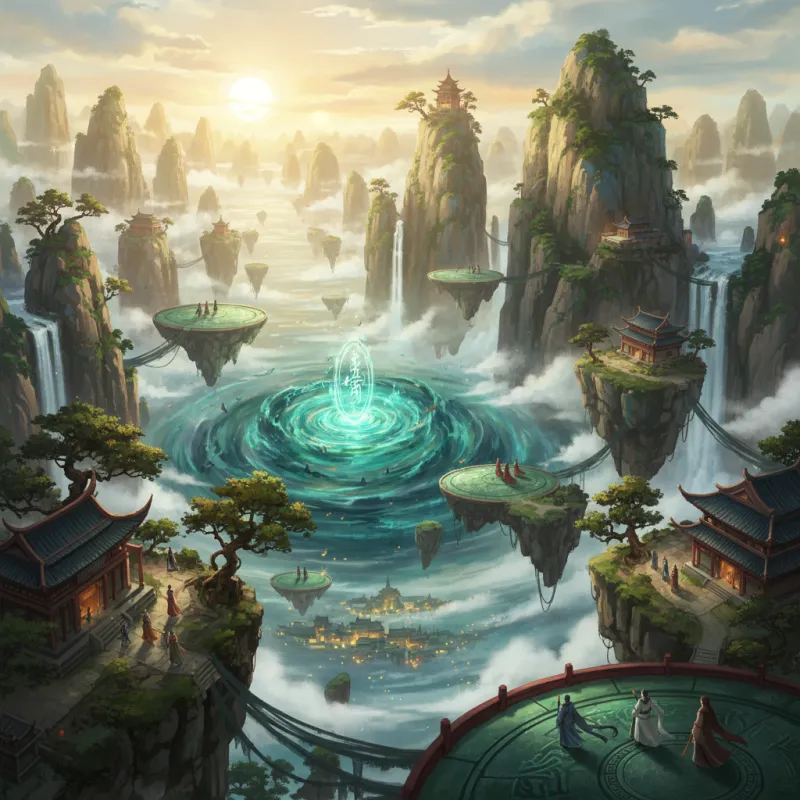
When Coiling Dragon hit 1.4 billion views on Qidian in 2014, Western publishers were still debating whether web fiction was "real literature." Meanwhile, Chinese readers were consuming cultivation novels at a rate that made the entire Western publishing industry look like a book club. We're talking about a genre where a single author can earn $1.5 million USD annually from reader subscriptions alone, where novels routinely exceed 3 million words, and where the top platforms host more active readers than the population of most European countries. This isn't a trend. It's a parallel literary universe that most of the West still hasn't noticed.
The Platform Revolution That Changed Everything
The cultivation web novel explosion didn't happen by accident. It happened because Qidian (起点中文网, Qǐdiǎn Zhōngwén Wǎng, literally "Starting Point Chinese Network") figured out something traditional publishing never could: how to turn readers into patrons and authors into entrepreneurs. Founded in 2002, Qidian pioneered the "VIP chapter" model where the first portion of a novel is free, but readers pay per chapter (typically 2-5 cents) to continue. This microtransaction approach, combined with daily serialization, created an economic engine that could sustain thousands of full-time authors.
By 2008, Qidian had over 10 million registered users. By 2015, that number exceeded 200 million. The platform didn't just host novels — it created a complete ecosystem with reader rankings, author earnings dashboards, recommendation algorithms, and a comment system that let readers interact with authors in real-time. When Er Gen (耳根) was writing I Shall Seal the Heavens, he'd post a chapter and within minutes have thousands of comments debating plot points, predicting twists, and occasionally roasting him for cliffhangers.
This model spread rapidly. Zongheng (纵横中文网), 17K, and dozens of other platforms emerged, each hosting tens of thousands of novels. The competition drove innovation: better recommendation systems, reader reward features (where fans could gift virtual items to authors), and even AI-assisted writing tools. By 2020, China's online literature market was valued at over $3 billion USD, with cultivation novels representing roughly 40% of all content.
Why Cultivation Specifically Dominated
Other genres existed on these platforms — romance, historical fiction, sci-fi — but cultivation novels became the dominant force for specific structural reasons. The cultivation realm system provided an infinitely scalable progression framework. An author could write 2,000 chapters and still have room for the protagonist to grow stronger. The genre's emphasis on personal power through effort resonated with readers in a rapidly modernizing China where social mobility felt both possible and desperately competitive.
The daily serialization format favored cultivation novels because the genre's structure naturally created cliffhangers. Each breakthrough to a new realm, each confrontation with a young master (少爷 shàoyé), each tournament arc provided perfect stopping points that kept readers coming back. Tang Jia San Shao (唐家三少), who holds the Guinness World Record for most prolific author, wrote Douluo Dalu (Soul Land) at a pace of 8,000-10,000 characters daily for years. That's roughly 3,000-4,000 English words per day, every single day, maintaining quality high enough to attract 100+ million readers.
The genre also benefited from low barriers to entry. Unlike historical fiction (which required research) or hard sci-fi (which demanded technical knowledge), cultivation novels operated in a semi-fantasy framework where authors could invent their own rules. Want to create a new cultivation technique? Just describe it with enough detail to sound plausible. Need a new antagonist? Introduce a rival sect. The alchemy system alone provided endless plot devices — rare herbs, pill refinement competitions, explosive cauldrons, miraculous healing.
The Translation Wave and Global Expansion
For years, cultivation novels remained a Chinese phenomenon. Then in 2014, a translator named RWX (Ren Woxing) started translating Coiling Dragon on his blog. The response was immediate and overwhelming. Western readers, particularly those already familiar with Japanese light novels and Korean manhwa, discovered a genre that made those look tame by comparison. Where Japanese isekai protagonists might gain one or two power-ups per arc, cultivation protagonists ascended through dozens of realms, each representing a fundamental transformation.
Wuxiaworld, the platform RWX founded, became the gateway for English-speaking readers. By 2017, it was receiving 50+ million page views monthly. Other translation sites emerged — Gravity Tales, Volare Novels — creating a competitive ecosystem that mirrored the Chinese platforms. The translation community developed its own terminology conventions: "young master" for 少爷, "face" for 面子 (miànzi, social prestige), "courting death" for 找死 (zhǎo sǐ, the genre's most iconic phrase).
The global expansion revealed something fascinating: cultivation novels appealed across cultures despite being deeply rooted in Chinese philosophy. Readers in Brazil, Russia, Indonesia, and the Philippines consumed translated chapters as voraciously as Chinese readers consumed originals. The genre's emphasis on meritocracy, personal cultivation, and overcoming heaven-defying odds resonated with audiences worldwide. When Martial God Asura was translated, it attracted readers who'd never heard of Daoism but immediately understood the appeal of a protagonist who refused to bow to fate.
The Economic Ecosystem Nobody Talks About
The money in cultivation web novels isn't just in reader subscriptions. It's in the entire multimedia empire that successful novels spawn. Battle Through the Heavens (斗破苍穹 Dòu Pò Cāngqióng) by Tian Can Tu Dou (天蚕土豆) started as a web novel in 2009. By 2023, it had generated: a 45-episode donghua (animated series), a 12-episode live-action drama, multiple mobile games, merchandise lines, and licensing deals worth hundreds of millions. The novel itself earned over $20 million in reader subscriptions.
This multimedia conversion became the standard playbook. Platforms like Tencent and iQiyi actively scout popular web novels for adaptation rights. Authors negotiate deals that give them percentages of all derivative works. The most successful authors — Tang Jia San Shao, Tian Can Tu Dou, Er Gen — have become multimedia brands. Tang Jia San Shao's net worth is estimated at over $100 million USD, earned almost entirely from web novel royalties and adaptations.
The ecosystem extends to fan communities. Major novels have dedicated wikis documenting every character, technique, and realm. Fan artists create character designs and scene illustrations. Audio drama productions hire professional voice actors to narrate chapters. Some novels have official merchandise stores selling everything from cultivation technique scrolls (decorative posters) to sect robes (cosplay outfits). The comment sections on chapters function as real-time focus groups, with authors sometimes adjusting plot directions based on reader feedback.
The Writing Factory and Its Discontents
The cultivation web novel industry's success comes with a dark side: the brutal pace required to maintain reader engagement. Authors on platforms like Qidian must post daily to maintain visibility in recommendation algorithms. Miss a day, and your novel drops in rankings. Miss a week, and readers abandon you for more consistent authors. This creates a treadmill where authors write 4,000-8,000 characters daily, every day, for years.
The pressure produces burnout, repetitive plots, and quality inconsistencies. Critics point to the proliferation of "young master" clichés, where every arc features a arrogant antagonist who underestimates the protagonist, gets face-slapped, and calls in a more powerful relative. The face-slapping cycle became so predictable that it spawned parody novels mocking the formula. Yet readers kept consuming because the formula worked — it provided reliable dopamine hits of vicarious triumph.
Some authors pushed back against the formula. Er Gen's A Will Eternal deliberately subverted cultivation novel tropes by making the protagonist a comedic coward who stumbled into power. Mao Ni (猫腻) wrote The Way of Choices with literary prose that elevated the genre beyond power fantasy. These novels proved cultivation fiction could be more than assembly-line entertainment, but they remained exceptions. The economic incentives favored volume over innovation.
Where the Genre Goes From Here
Cultivation web novels have reached a crossroads. In China, the market is maturing. Readers are demanding higher quality, more complex plots, and better character development. Platforms are experimenting with new models: premium subscriptions for ad-free reading, author patronage systems, even blockchain-based ownership of chapters. The government's increased scrutiny of online content has forced authors to be more careful about violence, sexuality, and political themes.
Internationally, the genre is still expanding. Machine translation tools have made thousands of untranslated novels accessible (if awkwardly readable). Original English-language cultivation novels are appearing on platforms like Royal Road and Kindle Unlimited, written by Western authors who grew up reading translations. The genre is hybridizing with Western fantasy, creating fusion works that blend cultivation systems with European medieval settings or sci-fi universes.
The fundamental appeal remains unchanged: the fantasy of starting from nothing and ascending to godhood through personal effort. In an era of increasing inequality and limited social mobility, cultivation novels offer a meritocratic dream where hard work and talent genuinely matter. The protagonist doesn't inherit power or get chosen by destiny — they seize it through relentless cultivation. That fantasy resonates whether you're reading in Shanghai, São Paulo, or Seattle.
The genre that conquered the Chinese internet is now conquering the global one. And it's doing so the same way its protagonists do: one realm at a time, refusing to acknowledge limits, and absolutely courting death if anyone tries to stop it.
Related Reading
- Best Cultivation Web Novels in 2024-2025: Updated Reading List
- How to Write Cultivation Fiction: A Beginner's Guide for Western Authors
- Top 10 Cultivation Web Novels That Changed the Genre
- 50 Cultivation Novel Tropes Every Reader Will Recognize
- The Philosophical Underpinnings of Chinese Cultivation Fiction and Immortal Realms
- Alchemy in Cultivation Fiction: Why Pill-Making Is the Most Dangerous Profession
- Auction Houses in Cultivation Fiction: Where Fortunes Change Hands