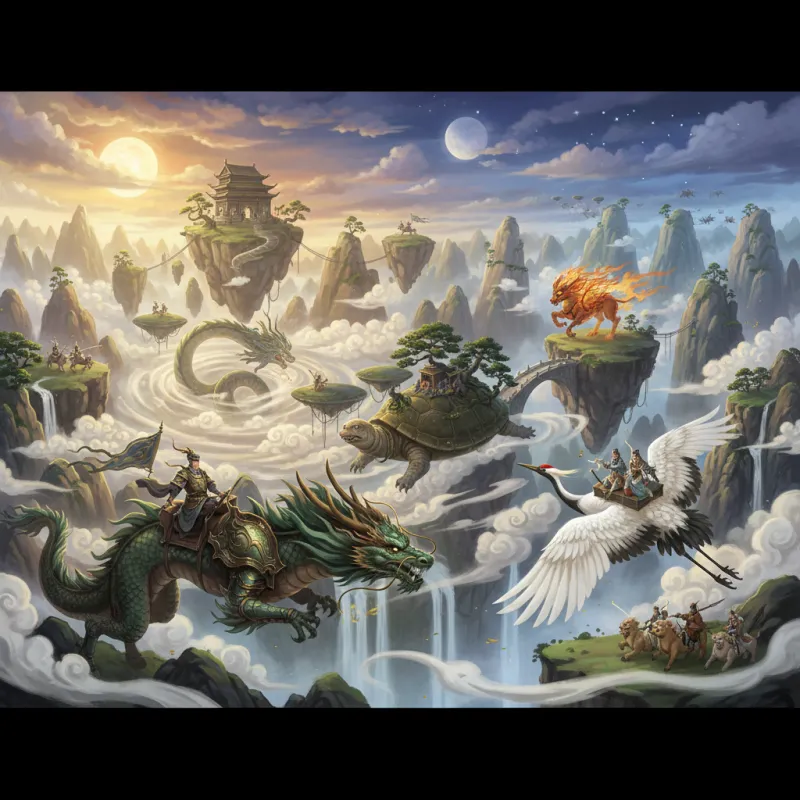
Every cultivator remembers the first time they saw someone ride a dragon. Not a wyvern, not a drake, not some lesser serpent with delusions of grandeur — a true dragon (真龙 zhēn lóng), scales gleaming like molten gold, voice shaking the heavens. That moment changes you. Suddenly your prized flying sword feels like showing up to a celestial banquet on a donkey. In cultivation fiction, mounts aren't just transportation — they're declarations of power, statements of intent, and occasionally, the only thing standing between you and becoming demon beast lunch.
The Unspoken Mount Hierarchy
Walk into any cultivation sect and you'll notice something immediately: the outer disciples ride whatever they can catch. The inner disciples have respectable spirit beasts. The core disciples? They're riding creatures that make mortals prostrate themselves. This hierarchy isn't written in any manual, but every cultivator knows it.
Dragons (龙 lóng) sit at the absolute peak. A true dragon mount means you've either reached the pinnacle of cultivation, stumbled into ridiculous fortune, or you're the protagonist and the author loves you. In Coiling Dragon, Linley's relationship with Bebe transcends the typical mount dynamic, but when he finally commands true dragons, it marks his ascension to genuine power. Dragons don't just fly — they command the elements, reshape weather, and their mere presence suppresses lesser beasts for thousands of miles.
Phoenixes (凤凰 fènghuáng) occupy the same tier, though they're rarer in fiction as mounts. Most cultivation novels treat phoenixes as too proud, too divine to be ridden. When they do appear, it's usually a mutual partnership rather than a master-servant relationship. The phoenix in Against the Gods serves as both mount and guardian, a relationship built on respect rather than subjugation.
Qilins (麒麟 qílín) represent the scholar's mount — auspicious, powerful, but less aggressive than dragons. They appear in A Record of Mortal's Journey to Immortality as mounts for high-level cultivators who've transcended the need to prove their strength through intimidation. A qilin mount suggests wisdom and restraint, which in cultivation terms means you're powerful enough that you don't need to show off.
The Practical Mounts Nobody Talks About
Here's what cultivation novels don't emphasize enough: most cultivators never ride dragons. They ride spirit cranes (灵鹤 líng hè), cloud leopards (云豹 yún bào), or if they're particularly unfortunate, oversized spirit chickens. These mounts don't shake the heavens or command the elements, but they get you from Sect A to Sect B without exhausting your spiritual energy.
I Shall Seal the Heavens actually addresses this beautifully. Meng Hao's parrot and meat jelly aren't prestigious mounts by any standard, but they're loyal, useful, and occasionally more valuable than a dragon that might eat you if you show weakness. The novel suggests something radical: the best mount isn't the most powerful one, it's the one that won't betray you when you're vulnerable.
Spirit cranes deserve special mention because they're everywhere in cultivation fiction, yet rarely get respect. They're the Honda Civics of the cultivation world — reliable, efficient, and nobody's impressed when you show up riding one. But they fly fast, require minimal spiritual energy to maintain, and won't attract every treasure-hunting cultivator within a thousand miles. Sometimes boring is exactly what you need.
The Beast Taming Bottleneck
Acquiring a legendary mount isn't like buying a horse. You can't just throw spirit stones at the problem, though many young masters try. The process typically involves one of three paths: beast taming techniques that take decades to master, stumbling into a fortuitous encounter that makes the beast indebted to you, or the protagonist method of accidentally saving a baby dragon and raising it.
Tales of Demons and Gods explores this systematically. Nie Li doesn't just grab the strongest demon beast he can find — he carefully selects beasts whose growth potential matches his cultivation path. His shadow devil demon spirit becomes more valuable than a dragon precisely because it synergizes with his techniques. This is the detail most cultivation novels gloss over: compatibility matters more than raw power.
The taming process itself varies wildly between novels. Some require blood contracts (血契 xuè qì) that bind cultivator and beast for life. Others use soul seals (魂印 hún yìn) that essentially enslave the creature. The ethical implications rarely get explored, though Martial World at least acknowledges that forcing a proud spirit beast into servitude might have consequences when it eventually breaks free.
When Your Mount Outgrows You
Here's a problem cultivation novels love to create: what happens when your mount becomes stronger than you? In Martial God Asura, Chu Feng's Eggy starts as a companion but rapidly evolves into something that could obliterate him. The power dynamic shifts, and suddenly the question isn't "will my mount obey me" but "why is my mount still tolerating me?"
This creates fascinating narrative tension. A mount that could leave at any time but chooses to stay suggests genuine loyalty rather than forced servitude. Desolate Era handles this well — Ji Ning's relationship with his mounts evolves from master-servant to genuine partnership as both grow stronger. The mounts that stay aren't bound by contracts; they're bound by mutual respect and shared battles.
The opposite scenario is equally interesting: cultivators who outlevel their mounts. That spirit crane that served you faithfully through Foundation Establishment becomes a liability when you're fighting Nascent Soul cultivators. Do you abandon it? Keep it as a pet? Most protagonists conveniently find ways to evolve their mounts, but A Will Eternal actually addresses this — Bai Xiaochun's turtle remains relatively weak, yet he refuses to abandon it, which says more about his character than any heroic speech could.
The Mount as Status Symbol
Let's be honest about what mounts really represent in cultivation fiction: flex culture taken to its logical extreme. When a young master descends from his golden-scaled flood dragon, he's not just arriving — he's announcing that his family has resources, connections, and power. The mount is the message.
Renegade Immortal subverts this beautifully. Wang Lin deliberately chooses unremarkable mounts or travels on his own, understanding that flashy displays attract attention he doesn't want. In a world where everyone's trying to out-flex each other, anonymity becomes its own form of power. The strongest cultivators often don't need mounts at all — they've transcended such concerns.
But for everyone else, mount selection is political calculation. Arrive at a sect negotiation on a spirit crane, and you're signaling you're open to dialogue. Arrive on a three-headed hell hound, and you're signaling something very different. The cultivation politics of mount choice rarely gets explicit attention, but it's always present.
The Forgotten Mounts
Cultivation fiction has a graveyard of abandoned mounts. Remember that spirit wolf the protagonist tamed in chapter 30? Neither does the author by chapter 300. Mounts get discarded as cultivators advance, replaced by stronger, flashier alternatives. It's the natural progression of power fantasy, but it creates a strange dissonance.
Stellar Transformations actually addresses this by having Qin Yu maintain relationships with early companions even as he ascends to godhood. His first mount doesn't become irrelevant — it evolves alongside him, or finds its own path. This approach treats mounts as characters rather than equipment, which makes the story richer even if it's less convenient for the plot.
The best cultivation novels understand that mounts aren't just power-ups or status symbols — they're relationships. A mount that's been with you since Foundation Establishment, that's bled beside you in a hundred battles, that's saved your life when you were weak — that bond means something. Or it should, anyway. Too many novels treat mounts as disposable, which undermines the supposed importance of loyalty and righteousness that cultivation is meant to teach.
The next time you read about a protagonist riding a dragon, ask yourself: what happened to the spirit beast that carried them when they were nobody? That answer tells you more about the story's values than any philosophical speech about the Dao.
Related Reading
- Spirit Beast Contracts: The Pokemon System of Cultivation Fiction
- Beast Taming in Cultivation Fiction: Your Pet Dragon and You
- Beast Tides: When Monsters Attack in Cultivation Fiction
- Spirit Beasts in Cultivation Fiction: A Bestiary
- Pill Refining: The Alchemist's Art in Cultivation
- Unraveling the Essence of Tribulations in Chinese Cultivation Fiction
- Herb Gathering: The Dangerous Art of Finding Rare Ingredients