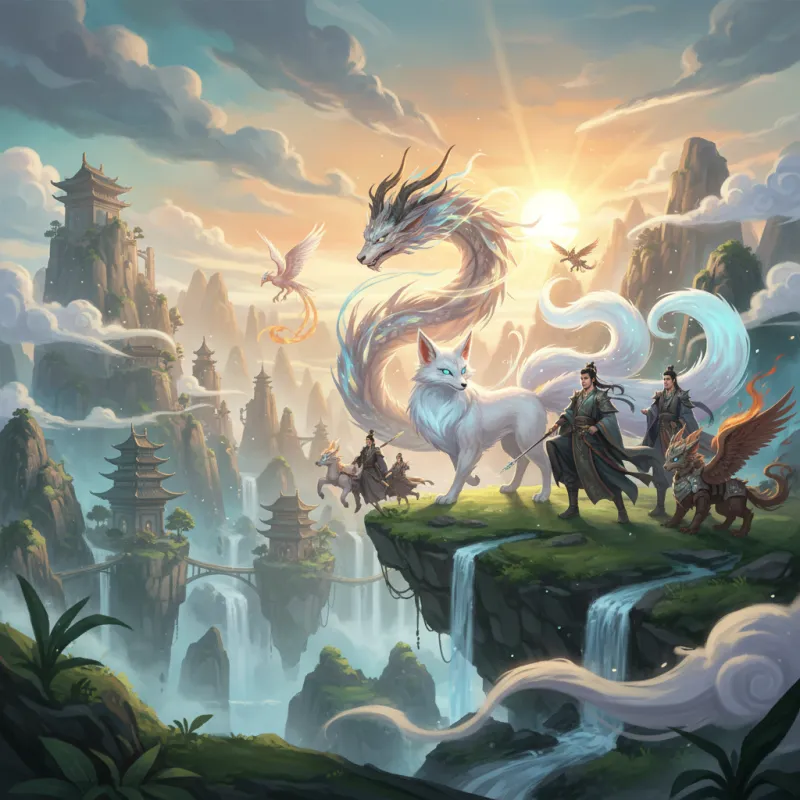
A phoenix the size of a mountain descends from the heavens, its wings trailing flames that could incinerate cities. Its master? A fifteen-year-old girl who found it as an egg in a forgotten ruin. This is the dream that keeps readers turning pages in cultivation fiction—not just power, but companionship in power. While protagonists obsess over their sword techniques and pill refinement, the truly wise cultivators know: the bond with a spirit beast can mean the difference between ascending to immortality and becoming fertilizer for someone else's spiritual herbs.
The Hierarchy of Beasts: From Mundane to Mythical
Not all creatures in the cultivation world are created equal. The taxonomy matters, and authors who blur these distinctions are doing their worldbuilding a disservice.
Ordinary beasts (凡兽 fánshòu) are just animals. A wolf is a wolf, even in a xianxia novel. They die to Qi Condensation cultivators without much fuss.
Spirit beasts (灵兽 língshòu) have absorbed spiritual energy over decades or centuries, developing intelligence and supernatural abilities. A spirit wolf might breathe ice or move like shadow. These are the entry-level companions—still impressive, but not world-shaking.
Demonic beasts (妖兽 yāoshòu) are the dangerous ones. They've cultivated their own power, often through consuming other creatures or humans. They're not pets; they're rivals. The thousand-year serpent that terrorizes a mountain range? That's a demonic beast, and it probably has a core (妖丹 yāodān) worth killing for.
Divine beasts (神兽 shénshòu) exist in legend and at the peak of power. We're talking phoenixes, dragons, qilins—creatures with bloodlines so pure they're born at power levels most cultivators will never reach. In Coiling Dragon, Bebe the Godeater Rat is eventually revealed to be a divine beast, which explains why a "mere" companion could fight beings that should be infinitely beyond him.
The distinction matters because it determines the relationship. You might tame a spirit beast. You negotiate with a demonic beast. A divine beast? You're lucky if it considers you worth talking to.
The Blood Contract: Binding Souls and Fates
The most common method of securing a spirit beast companion is the blood contract (血契 xuèqì), and it's more serious than most novels acknowledge. This isn't a handshake agreement. You're literally binding your life force to another being's, creating a connection that transcends death.
The mechanics vary by novel, but the core concept remains: both parties contribute blood (usually mixed in some ritual), and their souls become linked. The cultivator can sense the beast's location and emotional state. The beast gains benefits from the cultivator's breakthroughs—when you advance to Core Formation, your bonded thunder eagle might jump two minor realms simultaneously.
But here's what makes it interesting: the bond goes both ways. If your spirit beast dies, you suffer soul damage that could cripple your cultivation. If you die, the beast often follows within hours. This creates genuine stakes. In Tales of Demons and Gods, Nie Li's careful selection of demon spirits isn't just about combat power—it's about choosing partners whose fates will be permanently intertwined with his own.
Some novels introduce variations: slave contracts that give the cultivator total control (morally questionable but common for demonic beasts), equal partnership contracts (rare, usually reserved for divine beasts who won't accept subordination), and even reverse contracts where the beast is actually the dominant party. That last one shows up in comedy-focused cultivation stories, usually for laughs, but the implications are darker than authors typically explore.
Raising a Beast: The Egg Gambit
There's a trope in cultivation fiction that borders on cliché but remains popular because it works: the protagonist finds an egg. Not just any egg—an ancient, forgotten, impossibly rare egg that everyone else dismissed as dead or worthless. The protagonist, through luck or hidden knowledge, recognizes its value and nurtures it. When it hatches, the creature imprints on them like a baby duck, except this baby duck will eventually breathe nuclear fire.
The appeal is obvious. An adult divine beast won't bow to a Foundation Establishment cultivator. But raise one from birth? You're not just its master; you're its parent. The loyalty is absolute, the bond unbreakable. Plus, you get to watch it grow alongside you, its breakthroughs mirroring your own journey.
Martial God Asura uses this repeatedly with Chu Feng's various beast companions. Each one starts weak, often mocked by his enemies, then grows into a powerhouse that makes those same enemies regret their words. It's wish fulfillment, certainly, but it's effective wish fulfillment.
The egg gambit also solves a narrative problem: how do you give a weak protagonist a powerful companion without breaking the story's logic? An adult dragon would trivialize most conflicts. A dragon egg that grows with the protagonist maintains tension while promising future power. The reader knows the payoff is coming; the anticipation is part of the pleasure.
Combat Synergy: When Beast and Master Fight as One
The best cultivation novels treat spirit beast combat as more than "protagonist fights while pet provides backup." The truly memorable battles showcase genuine synergy, where beast and master complement each other's abilities in ways neither could achieve alone.
Consider the classic formation: cultivator focuses on technique and precision while the spirit beast provides raw power and instinct. The cultivator sets up arrays and formations; the beast charges through enemy lines, disrupting their coordination. Or the reverse—the beast tanks damage with its naturally tough body while the cultivator strikes from range with spells and artifacts.
Some novels introduce fusion techniques where cultivator and beast temporarily merge, combining their strengths. This shows up in Battle Through the Heavens with Xiao Yan and his various flame-based companions. The fusion isn't just a power boost; it's a transformation that grants abilities neither party possesses separately.
The spatial dynamics matter too. A flying beast gives the cultivator aerial superiority and escape options. An earth-burrowing beast enables ambush tactics and underground travel. A water-dwelling beast turns rivers and oceans from obstacles into advantages. Smart protagonists choose companions that cover their weaknesses rather than doubling down on existing strengths.
Then there's the intelligence factor. A spirit beast with human-level intelligence can execute complex strategies, guard the cultivator during breakthroughs, and even handle social situations (usually comedically). The beasts that can speak human language often become secondary protagonists in their own right, with distinct personalities and character arcs.
The Bloodline Awakening: When Your Cat Turns Out to Be a God
One of cultivation fiction's most satisfying reveals is the bloodline awakening—when a seemingly ordinary spirit beast companion suddenly manifests divine heritage. That little fox you've been raising? Actually descended from the Nine-Tailed Celestial Fox, and it just unlocked its first tail. The power spike is dramatic, but more importantly, it recontextualizes the entire relationship.
Bloodline purity (血脉 xuèmài) determines a beast's potential ceiling. A common wolf might reach the equivalent of Core Formation with centuries of effort. A wolf with a trace of divine beast bloodline could potentially reach Nascent Soul or beyond. And a pure-blooded divine beast? The sky isn't even the limit; they're aiming for the stars beyond the sky.
The awakening usually happens during moments of extreme danger or emotional intensity. The beast's master is about to die, and suddenly ancient memories flood the creature's mind. Seals placed by ancestors break. The true form emerges. What was a house-cat-sized companion becomes a building-sized avatar of destruction.
Stellar Transformations handles this particularly well with Qin Yu's relationship with Hei Yu, the black eagle. The gradual revelation of Hei Yu's true nature and capabilities parallels Qin Yu's own journey of discovering his hidden potential. Neither is what they initially appeared to be, and their growth trajectories mirror each other in satisfying ways.
The Dark Side: When Companions Become Liabilities
Not every spirit beast relationship is sunshine and loyalty. The genre's best works acknowledge the complications and dangers inherent in binding your fate to another being's.
Betrayal is rare but devastating. A demonic beast might fake submission while plotting revenge. A spirit beast corrupted by demonic energy could turn on its master. Some novels feature antagonists who specifically target the protagonist's companions, knowing the emotional and practical damage it inflicts.
More common is the resource drain. Spirit beasts need to eat, and high-level beasts have expensive tastes. That divine phoenix doesn't sustain itself on birdseed—it needs spiritual fruits, rare herbs, or even other spirit beasts. Protagonists often find themselves hunting constantly just to keep their companions fed. In Desolate Era, Ji Ning's various beast companions require resources that would bankrupt lesser cultivators.
There's also the attention problem. A powerful spirit beast is a status symbol and a target. Other cultivators will challenge you to steal it. Sects will demand you hand it over "for the greater good." Demonic cultivators will try to kill it for its core. The stronger your companion, the more trouble it attracts.
And then there's the lifespan issue that most novels conveniently ignore. Spirit beasts live longer than mortals but not necessarily longer than cultivators. What happens when your beloved companion reaches the end of its natural lifespan while you're still in your prime? Some novels address this with cultivation methods that extend beast lifespans or transform them into higher beings. Others just... don't bring it up.
Beyond Combat: The Emotional Core
Here's what separates memorable spirit beast companions from forgettable ones: emotional resonance. The best examples in cultivation fiction aren't just power-ups or combat tools—they're characters with agency, personality, and genuine relationships with their masters.
The loyal companion who refuses to abandon its master even when logic demands it. The proud divine beast who slowly learns to respect a "mere human." The comedic relief beast whose antics lighten dark moments. The wise ancient creature who serves as mentor and friend. These archetypes work because they tap into something primal: the human desire for unconditional loyalty and companionship.
When a spirit beast dies protecting its master, the impact should be devastating. When it achieves a breakthrough, we should feel triumph. When it's injured, we should feel the master's rage. The novels that nail this emotional component—I Shall Seal the Heavens with Meng Hao's various companions, A Record of a Mortal's Journey to Immortality with Han Li's more pragmatic beast relationships—create moments that stick with readers long after they've forgotten the specific cultivation techniques or realm names.
The bond between cultivator and spirit beast represents something the genre often struggles to portray: genuine connection in a world defined by ruthless competition and betrayal. Everyone else might abandon you when you lose your power, but your spirit beast? It remembers when you were weak together. That loyalty, earned through shared struggle rather than demanded through strength, is worth more than any divine treasure or supreme technique.
In the end, spirit beasts remind us that cultivation fiction, for all its power fantasies and progression mechanics, works best when it remembers the "fiction" part—when it tells stories about relationships, loyalty, and the bonds that transcend mere power levels.
Related Reading
- Flying Swords: The Cultivator's Signature Weapon
- Storage Rings and Spatial Equipment: Pocket Dimensions on Your Finger
- Storage Rings: Spatial Magic in Cultivation
- Exploring Artifacts and Their Role in Chinese Cultivation and Xianxia Fiction
- Flying Swords: The Iconic Vehicles of Cultivation Fiction
- Alchemy in Cultivation Fiction: Why Pill-Making Is the Most Dangerous Profession
- Sect Hierarchy Explained: From Outer Disciple to Patriarch
- Beast Tides: When Monsters Attack in Cultivation Fiction